The gray whale (Eschrichtius robustus) is a baleen whale that migrates between Mexican breeding lagoons and Arctic feeding grounds in the Bering and Chukchi seas. The eastern North Pacific population makes a round trip of 5,000 to 7,000 miles each way, one of the longest migrations of any mammal.[1]
| Scientific name | Eschrichtius robustus |
|---|---|
| Adult length | About 45–46 ft |
| Adult weight | 30–40 tons |
| Migration | 5,000–7,000 miles each way |
| Gestation | 12–13 months |
| Lifespan | Estimated 50–60 years |
Description
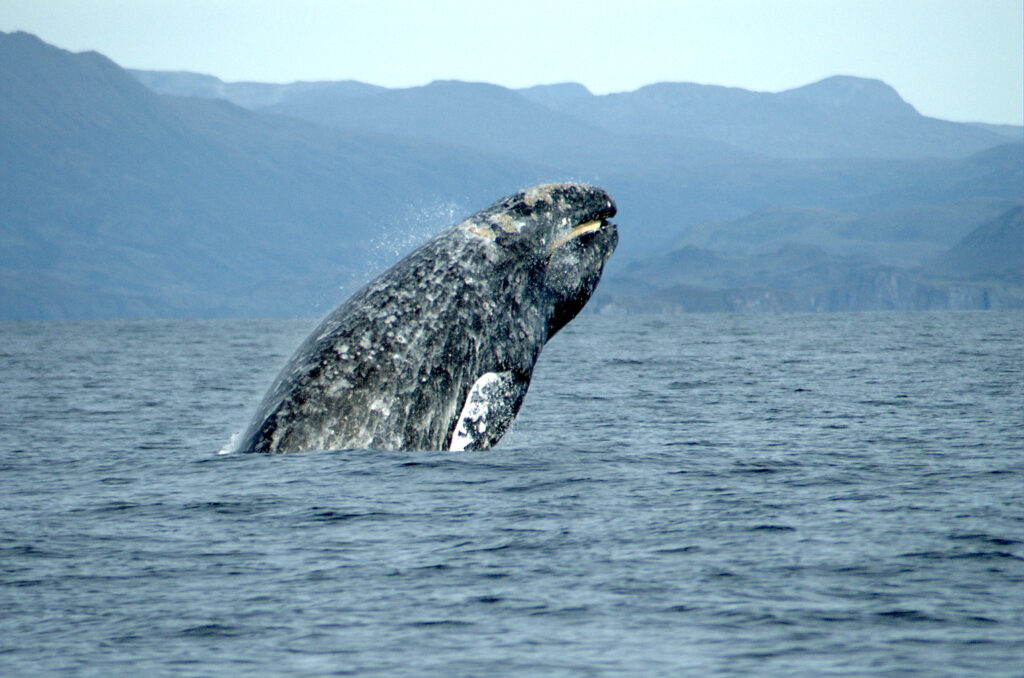
Gray whales are slate-gray with gray and white patches, often scarred and marked with barnacles and orange whale lice. They have no dorsal fin but a dorsal hump about two-thirds of the way down the back, followed by 6 to 12 knobs toward the tail, and two to four throat grooves about five feet long. Adults are 45 to 46 feet long and weigh 30 to 40 tons, with females slightly larger, and the tail fluke is 10 to 12 feet across.[1]
Range and migration
The species lives in the North Pacific and adjacent Arctic waters in two isolated stocks, a western Pacific (Korean) stock and an eastern Pacific (California) stock. The eastern stock moves north from late February to May close to shore, enters the Bering Sea mostly in April and May through Unimak Pass and reaches St. Lawrence Island in May or June. The southward migration begins in mid-October, with whales passing Unimak Pass from late October to early January and reaching Baja California in December and January.[1]
Feeding
Gray whales are mainly bottom feeders that eat amphipod crustaceans, which reach 12,000 to 20,000 per square yard in the southern Chukchi and northern Bering seas. A feeding whale eats about 1.3 tons a day, feeding almost exclusively in summer and rarely during migration or winter, with dives to the bottom of 3 to 15 minutes.[1]
Reproduction
Gestation lasts 12 to 13 months, and a female gives birth to a single calf every two or more years in shallow protected lagoons such as Scammon’s Lagoon in Baja California. Newborns are about 15 feet long and weigh 1,100 to 1,500 pounds, and they nurse for 7 to 8 months on milk that is 53 percent fat. Whales reach maturity at 5 to 11 years and the life span is estimated at 50 to 60 years.[1]
Population and harvest
The source, revised in 2008, put the eastern North Pacific population at about 26,000, probably close to its original size, and the western stock at 101 animals. The western stock was listed as endangered in 1970, the eastern stock was removed from that listing in 1994, and both are designated depleted under the Marine Mammal Protection Act. Alaska Native hunters took an average of two whales a year in recent years, within an International Whaling Commission limit of up to 140 a year for the whole eastern stock. These figures are from the source and may have changed.[1]
FAQs
How far do gray whales migrate? 5,000 to 7,000 miles each way.
What do gray whales eat? Mainly bottom-dwelling amphipod crustaceans.
How long do they live? Estimated 50 to 60 years.
Sources
Key facts
- Migrates 5,000–7,000 miles each way
- Gestation 12–13 months
Quick checkWhat do gray whales eat in Alaska waters?Show answer
Bottom-dwelling amphipod crustaceans
Sources
- Alaska Department of Fish and Game. Gray Whale, Wildlife Notebook Series (revised 2008). 2008 (accessed 2026-11-14)
Editorially reviewed by Specialty Digest Editorial TeamLast reviewed November 14, 2026Researched and drafted with AI assistanceReport an issue