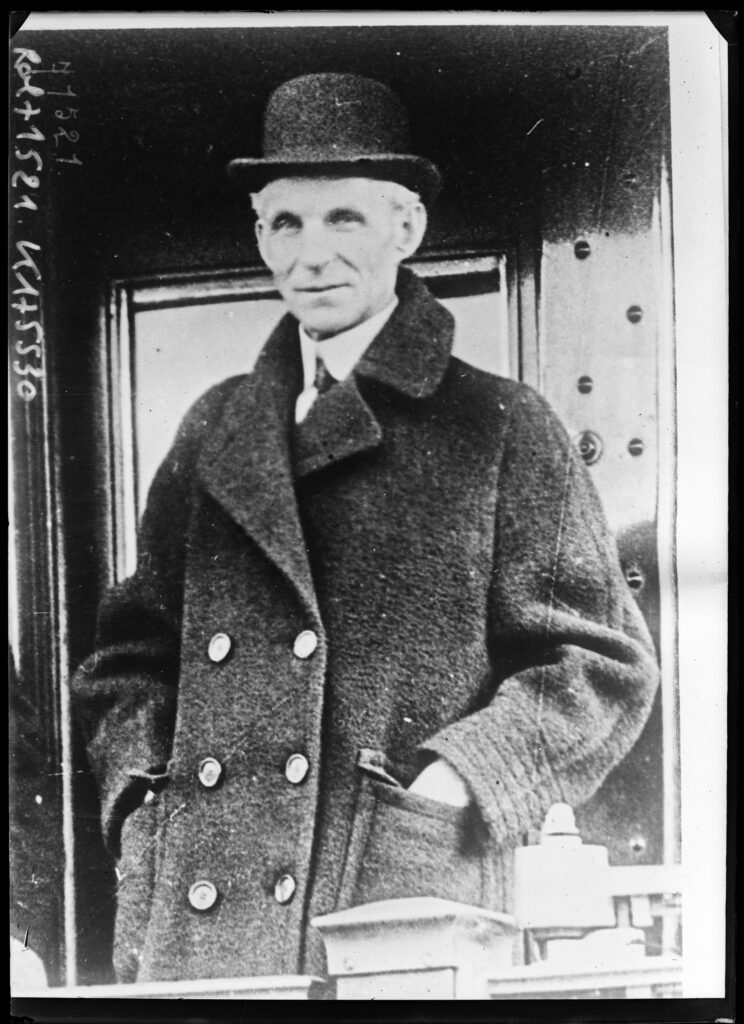
Henry Ford (1863-1947) was an American industrialist and founder of the Ford Motor Company, widely credited with revolutionizing automobile manufacturing through the development of large-scale assembly line production techniques. His innovations in manufacturing dramatically reduced the cost of automobiles, making car ownership accessible to a much broader segment of the American population and transforming both the automotive industry and American industrial practice more broadly.
Henry Ford at a Glance
| Full name | Henry Ford |
| Born | July 30, 1863, Greenfield Township, Michigan |
| Died | April 7, 1947, Dearborn, Michigan |
| Known for | Founding Ford Motor Company; pioneering moving assembly line manufacturing |
| Occupation | Industrialist, businessman, engineer |
| Major events | Founded Ford Motor Company 1903; introduced the Model T 1908; implemented the moving assembly line 1913 |
| Nationality | American |
Early Life and Mechanical Interests
Henry Ford was born on a farm in Greenfield Township, Michigan, and developed an early fascination with machinery and mechanical devices that set him apart from the agricultural expectations typical of his rural upbringing. This early interest led him to pursue work as a machinist and engineer in Detroit, where he gained practical technical experience that would later prove essential to his development of automotive manufacturing techniques.
Early Career and Engineering Work
Before founding his own automobile company, Ford worked as an engineer for the Edison Illuminating Company, a position that provided him with valuable experience in mechanical and electrical engineering while also allowing him to pursue his growing interest in internal combustion engine technology during his personal time. His work during this period included building his own experimental automobiles, efforts that gradually convinced him of the viability of commercial automobile production.
Founding of Ford Motor Company
In 1903, Ford founded the Ford Motor Company, establishing the enterprise that would become one of the most significant and influential automobile manufacturers in history, following two earlier unsuccessful attempts at establishing automobile companies. The company’s early years were marked by considerable experimentation with vehicle designs, as Ford worked to develop a car that would be both reliable and affordable for ordinary consumers.
Introduction of the Model T
In 1908, Ford Motor Company introduced the Model T, a durable and relatively affordable automobile that would become enormously popular and remain in production for nearly two decades, fundamentally transforming American transportation patterns. The Model T’s combination of durability, simplicity, and relative affordability made it accessible to a far broader range of American consumers than earlier automobiles had been, helping to establish the automobile as a mainstream consumer product rather than a luxury item.
The Moving Assembly Line
In 1913, Ford implemented the moving assembly line in his manufacturing plants, a revolutionary production technique that dramatically reduced the time and cost required to manufacture each vehicle by having workers remain stationary while the product moved past them on a conveyor system. This innovation, often considered one of the most significant developments in the history of industrial manufacturing, allowed Ford to dramatically increase production volume while simultaneously reducing the price of the Model T, making automobile ownership increasingly accessible to American workers.
Labor Practices and the Five Dollar Day
In 1914, Ford introduced the Five Dollar Day, a wage policy that more than doubled the typical daily pay for his factory workers, a decision that attracted considerable attention and was widely interpreted as an effort to reduce the high turnover rates that had plagued assembly line work. This policy, while partly motivated by practical business considerations related to worker retention and productivity, also reflected Ford’s broader views on the relationship between worker wages and consumer purchasing power within an industrial economy.
Expansion of Manufacturing Operations
As Ford Motor Company grew throughout the 1910s and 1920s, the company expanded its manufacturing operations substantially, eventually constructing the massive River Rouge Complex, an enormous industrial facility designed to handle nearly every stage of automobile production from raw materials to finished vehicles. This vertically integrated approach to manufacturing reflected Ford’s broader philosophy of industrial efficiency and control over the production process.
Later Business Challenges
In the later years of his leadership, Ford faced increasing competition from other automobile manufacturers who had adopted more diverse model offerings and regular styling updates, challenges that eventually prompted Ford Motor Company to update its own product lineup beyond the aging Model T. The company’s transition to newer models, including the Model A introduced in 1927, reflected the broader competitive pressures facing the automobile industry as it continued to mature during this period.
Founding of the Henry Ford Museum
Later in his life, Ford established The Henry Ford, a large museum and historical complex in Dearborn, Michigan, dedicated to preserving American industrial and cultural history through an extensive collection of historical artifacts, buildings, and exhibits. This institution reflected Ford’s broader interest in American history and technological progress, and it continues to operate today as a major cultural and educational institution.
Transfer of Leadership
In his later years, Ford gradually transferred leadership responsibilities within Ford Motor Company to younger family members, a transition that continued the company’s operations as a major industrial enterprise following his eventual retirement from active management. This succession process reflected the broader challenge faced by many industrial founders of ensuring their enterprises could continue successfully beyond their own direct leadership.
Industrial Legacy
Ford’s manufacturing innovations, particularly the moving assembly line, had a transformative impact on industrial production methods well beyond the automobile industry, influencing manufacturing practices across numerous sectors throughout the twentieth century. The principles of mass production that Ford helped pioneer became a foundational element of modern industrial manufacturing, studied extensively by business historians and management theorists in the decades that followed.
Impact on American Transportation
The widespread availability of affordable automobiles that resulted from Ford’s manufacturing innovations fundamentally transformed American society, enabling new patterns of suburban development, altering the nature of work and commerce, and reshaping the physical landscape of American cities and towns. This transformation in personal transportation, driven substantially by Ford’s production techniques, represents one of the most significant social and economic changes of the early twentieth century in the United States.
Legacy
Henry Ford remains one of the most historically significant figures in the history of American industry, remembered for his transformative contributions to automobile manufacturing and for pioneering production techniques that reshaped industrial practice across numerous sectors. His work fundamentally changed how goods were manufactured and how ordinary Americans experienced transportation, establishing a model of industrial mass production that continued to influence manufacturing practices long after his death.
References
Frequently Asked Questions
What is Henry Ford best known for? He is best known for founding Ford Motor Company and pioneering the moving assembly line, which revolutionized automobile manufacturing.
What was the Model T? It was an affordable and durable automobile introduced by Ford Motor Company in 1908 that remained in production for nearly two decades and transformed American transportation.
Why did Henry Ford introduce the Five Dollar Day? He introduced it in 1914 to reduce high worker turnover on the assembly line and to help ensure factory workers could afford to purchase the cars they built.
What impact did Ford’s assembly line have on manufacturing? It dramatically reduced production time and cost, becoming a foundational model for mass production methods used across numerous industries throughout the twentieth century.
Editorially reviewed by Specialty Digest Editorial TeamLast reviewed November 29, 2026Researched and drafted with AI assistanceReport an issue