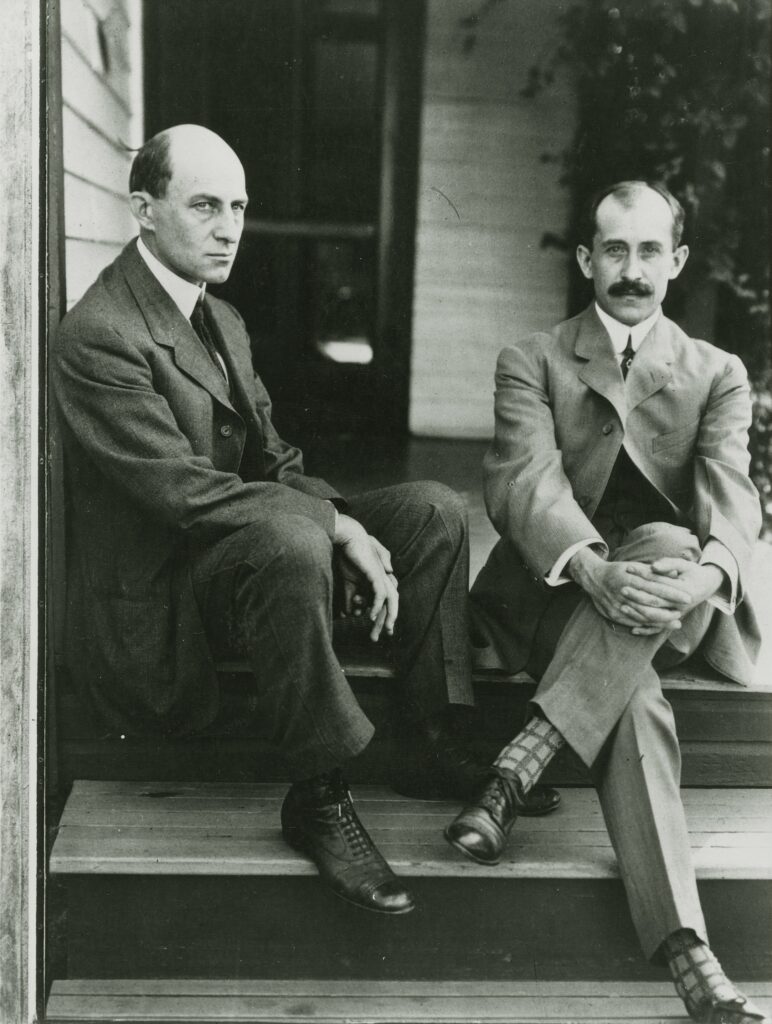
The Wright Brothers, Orville (1871-1948) and Wilbur (1867-1912) Wright, were American aviation pioneers credited with designing, building, and flying the world’s first successful powered airplane. Their historic flight at Kitty Hawk, North Carolina, in December 1903 marked the beginning of practical powered aviation and established the technical foundation upon which the modern aerospace industry was built.
The Wright Brothers at a Glance
| Full names | Wilbur Wright and Orville Wright |
| Born | Wilbur: April 16, 1867; Orville: August 19, 1871, near Millville, Indiana and Dayton, Ohio |
| Died | Wilbur: May 30, 1912; Orville: January 30, 1948 |
| Known for | Designing and flying the first successful powered airplane, 1903 |
| Occupation | Inventors, aviation pioneers, bicycle manufacturers |
| Major events | First powered flight at Kitty Hawk 1903; founded Wright Company 1909 |
| Nationality | American |
Early Life and Bicycle Business
Wilbur and Orville Wright grew up in Dayton, Ohio, in a family that encouraged intellectual curiosity and mechanical experimentation from an early age, interests that would later prove essential to their aviation work. Before turning their attention to flight, the brothers operated a successful bicycle sales and repair shop, which provided them with both the mechanical expertise and the financial resources that would later support their aeronautical experiments.
Early Interest in Flight
The Wright brothers became seriously interested in the problem of human flight during the 1890s, studying the work of earlier aviation pioneers and gliding experimenters while developing their own theoretical understanding of the aerodynamic and control challenges involved in sustained flight. Unlike many contemporaries who focused primarily on generating lift and power, the brothers recognized that solving the problem of controlling an aircraft in flight was equally essential to achieving practical powered flight.
Glider Experiments at Kitty Hawk
Beginning in 1900, the Wright brothers conducted a series of glider experiments at Kitty Hawk, North Carolina, a location chosen for its steady winds and soft sandy terrain that would cushion the inevitable crashes during testing. These glider experiments allowed them to refine their understanding of aerodynamics and, crucially, to develop and test their innovative system of three-axis control, which used wing warping combined with a movable rudder to allow a pilot to maintain balance and steer the aircraft.
Development of a Powered Aircraft
Having refined their glider designs and control systems, the Wright brothers turned their attention to developing a powered aircraft, designing and building their own lightweight gasoline engine and efficient propellers after finding that no commercially available engine met their requirements. This combination of a purpose-built engine, carefully designed propellers, and their proven control system represented the culmination of years of careful engineering and experimentation.
The First Powered Flight
On December 17, 1903, at Kitty Hawk, Orville Wright piloted the Wright Flyer on the first sustained, controlled flight of a powered heavier-than-air aircraft, covering a distance of approximately 120 feet in twelve seconds, with the brothers alternating as pilots for several additional flights that same day. This historic achievement, witnessed by a small group of local observers, represented the successful culmination of years of theoretical study and practical experimentation into the challenges of powered flight.
Refinement of Their Aircraft
Following their initial success at Kitty Hawk, the Wright brothers continued to refine their aircraft designs over the following years, developing increasingly capable airplanes with improved control, endurance, and performance at a field near their home in Dayton, Ohio. Their continued experimentation during this period, often conducted with relatively little public attention, resulted in substantial improvements to their original design and demonstrated the practical viability of their approach to powered flight.
Public Demonstrations and Recognition
As their aircraft designs matured, the Wright brothers began conducting public demonstration flights in the United States and Europe, which helped establish widespread recognition of their achievement and generated significant interest from military and commercial organizations. These demonstrations, which showcased increasingly sophisticated flying capabilities, played a crucial role in convincing skeptical observers of the practical potential of powered aviation.
Founding of the Wright Company
In 1909, the Wright brothers founded the Wright Company to manufacture airplanes commercially, establishing one of the earliest aircraft manufacturing enterprises in the United States and working to capitalize on the growing interest in aviation technology. The company’s formation marked an important transition from experimental invention to commercial enterprise, reflecting the brothers’ recognition of aviation’s emerging economic potential.
Patent Disputes
The Wright brothers’ pioneering patents on their flight control system led to extensive legal disputes with other aviation inventors and companies, as the brothers sought to protect their intellectual property rights amid the rapidly growing aviation industry. These patent battles consumed considerable time and resources during the years following their initial success, reflecting the high commercial stakes associated with early aviation technology.
Wilbur’s Death and Orville’s Later Role
Wilbur Wright died in 1912 after contracting typhoid fever, leaving Orville to continue the brothers’ aviation work and manage their business interests in the years that followed. Orville remained involved in aviation-related activities for decades afterward, eventually selling his interest in the Wright Company while continuing to be recognized as one of the founding figures of powered flight until his death in 1948.
Technical Innovations
Beyond their historic first flight, the Wright brothers made numerous lasting technical contributions to aviation, including their pioneering three-axis control system, which remains a fundamental principle underlying the control of fixed-wing aircraft to the present day. Their systematic, scientific approach to solving the problems of flight, including extensive wind tunnel testing to refine their understanding of aerodynamics, set a methodological standard that influenced subsequent generations of aviation engineers and designers.
Honors and Commemoration
The Wright brothers have been commemorated extensively in the decades since their pioneering flight, including through the establishment of the Wright Brothers National Memorial at Kitty Hawk, numerous museum exhibits dedicated to their achievement, and the naming of countless institutions, awards, and landmarks in their honor. The original Wright Flyer itself has been preserved and displayed at the Smithsonian National Air and Space Museum, serving as a lasting physical testament to their historic achievement and drawing visitors from around the world who wish to see the aircraft that first demonstrated powered flight.
Influence on Early Aviation Development
The technical principles the Wright brothers established, particularly their emphasis on pilot-controlled stability and their systematic approach to aerodynamic testing, profoundly influenced the generation of aviation engineers and inventors who followed in their wake during the early twentieth century. Their work provided a crucial foundation during aviation’s formative years, as other inventors and companies built upon the control principles and engineering methods the brothers had pioneered, accelerating the rapid development of aircraft technology in the years following their historic flight.
Legacy
The Wright Brothers remain among the most significant inventors in the history of technology, remembered for achieving the first successful powered flight and for establishing the fundamental principles of aircraft control that underpinned the subsequent development of aviation. Their achievement at Kitty Hawk transformed human transportation and laid the technical foundation for the vast aerospace industry that followed, fundamentally reshaping how people and goods move across the world.
References
- New World Encyclopedia – Wright Brothers
- History.com – Wright Brothers
- Smithsonian National Air and Space Museum – Wright Brothers
Frequently Asked Questions
What are the Wright Brothers best known for? They are best known for designing, building, and flying the world’s first successful powered airplane at Kitty Hawk, North Carolina, in 1903.
When did the Wright Brothers achieve their first powered flight? Their first sustained, controlled powered flight occurred on December 17, 1903, piloted by Orville Wright.
What made the Wright Brothers’ approach to flight different from earlier attempts? They focused heavily on solving the problem of aircraft control, developing a three-axis control system that remains fundamental to fixed-wing aircraft design today.
What happened to the Wright Brothers after their historic flight? They continued refining their aircraft, founded the Wright Company in 1909, and became involved in extensive patent disputes before Wilbur’s death in 1912.
Editorially reviewed by Specialty Digest Editorial TeamLast reviewed November 29, 2026Researched and drafted with AI assistanceReport an issue