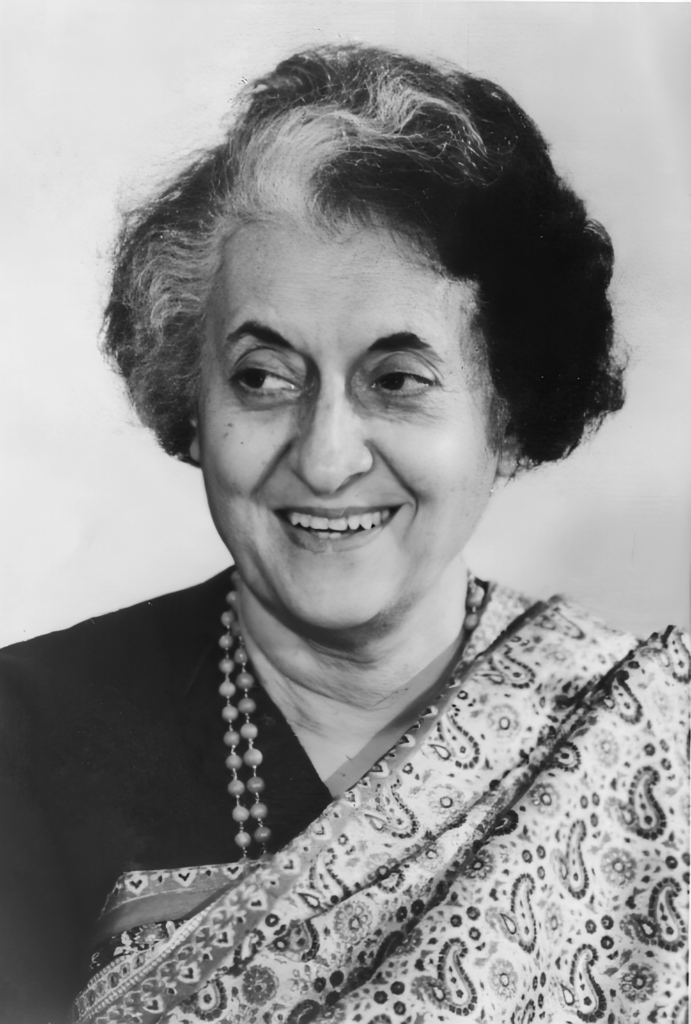
Indira Gandhi (1917 – 1984) was an Indian politician who served as Prime Minister of India for three consecutive terms from 1966 to 1977 and again from 1980 until her assassination in 1984, making her the first and to date only woman to hold the office. The daughter of India’s first prime minister, Jawaharlal Nehru, she became one of the most dominant and consequential figures in Indian political history, shaping the nation’s economy, foreign policy, and democratic institutions across nearly two decades in power.
Indira Gandhi at a Glance
| Full name | Indira Priyadarshini Gandhi (nee Nehru) |
| Born | November 19, 1917, Allahabad, British India |
| Died | October 31, 1984, New Delhi, India |
| Known for | First woman Prime Minister of India; leadership during the 1971 war and the Green Revolution; the Emergency of 1975-1977 |
| Occupation | Politician |
| Major events | Election as Prime Minister in 1966; 1971 Indo-Pakistani War; declaration of Emergency in 1975; assassination in 1984 |
| Nationality | Indian |
Early Life and Family Background
Indira Gandhi was born in Allahabad into the prominent Nehru family, the only child of Jawaharlal Nehru, who would become independent India’s first prime minister, and Kamala Nehru. She grew up immersed in the Indian independence movement, witnessing her family’s repeated imprisonment by British colonial authorities and developing close relationships with leading nationalist figures, including Mahatma Gandhi, from whom she did not inherit her surname, which came instead from her marriage to Feroze Gandhi, a politician unrelated to Mahatma Gandhi’s family.
Education and Early Political Involvement
Gandhi received an international education, studying at Visva-Bharati University in India and later at Oxford University in England, though she did not complete a formal degree at either institution. She became politically active from a young age, organizing children in support of the independence movement, and after India achieved independence in 1947 she served informally as her father’s hostess and close aide during his years as prime minister, gaining firsthand exposure to the mechanics of governance.
Rise to the Prime Ministership
Following the death of Prime Minister Lal Bahadur Shastri in January 1966, the Indian National Congress party selected Gandhi as a compromise candidate for prime minister, with senior party leaders believing she could be guided and controlled given her relative inexperience. This assessment proved mistaken, as Gandhi quickly consolidated power within the party and the government, demonstrating a political independence and strategic skill that surprised many of the leaders who had supported her selection.
Economic Policy and Bank Nationalization
Gandhi pursued a program of economic policies oriented toward socialism and state control, most notably the nationalization of India’s major banks in 1969, a move that significantly expanded state influence over the financial sector and remains one of the most debated economic decisions of her tenure. Her government also abolished the privy purses previously paid to former Indian princely rulers, further consolidating the authority of the central government over regional power structures that had persisted since independence.
The Green Revolution
During Gandhi’s leadership, India implemented major agricultural reforms known collectively as the Green Revolution, introducing high-yield crop varieties, expanded irrigation, and modern farming techniques that dramatically increased food grain production and helped India move toward food self-sufficiency after decades of dependence on food imports. This transformation of Indian agriculture is widely regarded as one of the significant achievements of the period, substantially reducing the threat of famine that had historically affected the subcontinent.
The 1971 Indo-Pakistani War
Gandhi’s government provided support to the independence movement in East Pakistan, which led to the 1971 Indo-Pakistani War and the subsequent creation of the independent nation of Bangladesh. India’s decisive military victory in this conflict significantly enhanced Gandhi’s domestic popularity and international standing, and the episode remains regarded as one of the most consequential foreign policy actions of her premiership, reshaping the geopolitical map of South Asia.
Nuclear Policy
Gandhi’s government conducted India’s first nuclear test in 1974, a peaceful nuclear explosion that demonstrated India’s technological capability and established the country as a nuclear-capable power. This decision had lasting implications for South Asian geopolitics and India’s international relations, contributing to ongoing regional strategic dynamics that would continue to shape the subcontinent for decades afterward.
The Emergency of 1975-1977
Facing political and economic pressures along with a court ruling that found her 1971 election invalid on technical grounds, Gandhi declared a state of Emergency in 1975, suspending certain civil liberties and ruling by decree for nearly two years. This period remains one of the most controversial chapters of Indian democratic history, and when Gandhi finally called elections in 1977, her party suffered a decisive defeat, resulting in her temporary departure from power and the first non-Congress government in India’s history as an independent nation.
Return to Power
Gandhi returned to the office of Prime Minister in January 1980 after the Indian electorate grew disillusioned with the fractious coalition government that had replaced her, demonstrating her continued political resilience and the enduring strength of her political base. Her second period in office focused on economic management, regional political challenges, and growing concerns about separatist movements in several Indian states, including Punjab.
Operation Blue Star and Punjab
In 1984, Gandhi authorized a military operation at the Golden Temple in Amritsar, a significant Sikh religious site, aimed at removing armed militants who had taken refuge there as part of a broader separatist movement in Punjab. This operation generated substantial controversy and significant unrest within the Sikh community, and the political and security consequences of the decision would shape the final months of Gandhi’s life and premiership.
Assassination
Indira Gandhi was assassinated in New Delhi on October 31, 1984, by members of her own security detail, in an act connected to the unrest following the Golden Temple operation earlier that year. Her assassination triggered a period of severe communal violence in India and marked a tragic end to one of the most consequential political careers in the nation’s modern history, with her son Rajiv Gandhi succeeding her as prime minister shortly afterward.
Legacy
Indira Gandhi remains one of the most significant and debated figures in modern Indian history, remembered for her decisive leadership during the 1971 war, her role in the Green Revolution’s transformation of Indian agriculture, and the lasting controversy surrounding the Emergency period. Her nearly two decades of cumulative leadership left a profound and lasting imprint on Indian politics, economic policy, and the institutions of Indian democracy, and her political legacy continues to be studied and debated by historians and political scientists.
References
- New World Encyclopedia – Indira Gandhi
- History.com – Indira Gandhi
- History.com – Indira Gandhi (India)
Frequently Asked Questions
What is Indira Gandhi best known for? She is best known as the first woman to serve as Prime Minister of India, leading the country through the 1971 war, the Green Revolution, and the controversial Emergency period of 1975 to 1977.
How long did Indira Gandhi serve as Prime Minister? She served from 1966 to 1977 and again from 1980 until her assassination in 1984, totaling nearly sixteen years in office across two periods.
What was Indira Gandhi’s relationship to Mahatma Gandhi? She was not related to Mahatma Gandhi; her surname came from her marriage to Feroze Gandhi, a politician whose family was unrelated to Mahatma Gandhi’s family.
How did Indira Gandhi die? She was assassinated in New Delhi on October 31, 1984, by members of her own security detail, in the aftermath of the 1984 Golden Temple operation in Punjab.
Editorially reviewed by Specialty Digest Editorial TeamLast reviewed November 29, 2026Researched and drafted with AI assistanceReport an issue