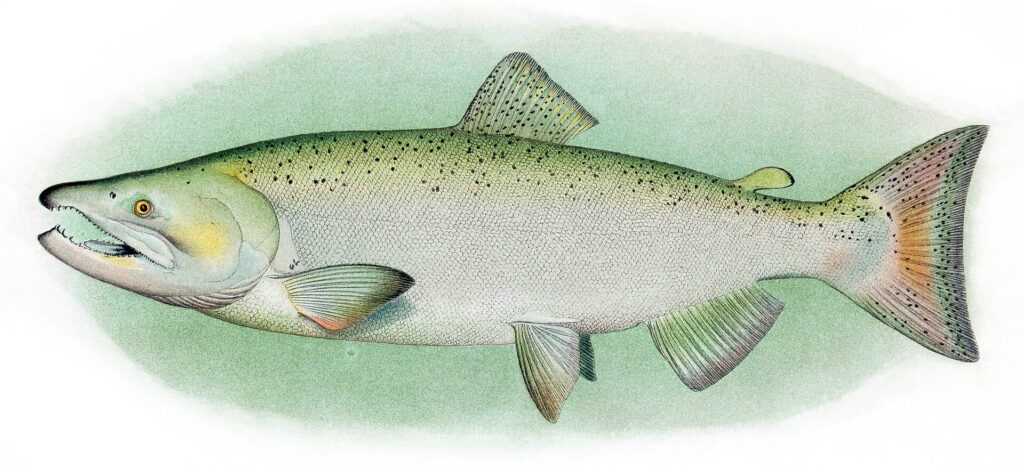
The king salmon, also called Chinook salmon (Oncorhynchus tshawytscha), is the largest Pacific salmon and the state fish of Alaska, designated in 1962. Adults typically weigh 10 to 50 pounds and can reach 130 pounds. The sport-caught world record, 97¼ pounds, was taken from Alaska’s Kenai River on May 17, 1985 [1][2].
| Scientific name | Oncorhynchus tshawytscha |
|---|---|
| State fish since | 1962 |
| Typical weight | 4.5–22.7 kg (10–50 lb) |
| Maximum weight | Up to 59 kg (130 lb) |
| Sport record | 97¼ lb, Kenai River, May 17, 1985 |
| Years at sea | 1 to 8; average 3–4 |
| Longest freshwater migration | Yukon River, over 3,000 km |
Description
Adults usually measure 60 to 90 centimeters and may reach 150 centimeters, weighing 4.5 to 22.7 kilograms and sometimes up to 59 kilograms. Fish over about 14 kilograms are called Tyee. Chinook are the largest Pacific salmon [1]. Alaskans call it king salmon for its size and flavorful flesh [1].
Records
The sport-caught world record is 44.1 kilograms (97¼ pounds), caught on May 17, 1985, in the Kenai River. The commercial record is 57 kilograms, caught near Rivers Inlet, British Columbia, in the late 1970s. Mature Chinook in the Kenai River averaged 37 pounds [1].
Life Cycle
Fish spend 1 to 8 years in the ocean, averaging three to four, before returning to their home rivers to spawn from September to December. Eggs hatch in 90 to 150 days depending on water temperature, and young fish usually stay in fresh water for 12 to 18 months before moving to estuaries. Males develop a hooked jaw called a kype, and females die after guarding their nests for 4 to 25 days. The Yukon River has the longest freshwater migration of any salmon, over 3,000 kilometers [1].
Range
Chinook are native from California to Alaska and in Asian rivers from northern Japan to northeast Siberia [1].
Value
Chinook is the most valuable Pacific salmon, though it made up less than 1 percent of the commercial Pacific salmon harvest by weight in 2010. The Kenai River is famous for its large sport-caught fish [1]. See the entry on sport fishing in Alaska.
Conservation
Some populations are endangered while many are healthy, and nine populations are listed under the U.S. Endangered Species Act as threatened or endangered. Threats include overfishing, habitat loss, dams, poor ocean conditions and hatchery practices, and Pacific salmon have disappeared from about 40 percent of their historic range outside Alaska [1].
State Fish
The king salmon became the state fish of Alaska in 1962 [2].
FAQs
What is the Alaska state fish? The king salmon, designated in 1962.
How big do king salmon get? Typically 10 to 50 pounds, up to 130 pounds.
What is the sport fishing record? 97¼ pounds, caught in the Kenai River on May 17, 1985.
How long do king salmon live at sea? One to eight years, averaging three to four.
What is a Tyee? A king salmon of more than about 30 pounds.
Sources
More in Biology
Key facts
Quick checkWhat is the sport-caught world record for king salmon?Show answer
97¼ pounds
Sources
- Wikipedia. Chinook salmon. 2026 (accessed 2026-11-12)
- Wikipedia. List of Alaska state symbols. 2026 (accessed 2026-11-12)
Editorially reviewed by Specialty Digest Editorial TeamLast reviewed November 12, 2026Researched and drafted with AI assistanceReport an issue