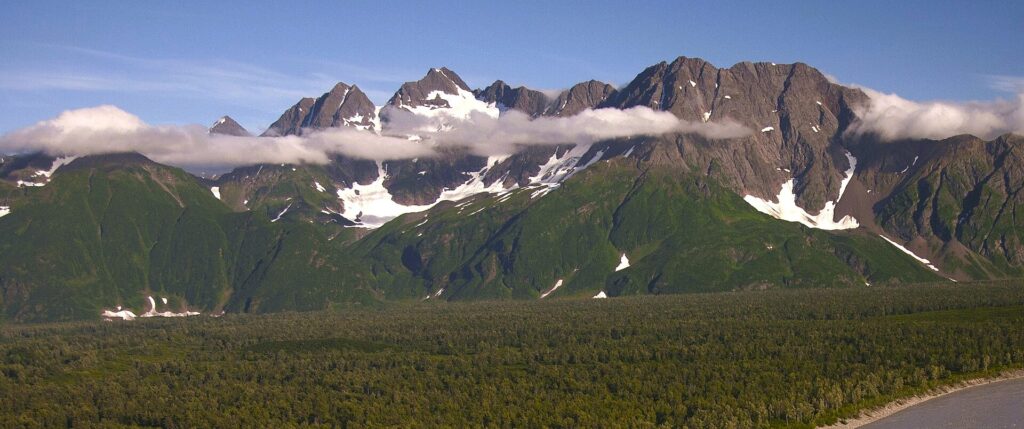
The mountain goat (Oreamnos americanus) is a hoofed mammal of the steep, high country of western North America. In Alaska it lives in the southeast and along the northern fringe of the Chugach Mountains in the south-central part of the state, the northernmost edge of its range.[1]
| Scientific name | Oreamnos americanus |
|---|---|
| Horns | 5.9–11 in, black, with growth rings |
| Head and body | 47–70 in |
| Cold tolerance | To −51°F |
| Alaska range | Southeast and northern Chugach Mountains |
| Lifespan | 12–15 years wild |
Description
The goat has a woolly, greyish-white double coat, with a fine undercoat beneath longer hollow outer hairs. Both sexes have beards, short tails and black horns 15 to 28 centimetres long with yearly growth rings, and males have longer horns and beards. The coat withstands temperatures as low as −51°F and winds up to 99 miles per hour.[1]
Range and habitat
The species lives from Washington, Idaho and Montana through British Columbia and Alberta into southern Yukon and southeastern Alaska, and British Columbia holds about half of the world population. It is a subalpine to alpine animal, living mostly above the tree line and occasionally descending to sea level in coastal areas.[1]
Diet and behaviour
Goats graze on grasses, herbs, sedges, ferns, mosses, lichens and the twigs and leaves of shrubs and conifers. Nannies form nursery groups of up to 50 animals, while adult billies often leave the herd alone or in small groups, and nannies defend kids from predators and can keep them from falling on steep slopes.[1]
Reproduction and survival
The rut runs from late October through early December, gestation lasts about six months, and one kid is usually born in late May or early June. Wild goats live 12 to 15 years, limited by tooth wear. In Alaska avalanches cause 23 to 65 percent of mountain goat deaths, depending on the region, and wolves, wolverines, lynx and bears also prey on them, with eagles a threat to kids.[1]
FAQs
Where do mountain goats live in Alaska? In the southeast and along the northern Chugach Mountains.
How cold can they tolerate? Down to −51°F.
What is a leading cause of death in Alaska? Avalanches, at 23 to 65 percent of deaths.
Sources
Key facts
- Coat tolerates −51°F
- Nursery groups up to 50
Quick checkWhat kills many Alaska mountain goats?Show answer
Avalanches
Sources
- Wikipedia. Mountain goat. 2026 (accessed 2026-11-14)
Editorially reviewed by Specialty Digest Editorial TeamLast reviewed November 14, 2026Researched and drafted with AI assistanceReport an issue