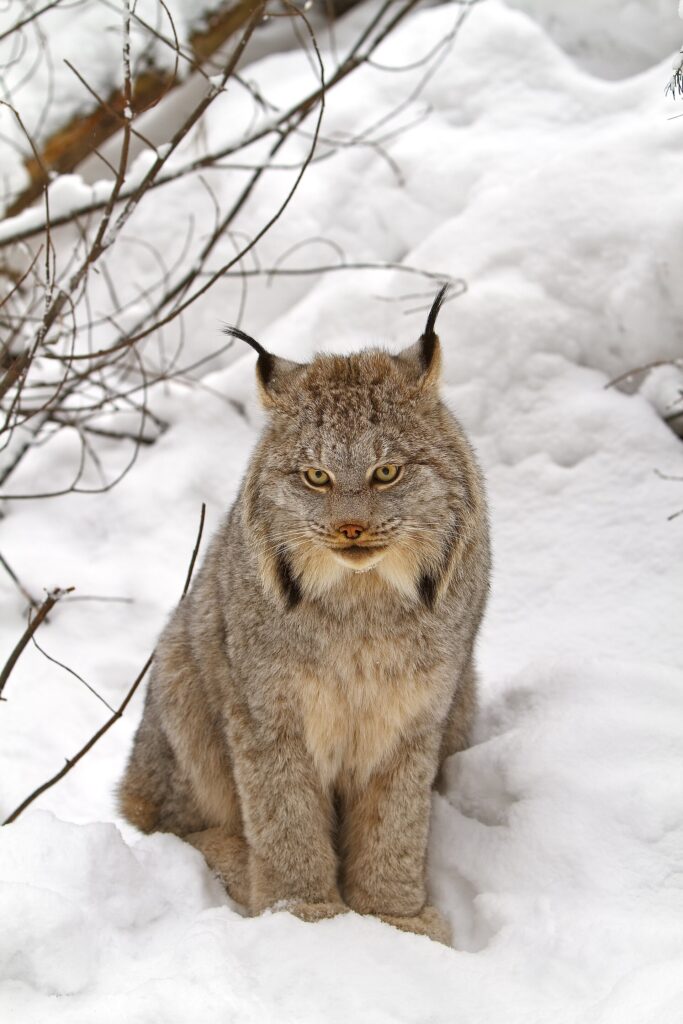
The Canada lynx (Lynx canadensis) is a medium-sized wild cat of the boreal forest, found across Alaska, Canada and the northern contiguous United States. Its numbers rise and fall with those of its main prey, the snowshoe hare, on a cycle of roughly 8 to 11 years in Alaska and central Canada.[1]
| Scientific name | Lynx canadensis |
|---|---|
| Shoulder height | 19–22 in (48–56 cm) |
| Weight | Females 11–26 lb; males 13–37 lb |
| Habitat | Dense boreal forest |
| Main prey | Snowshoe hare (35–97% of diet) |
| Lifespan | Up to 16 years wild |
Description
The lynx has long, dense fur, triangular ears with black tufts and broad, snowshoe-like paws. Total length is 29 to 42 inches, and the short tail has a fully black tip. Females weigh 5 to 12 kilograms and males 6 to 17 kilograms, and the hindlimbs are longer than the forelimbs, so the back slopes toward the front.[1]
Range and habitat
The species lives mainly in dense boreal forest and generally avoids open areas. It ranges across Alaska and Canada and into the northern United States, and it has been recorded at elevations up to 14,140 feet. It is considered extirpated in six U.S. states, and reintroductions in Colorado began in 1999. Most of Alaska permits seasonal trapping.[1]
Diet and the hare cycle
Snowshoe hares make up 35 to 97 percent of the diet, and a lynx eats about 1.3 to 2.6 pounds of food a day. When hares are scarce it takes grouse, ptarmigan, squirrels, voles and young hoofed animals. Hare densities can swing from about 2,300 to about 12 per square kilometre, and lynx populations vary three- to 17-fold in step. When hares crash, lynx may travel more than 1,000 kilometres and often stop producing litters. Alaskan research found that lynx predation contributed to declines in red fox, caribou and Dall sheep when hares were scarce.[1]
Reproduction and lifespan
Mating runs from March to early April, gestation lasts two to three months, and litters hold 1 to 8 kittens. Kittens are blind for the first 14 days, leave the den at about five weeks, are weaned at 12 weeks and leave their mother at about 10 months. Lynx live up to 16 years in the wild, though most do not survive past 10.[1]
FAQs
What does the Canada lynx eat? Mainly snowshoe hares.
How long does the hare cycle last? Roughly 8 to 11 years.
How long do lynx live? Up to 16 years in the wild.
Sources
Key facts
- Hare cycle 8–11 years
- Up to 16 years wild
Quick checkWhat is the Canada lynx main prey?Show answer
Snowshoe hare
Sources
- Wikipedia. Canada lynx. 2026 (accessed 2026-11-14)
Editorially reviewed by Specialty Digest Editorial TeamLast reviewed November 14, 2026Researched and drafted with AI assistanceReport an issue