Namibia is a country on the southwest coast of Africa, bordered by the Atlantic Ocean to the west, Angola and Zambia to the north, Botswana to the east, and South Africa to the south. With a population of just over 3.1 million people spread across about 824,290 square kilometers, according to the World Bank, it is one of the most sparsely populated countries in the world and the driest country in Sub-Saharan Africa.
Where Is Namibia Located?
Namibia stretches along the South Atlantic coast of southwestern Africa, characterized by vast semi-desert landscapes, according to the World Bank. The country is dominated by the Namib Desert, one of the oldest deserts on earth, running the length of its coastline, and by the Kalahari further inland to the east, with a narrow strip of territory, the Caprivi Strip, extending toward the country’s northeastern border with Zambia and Zimbabwe. The capital, Windhoek, sits on a plateau in the center of the country.
A Brief History of Namibia
The territory was inhabited for millennia by San, Nama, and later Bantu speaking peoples such as the Ovambo and Herero before German colonization began in the 1880s, when the area became the colony of German South West Africa. Colonial rule under Germany was marked by the 1904 to 1908 war against the Herero and Nama peoples, a campaign later recognized by Germany as a genocide. After the First World War the territory passed to South African administration, which extended its system of apartheid into the territory it called South West Africa, prompting a long independence struggle led by the South West Africa People’s Organisation, or SWAPO, that culminated in Namibian independence in 1990.
Government and Economy
Namibia is a multiparty presidential republic. According to the World Bank, the country established strong democratic institutions and achieved important development gains since independence, including expanded access to infrastructure, education, and health services, which supported its transition to upper middle income status in the late 2000s, although it was reclassified as a lower middle income economy in 2025 following a decline in gross national income per capita. The World Bank also notes that Namibia remains one of the most unequal countries in the world by income distribution. Mining, particularly of diamonds and uranium, along with fishing and tourism, are central to the national economy.
Culture and People
Namibia is a diverse, multi-ethnic society with at least eleven distinct ethnic groups, according to the World Bank, including the Ovambo, who form the largest population group, alongside the Herero, Nama, Damara, and other communities, as well as a population of German descent that reflects the country’s colonial history. English is the official language, while Afrikaans, German, and a range of Bantu and Khoisan languages, including languages that use distinctive click consonants, are also widely spoken.
What Is Namibia Known For?
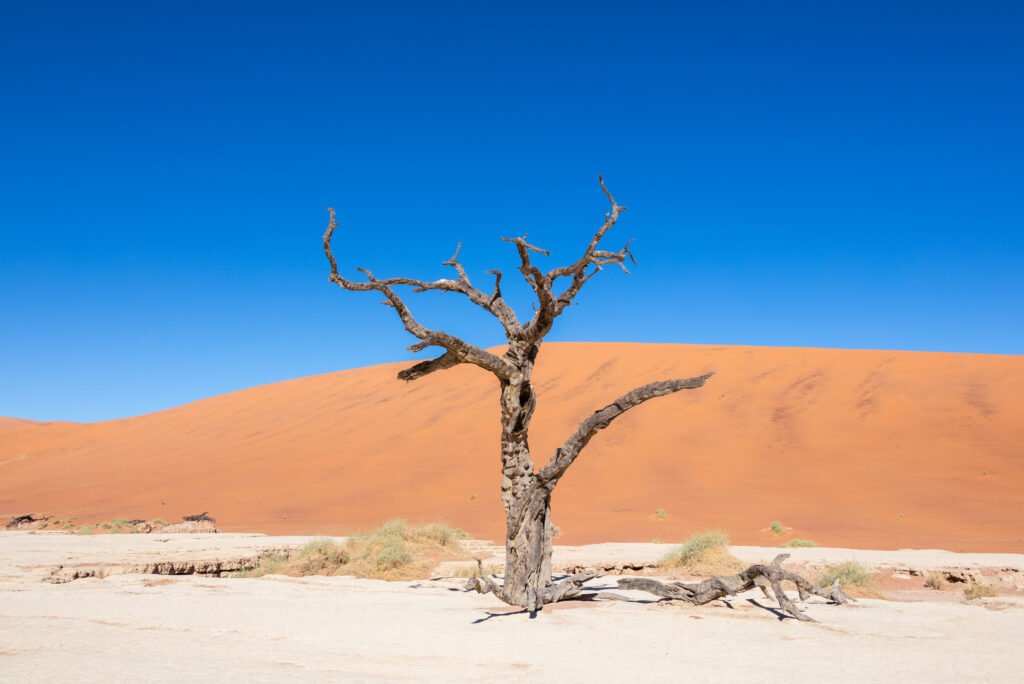
Namibia’s single most recognizable landmark is Deadvlei, a bleached white clay pan set among some of the tallest sand dunes on earth in the Namib-Naukluft area, part of the Namib Sand Sea, a UNESCO World Heritage Site. Deadvlei is scattered with the blackened skeletons of centuries old camel thorn trees, preserved by the extreme dry climate rather than decayed, standing in stark contrast against the pan’s white floor and the deep orange dunes that surround it, including Dune 45 and Big Daddy, among the tallest in the world. The scene has become the single most widely photographed and reproduced image associated with Namibia.
Why Namibia Matters
Namibia was the first country in the world to write environmental protection into its constitution at independence, and it has since become an internationally cited model for community based conservation, managing large stretches of land for wildlife alongside local livelihoods. Its arid, dramatically scenic landscapes, anchored by the ancient Namib Desert, also give it an outsized profile in global tourism and nature photography relative to its small population.
Key Takeaways
- Namibia is a sparsely populated country on Africa’s southwest coast with a population of about 3.1 million people.
- It was colonized by Germany in the 1880s and later administered by South Africa before gaining independence in 1990.
- The World Bank notes Namibia remains one of the most unequal countries in the world by income, despite strong post-independence development gains.
- The Namib Desert, running the length of the country’s coastline, is one of the oldest deserts on earth.
- Deadvlei, a white clay pan of ancient dead trees amid towering orange dunes, is Namibia’s single most iconic landmark.
Sources
- The World Bank: Namibia Overview
- UNESCO World Heritage Centre: Namib Sand Sea
- The World Bank: World Development Indicators, Namibia
Key facts
Quick checkWhat UNESCO World Heritage Site contains the Deadvlei clay pan?Show answer
The Namib Sand Sea.
Sources
- The World Bank. Namibia Overview. Undated (accessed 2026-09-28)
- UNESCO World Heritage Centre. Namib Sand Sea. Undated (accessed 2026-09-28)
- The World Bank. World Development Indicators, Namibia. 2025 (accessed 2026-09-28)
Editorially reviewed by Specialty Digest Editorial TeamLast reviewed September 28, 2026Researched and drafted with AI assistanceReport an issue