The trumpeter swan (Cygnus buccinator) is the heaviest native North American bird and the largest living waterfowl. Alaska holds the largest numbers of breeding pairs, and birds from the Copper River provided the stock for reintroductions across the species’ historic range.[1]
| Scientific name | Cygnus buccinator |
|---|---|
| Length | 54–65 in (138–165 cm) |
| Weight | 15–30 lb typical |
| Wingspan | 6–10 ft (185–305 cm) |
| Clutch | 4–6 eggs; 32–37 days incubation |
| Population, 2010 | About 46,225 |
Description
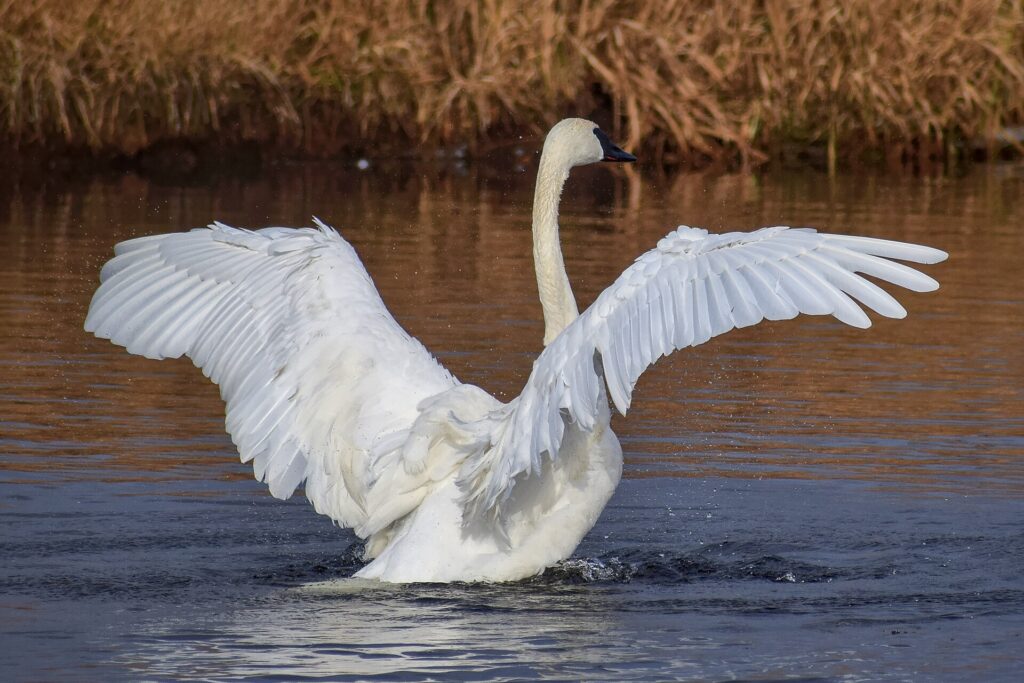
Adults are entirely white with a large, wedge-shaped black bill of 10.5 to 12 centimetres, the largest bill of any waterfowl. Cygnets are light grey with pinkish legs and gain white plumage after about a year, and the swan swims with a straight neck. Adults typically measure 138 to 165 centimetres long and weigh 7 to 13.6 kilograms, with a wingspan of 185 to 304.8 centimetres.[1]
Habitat and diet
Trumpeters prefer large, shallow ponds, undisturbed lakes, pristine wetlands, slow rivers and marshes, with enough open water for takeoff and little human disturbance during breeding. They eat almost entirely aquatic plants, feeding by swimming, up-ending and digging for roots and tubers, while young swans eat insects, small fish and crustaceans before shifting to plants within a few months.[1]
Nesting
Pairs often mate for life. Nest construction takes 11 to 35 days, usually beginning in late April, and females typically lay four to six eggs, incubated for 32 to 37 days. Cygnets can swim within two days and fledge at roughly three to four months.[1]
Population and Alaska
Fewer than 70 wild birds were known by 1933. Surveys counted about 3,722 in 1968 and roughly 46,225 by 2010, largely through reintroductions. Alaska holds the largest numbers of breeding pairs, and a 1950s aerial survey of the Copper River found several thousand trumpeters in a population that had been presumed near extinction. Those birds provided genetic stock for reintroductions, including in Michigan beginning in 1986.[1]
FAQs
How big is a trumpeter swan? Up to about 30 pounds with a wingspan to 10 feet.
Where do most nest in the U.S.? Alaska holds the largest numbers of breeding pairs.
Were they once nearly extinct? Fewer than 70 wild birds were known by 1933.
Sources
Key facts
- Wingspan up to 10 ft
- Copper River stock reintroduced
Quick checkWhat bird is the heaviest native in North America?Show answer
The trumpeter swan
Sources
- Wikipedia. Trumpeter swan. 2026 (accessed 2026-11-14)
Editorially reviewed by Specialty Digest Editorial TeamLast reviewed November 14, 2026Researched and drafted with AI assistanceReport an issue