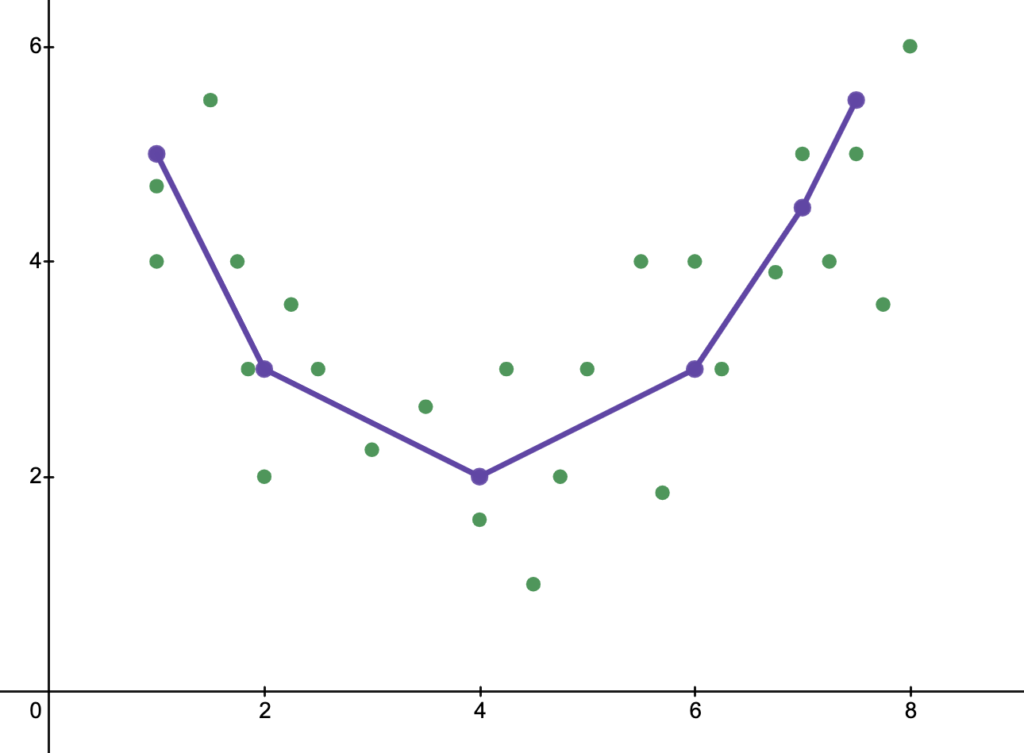
Underfitting occurs when a machine learning model is too simple, or too little trained, to capture the real pattern in the data. It performs poorly not only on new examples but also on the data it was trained on. If overfitting is a student who memorizes the practice exam without understanding, underfitting is a student who never learned the material and fails both the practice test and the real one. The goal of good modeling is to land between these extremes, achieving strong generalization.
An intuition
Suppose the true relationship between a house’s size and its price is curved, with prices rising faster for larger homes. A straight line fitted to the data will be too rigid: it overestimates for mid-sized homes and underestimates for the largest and smallest, no matter how much data is used. The model’s assumption, that the relationship is linear, is simply too limited. This persistent error is called bias [1].
Bias and variance
In the bias-variance trade-off, total error comes from bias, variance and irreducible noise. High bias means the model makes strong, wrong assumptions and misses the pattern, which is the signature of underfitting. High variance means the model is overly sensitive to the training sample, which is the signature of overfitting [1]. Making a model more flexible lowers bias and raises variance, and the best point balances the two.
Signs of underfitting
- High error on training data. The model cannot even fit what it has seen.
- Similar, poor performance on validation data. Both training and validation scores are low and close together.
- Flat learning curves. Adding more data does not improve results, because the model lacks capacity.
- Systematic residual patterns. Errors show a clear structure, such as consistently overestimating at high values, which a better model could capture.
- Near-baseline performance. The model barely beats a trivial guess such as always predicting the average.
A useful check is to see whether a more complex model can reduce training error. If a bigger or more flexible model fits the training data much better, the first model was underfitting.
Causes
- Model too simple. For example a linear model for a nonlinear problem, or a very shallow tree or small network.
- Insufficient training. Too few epochs, a learning rate that is too low or too high, or stopping too early; see gradient descent.
- Too much regularization. Heavy penalties or dropout restrict the model too strongly; see regularization.
- Poor features. Inputs that do not contain the information needed, or that are badly scaled; see feature engineering.
- Overly aggressive preprocessing. Removing useful information, such as heavy dimensionality reduction.
- Noisy labels or mismatched data. If the target is nearly random, no model will fit well, although this reflects data limits more than model flaws.
- Bugs. Errors in data pipelines, label alignment or loss functions can look like underfitting.
How to fix it
- Increase model capacity. Use a more expressive algorithm, add layers or units, increase tree depth, or add polynomial and interaction terms.
- Add or improve features. Include informative variables, transform skewed ones and encode categories well; see data preprocessing.
- Reduce regularization. Lower weight decay, dropout or other penalties.
- Train longer and tune optimization. More epochs, a better learning rate schedule and a suitable optimizer; see backpropagation.
- Check for bugs. Verify that the model can overfit a tiny sample of the data. If it cannot, something is broken in the code or data. This quick test is a standard debugging habit in deep learning.
- Reconsider the problem. Make sure the target can be predicted from the available inputs, and that labels are correct; see data labeling.
After each change, evaluate on validation data and watch for the opposite problem: as complexity rises, overfitting may appear.
Underfitting versus overfitting
- Training error. High when underfitting, low when overfitting.
- Validation error. High in both cases; with overfitting, it is much higher than training error.
- Cause. Too little capacity or training versus too much capacity relative to data.
- Remedy. Increase complexity versus constrain or add data.
Underfitting in modern AI
In large neural networks, underfitting is often a matter of scale and training: a model that is too small, trained on too few tokens or for too short a time, may not reach its potential. Research on scaling laws shows that performance improves predictably with more parameters, data and compute, and that many models were once undertrained for their size; see training data. Compression and distillation deliberately shrink models, which can introduce underfitting if pushed too far; see model compression.
A worked scenario
A retailer builds a model to predict weekly sales from price, season and promotions. The first attempt is a simple linear regression. It explains only 35 percent of the variation in sales on the training data, and about the same on validation data, a clear sign of underfitting. An analyst plots the errors and sees a repeating seasonal pattern the model ignores, along with a jump around holidays. She adds features for the week of the year, a holiday flag and an interaction between price and promotion, then switches to a gradient boosted tree model that can capture nonlinear effects. Training explained variance rises to 88 percent and validation to 82 percent. The small gap suggests the new model is not badly overfitted, and she confirms this on a held-out test period. The improvement came not from more data but from giving the model the right information and enough flexibility.
The sanity check of overfitting a small sample
A reliable way to separate underfitting caused by weak models from problems caused by bugs is to try to overfit a handful of examples on purpose. A healthy neural network, given ten training examples and enough steps, should drive its training loss close to zero. If it cannot, the cause is likely a bug, such as mismatched labels, a wrongly connected loss, a learning rate that is far too small or large, or inputs that were accidentally zeroed. Only after this test passes is it sensible to scale up to the full data set and tune for generalization.
Irreducible error and realistic expectations
Not all error can be removed. Some outcomes are inherently noisy, such as the exact day a customer will cancel or the result of a coin flip. Such irreducible error sets a floor on what any model can achieve, and chasing it leads to overfitting. Comparing a model with strong baselines and with human performance, and checking how much labelers disagree, helps estimate how much room for improvement really exists; see model evaluation.
FAQs
What is underfitting? It is when a model is too simple or too weakly trained to learn the pattern in the data, performing poorly on both training and new data.
How do you detect underfitting? Look for high error on training data, with validation error similarly poor.
What causes underfitting? An overly simple model, too little training, excessive regularization or uninformative features.
How is underfitting different from overfitting? Underfitting has high bias and poor training performance, while overfitting has high variance and a big gap between training and test performance.
How do you fix underfitting? Use a more flexible model, better features, less regularization and longer training.
More in AI Evaluation and Reliability
Key facts
- An underfitted model has high error on both the training data and new data, because it cannot capture the underlying pattern1.
- Underfitting is associated with high bias in the bias-variance trade-off1.
- Remedies include using a more flexible model, adding informative features, reducing regularization and training for longer2.
Related concepts
Quick checkWhat is underfitting?Show answer
Underfitting is a modeling error in which a machine learning model is too simple or too weakly trained to capture the underlying pattern in the data, so it performs poorly on both the training data and on new data.
Sources
- Trevor Hastie, Robert Tibshirani and Jerome Friedman, The Elements of Statistical Learning, Springer, https://hastie.su.domains/ElemStatLearn/
- Ian Goodfellow, Yoshua Bengio and Aaron Courville, Deep Learning, MIT Press, https://www.deeplearningbook.org/
Editorially reviewed by Specialty Digest Editorial TeamLast reviewed November 17, 2026Researched and drafted with AI assistanceReport an issue