The yelloweye rockfish (Sebastes ruberrimus) is the most common non-pelagic rockfish in Alaska. It belongs to a genus of slow-growing, long-lived fish, and it is often wrongly called red snapper, a species that does not occur in Alaska.[1]
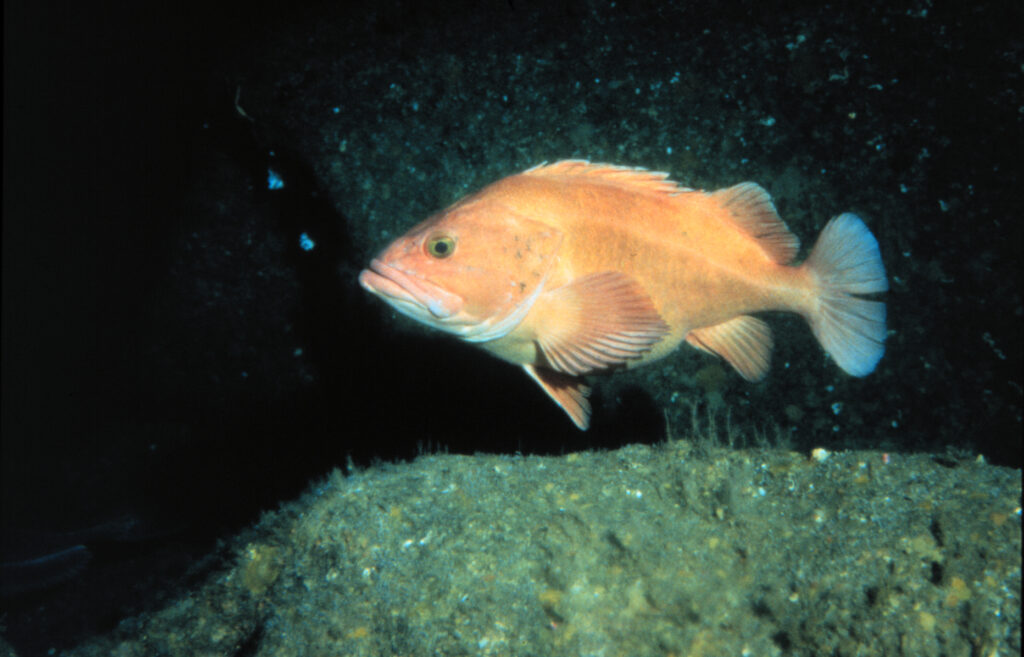
| Scientific name | Sebastes ruberrimus |
|---|---|
| Management group | Non-pelagic rockfish |
| Gulf of Alaska rockfish species | 32 |
| Rockfish size range | 8–40 in |
| Longest-lived rockfish aged | 205 years (rougheye) |
| Reproduction | Live-bearing |
Yelloweye and the non-pelagic group
The yelloweye is the most common member of the non-pelagic group in Alaska, rockfish that live near the bottom in rocky areas, usually solitary or in small schools. It is often misnamed red snapper. The source gives no yelloweye-specific figures for size, lifespan or range, so the details below describe rockfish in general.[1]
Rockfish biology
There are 32 rockfish species in the Gulf of Alaska, fewer than 10 of them commonly harvested, and adults range from 8 to 40 inches. They have large scales and spines on the head, gill covers and fins, and colours from bright red, orange or yellow to black and gray. Rockfish are among the longest-living vertebrates, with one rougheye rockfish from Southeast Alaska aged at 205 years. They grow slowly, with most beginning to reproduce at 5 to 7 years and some not until 15 to 25, and they are live-bearing, with females releasing thousands to millions of larvae. Juveniles hide in kelp, eelgrass or around rocks before moving to deeper adult habitat, and adults eat sand lance, herring, small rockfish and crustaceans.[1]
Fishery management
Rocky habitat is easy to locate, the fish are easy to catch, they mature late and survival after release is low because an unvented swim bladder often causes injuries. Recreational and subsistence fisheries have some of the most restrictive bag limits on the Pacific Coast, with stricter limits for non-pelagic species. Recommended practice is to use a single circle hook, avoid high-relief rocky habitat and target pelagic rather than non-pelagic species, and recovery from overfishing may take decades.[1]
FAQs
Is yelloweye the same as red snapper? No, red snapper does not occur in Alaska.
How long do rockfish live? Some live over 200 years.
Why are bag limits strict? Rockfish mature late and survive release poorly.
Sources
Key facts
- 32 rockfish species in Gulf of Alaska
- Some live 200+ years
Quick checkIs red snapper found in Alaska?Show answer
No
Sources
- Alaska Department of Fish and Game. Rockfish, Wildlife Notebook Series. 2026 (accessed 2026-11-14)
Editorially reviewed by Specialty Digest Editorial TeamLast reviewed November 14, 2026Researched and drafted with AI assistanceReport an issue