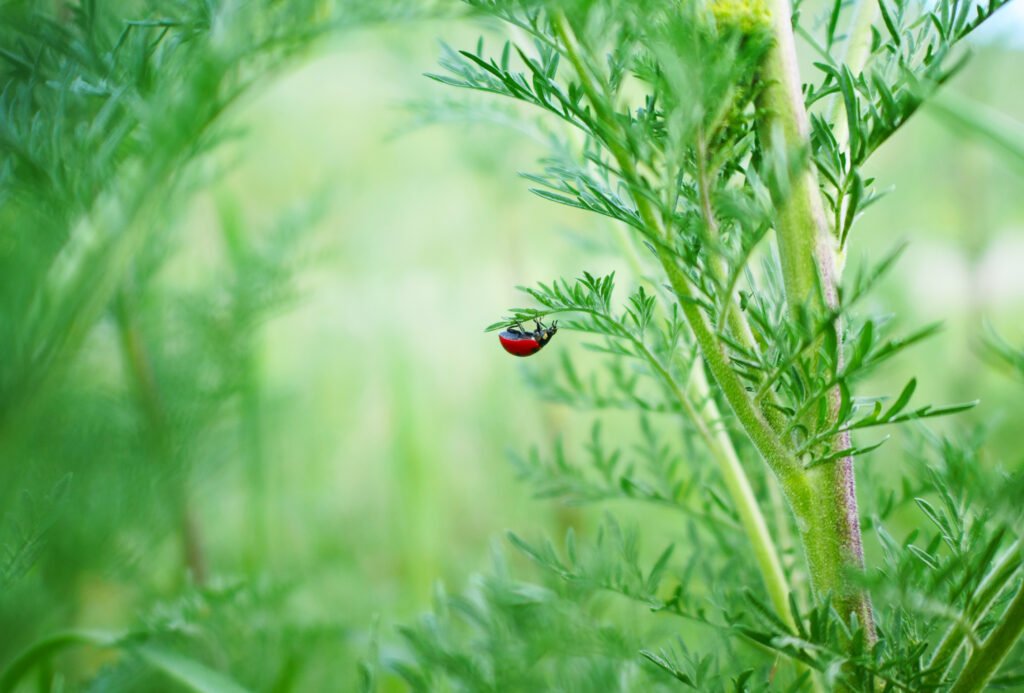
Integrated pest management, usually shortened to IPM, is an approach to controlling insects, weeds, and plant diseases that combines several different tactics rather than relying mainly on chemical pesticides. The goal is to keep pests below the level where they cause meaningful economic damage, using the least disruptive and least costly combination of tools available, and turning to synthetic pesticides only when other methods are not enough on their own.
The Core Tactics of IPM
IPM programs typically draw on four broad categories of control. Biological control uses a pest’s natural enemies, such as introducing ladybugs or parasitic wasps to prey on aphids, instead of spraying them directly. Cultural control changes farming practices themselves, such as rotating crops so a pest that specializes in one plant loses its host the following season, or adjusting planting dates so a crop’s most vulnerable growth stage does not line up with a pest’s peak activity. Physical and mechanical control includes barriers, traps, and simply removing infested plants by hand. Chemical control, the use of pesticides, remains part of the toolkit but is applied selectively and at the lowest effective dose, guided by monitoring rather than used preventively on a fixed schedule.
Monitoring and Thresholds
A defining feature of IPM is that action is triggered by actual pest counts rather than by calendar dates or fear alone. Farmers or agronomists regularly scout fields, counting pests or checking traps, and compare what they find against an established “economic threshold,” the pest population at which the cost of the damage it will cause exceeds the cost of treating it. Below that threshold, no action is taken at all, since spraying would cost more than the damage it prevents and would also kill beneficial insects that are keeping other pests in check.
Why IPM Developed
IPM emerged in the 1960s and 1970s partly in response to problems caused by heavy, routine pesticide use: pests evolving resistance to chemicals applied too frequently, outbreaks of secondary pests once a pesticide wiped out the natural predators that had been controlling them, and growing public concern about pesticide residue and environmental harm following the publication of Rachel Carson’s “Silent Spring” in 1962. Agricultural scientists realized that treating every pest sighting as an emergency requiring chemical treatment was often making long-term pest problems worse rather than better, which pushed the field toward a more selective, threshold-based approach.
Adoption and Impact
IPM is now taught and promoted by agricultural extension services worldwide and is required or incentivized under many government farm programs and organic-adjacent certification schemes. Studies comparing IPM-managed farms with conventionally sprayed ones have generally found that IPM can maintain similar yields while cutting pesticide use substantially, though the savings and effectiveness vary widely by crop, region, and how rigorously the monitoring step is actually carried out, since skipping scouting and simply spraying less without replacing it with another tactic can let pest populations grow unchecked.
FAQs
Does integrated pest management mean no pesticides at all? No. IPM does not ban pesticides; it uses them selectively, at the lowest effective dose, and only once monitoring shows a pest has crossed an economic threshold, rather than applying them preventively on a fixed schedule.
Is IPM the same as organic farming? No. Organic farming is defined by which inputs are prohibited, mainly synthetic pesticides and fertilizers, while IPM is defined by a decision-making process and can be practiced on either conventional or organic farms.
Real-World Examples
California’s wine-grape industry is often cited as an IPM success story: growers there combined pheromone traps that disrupt mating in the vine moth, carefully timed releases of predatory mites, and selective fungicide use to cut insecticide applications dramatically over several decades while keeping crop losses low. School districts and public parks departments across the United States have also adopted IPM programs for managing insects and weeds on their grounds, driven partly by parent and staff concern about children’s exposure to pesticide residue on playgrounds and athletic fields, replacing routine spraying with monitoring-based treatment only where and when it is actually needed.
Globally, the United Nations Food and Agriculture Organization has promoted IPM for decades as a cornerstone of sustainable agriculture in developing countries, training farmers in rice-growing regions of Southeast Asia in particular to recognize natural predators like spiders and dragonflies already present in paddies, rather than spraying broad-spectrum insecticides that killed those predators along with the target pests and often made subsequent outbreaks worse.
Measuring Success
Agricultural researchers typically judge an IPM program by tracking several things at once over multiple seasons: whether pest damage stays below the economic threshold, whether total pesticide applications fall compared with a conventional calendar-based spraying schedule, whether yields hold steady, and whether populations of beneficial insects recover and remain stable. Programs that succeed on all four measures are considered the strongest evidence that IPM works as intended, while programs that cut spraying but see yields or pest damage worsen are usually a sign that monitoring or one of the non-chemical tactics was not applied rigorously enough to make up for the reduced pesticide use.
Pest resistance to individual tactics remains an ongoing challenge even within IPM: insects can evolve resistance to a biological control agent or a repeatedly used pesticide class just as they can to a single chemical used alone, which is why most IPM programs deliberately rotate between different tactics and pesticide modes of action rather than repeating the same treatment season after season.
Training and extension support remain a limiting factor in many regions, since IPM demands more agronomic knowledge from a farmer than simply spraying on a fixed schedule.
More in Agriculture & Food
Editorially reviewed by Specialty Digest Editorial TeamLast reviewed November 4, 2026Researched and drafted with AI assistanceReport an issue