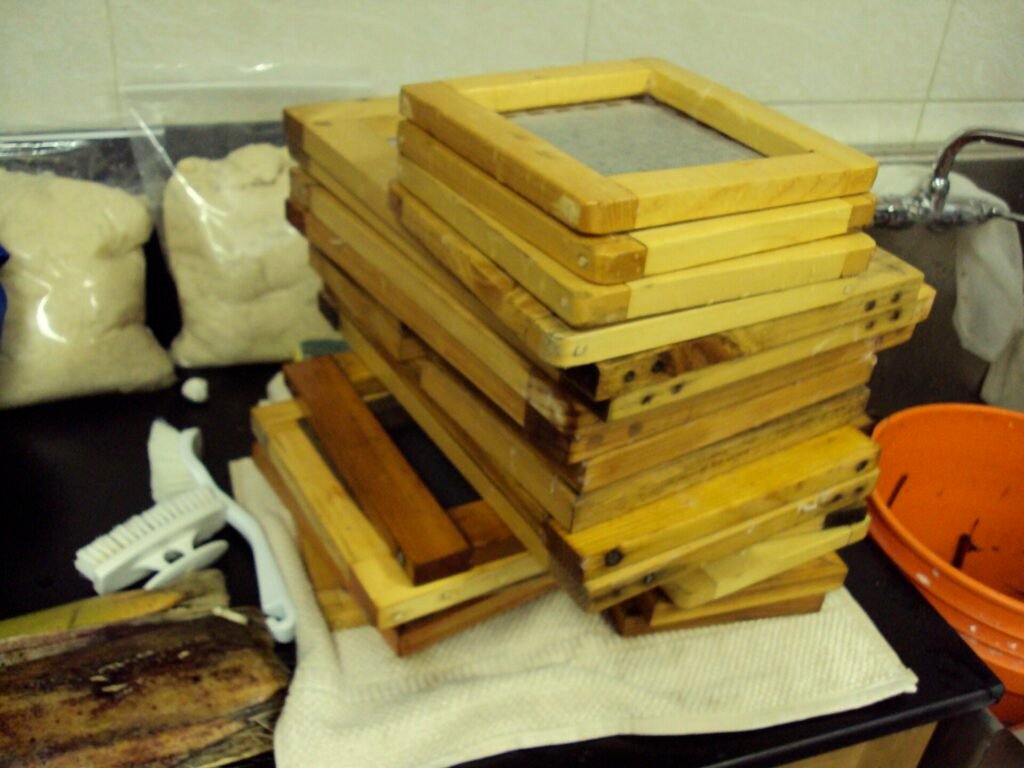
Paper is a thin sheet made from a mat of plant fibers that are separated in water, lifted on a screen and dried. It was developed in China, where the court official Cai Lun presented an improved version to the emperor in 105 CE, and it reached Europe by way of the Islamic world.
History of paper
In 1957, archaeologists working in a Han dynasty tomb at Baqiao, China, found a bronze mirror with remnants of hemp paper stuck to it. The tomb dated to the 2nd century BCE, which showed that paper was older than Cai Lun.
Cai Lun, an imperial court official of the first and second centuries CE, presented his process to the emperor in 105. It used plant fibers, netting and recycled materials, and it made paper suitable for many uses and helped it spread.
From China, merchants and missionaries carried paper and the knowledge of making it to Japan, Korea and Central Asia, where Muslims met it in the eighth century. One account says Chinese prisoners taken after the Battle of Talas in 751 introduced papermaking to Samarkand, and while that story may not be literally true, paper clearly reached the Middle East through Central Asia.
Papermaking then spread to Iraq, Syria, Egypt, North Africa and Spain. The first Spanish paper mill is documented at Jativa in 1056, and Fez was reported to have 400 mills by the end of the 12th century. Europeans began making paper themselves in the 11th and 12th centuries, and Ulman Stromer built the first mill north of the Alps, at Nuremberg, in the late 14th century.
In 1900 a Chinese Buddhist monk accidentally found more than 30,000 paper scrolls in a cave at Dunhuang, in Gansu Province. The cave was first used in 366 and sealed in the 10th century, so the papers date from that six-century span.
Who invented paper?
Tradition names Cai Lun, but the Baqiao find suggests his achievement was less an invention than an improvement of methods in use for at least two hundred years. Researchers also disagree over whether the Baqiao fragments count as paper or only as precursors, which depends on how paper is defined.
Credit for the spread of the technology belongs to many people. Papermakers in the Islamic world, for example, improved the process by using waste rags and old rope as fiber and dipping the mold into a large vat of pulp.
How paper is made
Papermaking has stayed close to the same logic for two thousand years. Fibers from plants such as hemp, flax, cotton rag and, today, wood are beaten in water into a thin pulp. A mold with a fine screen is dipped into the pulp and lifted, the water drains away, and the matted layer is pressed and dried into a sheet.
Medieval papermakers sized their sheets, or sealed the surface so ink would not soak in, with starch, and some added chalk. Modern mills use wood pulp, large machines and chemical treatments, but the principle of forming a fiber mat from a water suspension is unchanged.
Types of paper
Handmade and mold-made papers, formed one sheet at a time, are still used for art, books and certificates. Machine-made paper is formed in continuous rolls and is the basis of newsprint, printing and writing paper.
Weight and finish matter as well. Thin tissue and heavy cardstock differ mainly in thickness, and coatings can improve print quality or give a glossy surface.
Other grades include paperboard and corrugated board for packaging, tissue for hygiene, and specialty papers such as filter paper and banknote paper.
Adoption was gradual. Paper copies of the Qur’an began to appear in the western Islamic world in the 13th century, while parchment copies were still being made well into the 14th century.
Paper vs. papyrus and parchment
Papyrus and parchment were the two major writing materials of antiquity. Papyrus was made from strips of the papyrus plant laid in layers and pressed together, and parchment was made from prepared animal skin.
Paper differs because its fibers are broken down in water and then re-formed into a sheet. The medieval writer al-Tha’alibi, quoted by Bloom, described paper from Samarkand as better looking, more supple and more convenient for writing than papyrus and parchment.
Impact of paper
Paper was cheaper and easier to write on than parchment or papyrus. Documents from the Cairo Geniza show how, in the medieval Islamic world, bills of exchange, orders of payment and personal letters were regularly sent on paper between traders as far apart as Spain and India.
The spread of paper also prepared the ground for the printing press. According to the historian Jonathan Bloom, the early printing presses made books many times faster than hand copyists and could not have worked without paper mills to feed them.
Paper today
Paper is still used for packaging, printing, hygiene products and documents. Writing in 1999, Bloom noted that despite predictions of paperless offices, people were using more paper than ever before.
Fiber for paper mostly comes from wood, so questions of sustainable forestry and recycling shape the industry. Recycling is not new, since used paper was already being saved in medieval Cairo so its fiber could be made into new sheets.
FAQs about paper
Did Cai Lun invent paper? He is traditionally credited, but archaeological finds show paper existed at least two centuries earlier.
Is paper made only from wood? No. Historic papers used hemp, flax and rags, and some modern papers still use cotton or recycled fiber.
What is a ream? It is a unit of 500 sheets. The word came into English from Arabic rizmah, meaning a bundle, through Spanish and Old French.
More in Materials Science
Key facts
- Remnants of hemp paper found at Baqiao in 1957 date to the 2nd century BCE.1
- Cai Lun presented his improved process to the emperor in 105.1
- Paper was in use for at least two hundred years before Cai Lun.1
- The first Spanish paper mill is documented at Jativa in 1056.2
- Ulman Stromer built the first paper mill north of the Alps at Nuremberg in the late 14th century.2
Related concepts
In the news
- ScienceTrans-Neptunian Objects: Hubble and Webb Find 27 New Ones as Small as 3 Miles Across
- ScienceNGC 7129: Webb Image Shows Stellar Jets and Shocked Gas in a Stellar Nursery
- ScienceExtreme Debris Disks: Webb Studies 21 Young Systems Showing Planetary Collisions
- BusinessSoda Ash in 2025: USGS Shows the U.S. Exports More Than Half of Its Output
- BusinessTitanium Minerals in 2025: USGS Shows China Mines a Third of Ilmenite
Quick checkDid Cai Lun invent paper?Show answer
He is traditionally credited and presented his process in 105, but hemp paper found in a Han dynasty tomb dates to the 2nd century BCE, so his achievement was an improvement of existing methods.
Sources
- Centre for the Study of Manuscript Cultures, University of Hamburg, A Short History of Paper in Imperial China, https://www.csmc.uni-hamburg.de/news/2024-08-13-smc-31.html
- Jonathan M. Bloom, Revolution by the Ream: A History of Paper, Saudi Aramco World, May/June 1999, https://archive.aramcoworld.com/issue/199903/revolution.by.the.ream-a.history.of.paper.htm
Editorially reviewed by Specialty Digest Editorial TeamLast reviewed November 4, 2026Researched and drafted with AI assistanceReport an issue