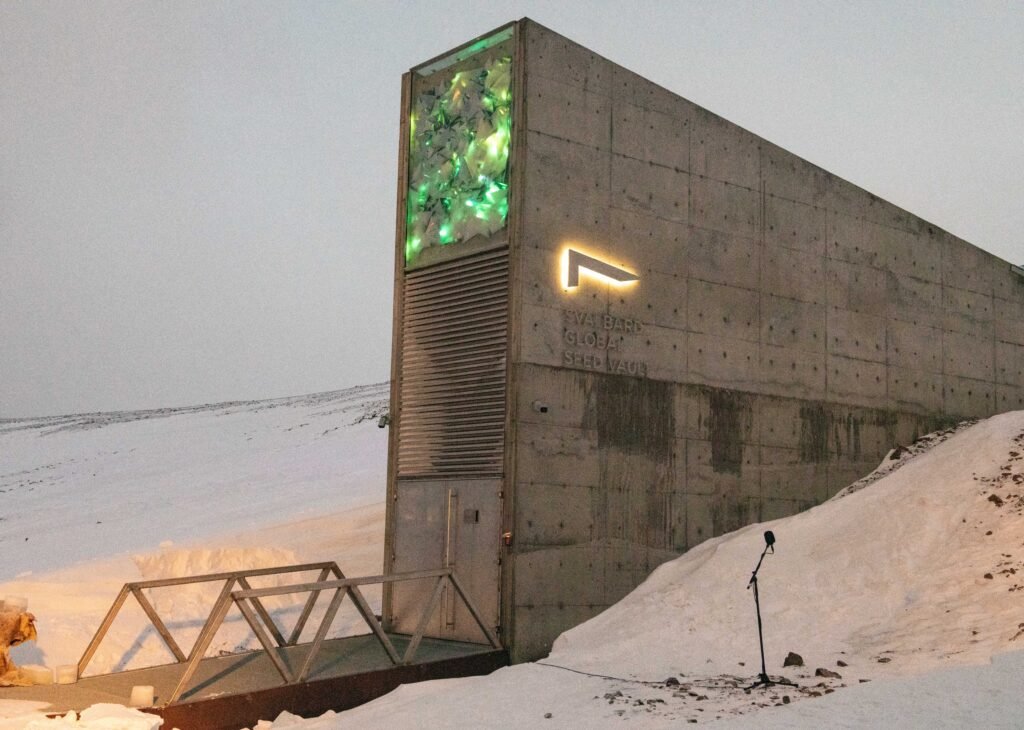
A seed bank is a facility built to store seeds for long periods of time, usually under cold, dry conditions that slow the natural aging process and keep the seeds viable for years, decades, or in some cases centuries. The goal is to preserve the genetic diversity of crop varieties and wild plant relatives so that diversity is not permanently lost if it disappears from farms, forests, or the wild.
Most seed banks keep what is called an “orthodox” seed collection, meaning seeds that naturally tolerate drying and cold without dying, such as wheat, rice, and many vegetable seeds; a smaller number of plant species produce “recalcitrant” seeds that cannot survive drying, such as avocado and mango, and must instead be preserved as living plants, tissue cultures, or cuttings rather than dried seed.
How Seeds Are Stored
Before storage, seeds are dried to a low moisture content and then sealed in moisture-proof containers, since moisture and warmth are the two biggest drivers of seed aging and loss of viability. Most major seed banks hold their collections at around minus 18 degrees Celsius, cold enough to effectively pause the biochemical processes that cause seeds to deteriorate over time, and samples are periodically tested for germination rate, with any batch that falls in quality grown out and its seeds refreshed and restored to storage.
Many seed banks also keep duplicate samples of the same variety in more than one physical location, so that a fire, equipment failure, or natural disaster at one site does not permanently destroy a unique variety that exists nowhere else.
Why Seed Diversity Matters
Modern commercial agriculture relies heavily on a relatively small number of high-yielding crop varieties, which makes the food supply more efficient but also more vulnerable, since a disease or pest that successfully attacks one widely planted variety can cause damage across an enormous area at once. Older and wild varieties held in seed banks often carry genetic traits, such as drought tolerance, disease resistance, or tolerance of poor soil, that breeders can cross into modern varieties when a new threat emerges, which is why seed banks are sometimes described as an insurance policy for the future of farming.
A well-known example occurred in the 1970s, when a disease called grassy stunt virus threatened rice crops across Asia; breeders eventually found resistance in a single wild rice sample held in a seed collection, which was then bred into commercial rice varieties to stop the outbreak.
The Svalbard Global Seed Vault
The best-known seed bank in the world is the Svalbard Global Seed Vault, built into a mountainside on a remote Norwegian island well inside the Arctic Circle and opened in 2008. It does not collect seeds directly from farmers or researchers; instead it serves as a backup for the seeds already held by hundreds of other seed banks worldwide, which send duplicate samples to Svalbard specifically so that a copy survives even if a disaster strikes their home institution.
That backup role proved its worth in 2015 and 2017, when researchers with the International Center for Agricultural Research in the Dry Areas, whose own seed bank in Syria had become impossible to access safely because of the civil war, withdrew duplicate samples from Svalbard to rebuild their collection at new facilities in Lebanon and Morocco.
National and Crop-Specific Seed Banks
Beyond Svalbard, most countries maintain their own national seed banks, often tied to agricultural research agencies, and several major crops have dedicated international collections, such as the International Rice Genebank in the Philippines and the maize and wheat collections held by the International Maize and Wheat Improvement Center in Mexico. These collections are actively used by plant breeders, not just kept in storage, with researchers regularly requesting samples to test for useful traits or to cross into new varieties under development.
Community seed banks and seed-saving networks, run by farmers and gardeners rather than government institutions, have also grown in many countries as a way to preserve locally adapted heirloom varieties that large institutional collections may not prioritize, while also keeping seed-saving knowledge and skills alive at the community level.
Threats and Limitations
Seed banks face real risks: funding cuts can leave a collection without the staff needed to test and refresh aging samples, power failures can compromise cold storage, and political instability or conflict can cut researchers off from their own collections entirely, as happened in Syria. Stored seed also cannot preserve everything about a living plant population, since traits shaped by the specific soil, climate, and pests of the place a variety evolved can be lost even when the seed itself survives, which is why many conservationists argue that seed banks should complement, not replace, conserving crop diversity on working farms and in the wild.
FAQs
How long can seeds actually survive in a seed bank? It varies enormously by species, but many common crop seeds stored properly can remain viable for decades, and some, under ideal cold, dry conditions, for considerably longer; seed banks periodically test and regrow samples rather than assuming indefinite viability.
Is the Svalbard Global Seed Vault open to the public? No. It is not a public gene bank that researchers draw from directly; it exists purely as a secure backup, and only the institutions that deposited a given sample can request its withdrawal.
Climate change adds further urgency to this work, since shifting rainfall and temperature patterns are expected to make traits like heat and drought tolerance, often found only in older or wild varieties, increasingly valuable for breeding the crops of the future.
More in Agriculture & Food
Editorially reviewed by Specialty Digest Editorial TeamLast reviewed November 4, 2026Researched and drafted with AI assistanceReport an issue