The University of Alaska System is the statewide public university system of Alaska, made up of three separately accredited universities, the University of Alaska Anchorage, the University of Alaska Fairbanks and the University of Alaska Southeast, on 19 campuses. Founded in 1917 as a land-grant institution, it serves nearly 30,000 full- and part-time students and offers about 400 degree programs. It is governed by a Board of Regents appointed by the governor [1][2].
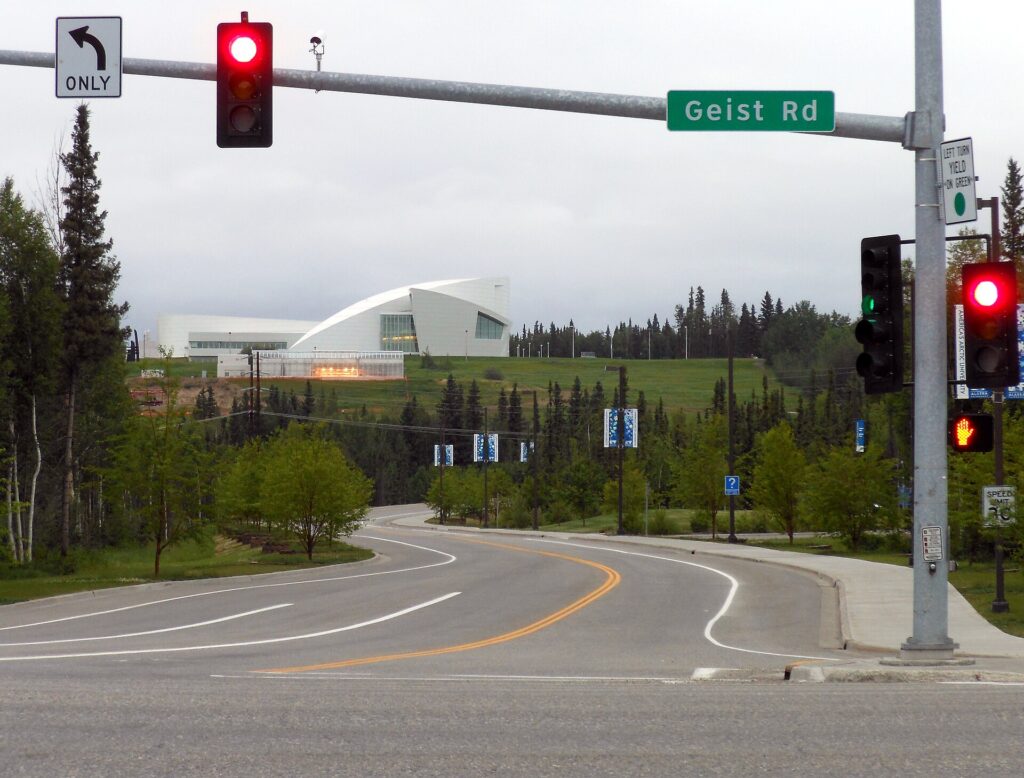
| Founded | 1917 |
|---|---|
| Universities | Anchorage, Fairbanks, Southeast |
| Campuses | 19 |
| Students | Nearly 30,000 |
| Programs | About 400 degrees |
| Governance | Board of Regents |
| Type | Land-, sea- and space-grant |
History
Congress set aside land for a college in 1915, and the university traces its origins to 1917. Instruction began in 1922 at the Alaska Agricultural College and School of Mines in Fairbanks, which became the University of Alaska in 1935. The Anchorage campus opened in 1954 and the Southeast campus in 1972, and the statewide system was formed in 1975 [2]. Article VII of the Alaska Constitution establishes the university [1].
The Three Universities
The University of Alaska Anchorage (UAA) is the largest, with about 15,000 students, roughly two-thirds of the system’s total, and twelve colleges. The University of Alaska Fairbanks (UAF) was the first university founded in Alaska and is the flagship, known for geology, atmospheric sciences and wildlife biology. The University of Alaska Southeast (UAS) is based in Juneau with campuses in Sitka and Ketchikan and is the smallest by enrollment [1]. See the entry on the University of Alaska Fairbanks.
Regional Campuses
UAA has community campuses in Valdez, the Kenai Peninsula (Soldotna and Homer), Kodiak and the Mat-Su area. UAF has five rural campuses: Bristol Bay (Dillingham), Chukchi (Kotzebue), Interior Alaska, Kuskokwim (Bethel) and Northwest (Nome). UAS has campuses in Juneau, Sitka and Ketchikan [1][2].
Governance
A Board of Regents, appointed by the governor and confirmed by the state legislature, governs the system. Regents serve eight-year terms, except the student regent, who serves two years. The board selects a president, who leads statewide administration, and chancellors oversee each of the three universities [1].
Research
Research institutes include the Agricultural and Forestry Experiment Station, the Geophysical Institute, the Institute of Marine Science, the Institute of Arctic Biology and the International Arctic Research Center, founded in 1997 as a U.S.-Japanese collaboration. The University of Alaska Museum of the North on the Fairbanks campus holds more than one million cultural and natural history objects [2].
Programs
All campuses are coeducational and offer bachelor’s and master’s degrees in several fields. Fairbanks offers doctorates in Alaska-focused subjects such as atmospheric sciences, fisheries, geology, geophysics, marine biology, oceanography and space physics, as well as anthropology and mathematics [2]. UAA also hosts the state’s WWAMI medical education program [1].
FAQs
When was the University of Alaska founded? The university traces its origins to 1917, with classes starting in 1922.
What are the three universities in the system? University of Alaska Anchorage, Fairbanks and Southeast.
Which is the largest University of Alaska campus? UAA, with about 15,000 students.
Who governs the University of Alaska? A Board of Regents appointed by the governor.
How many campuses does the system have? Nineteen.
Sources
More in Education
Key facts
Quick checkHow many universities are in the University of Alaska System?Show answer
Three
Sources
- Wikipedia. University of Alaska System. 2026 (accessed 2026-11-12)
- Encyclopaedia Britannica. University of Alaska. 2026 (accessed 2026-11-12)
Editorially reviewed by Specialty Digest Editorial TeamLast reviewed November 12, 2026Researched and drafted with AI assistanceReport an issue