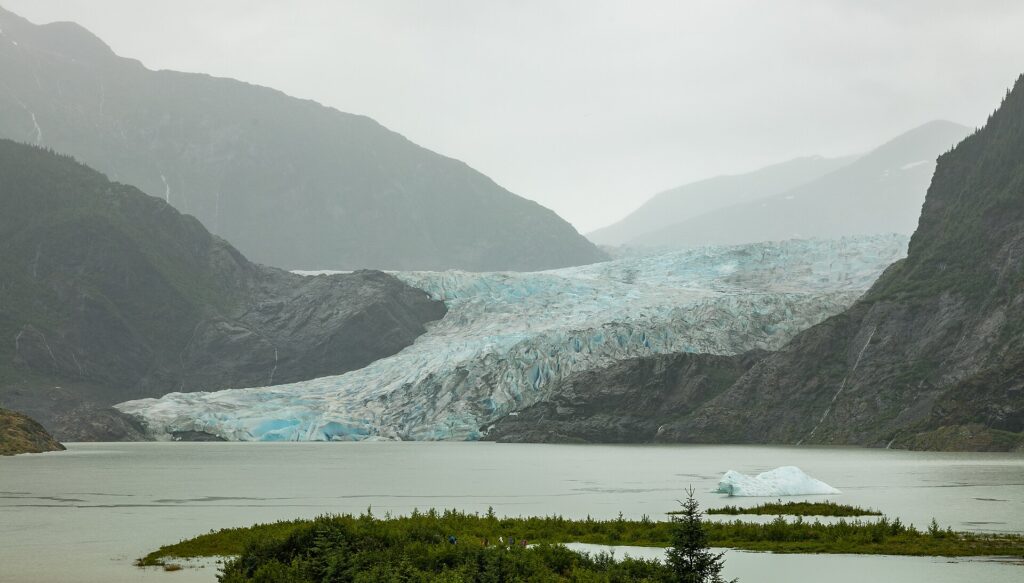
Juneau is the capital of Alaska and a consolidated city and borough in the Southeast region. Founded after gold was found in 1880, it became the capital in 1906 and has a population of 32,255 (2020). It is the least populous state capital in the United States and has no road connection to the rest of Alaska or the contiguous states, so people and goods arrive by air, sea or ferry. The municipality covers about 3,255 square miles and includes the Mendenhall Glacier [1].
| Location | Gastineau Channel, Southeast Alaska |
|---|---|
| Population (2020) | 32,255 |
| Area | About 3,255 square miles |
| Founded | October 1880 (Joe Juneau and Richard Harris) |
| Capital since | 1906 (moved from Sitka) |
| Consolidated | July 1, 1970 |
| Road connection | None to the rest of Alaska or the contiguous U.S. |
History
Joe Juneau and Richard Harris staked a townsite in October 1880 after finding gold near Gold Creek. The town was named Juneau in December 1881 [1]. The Auke (A’akw Ká’an) and Taku Tribes fished the Gastineau Channel for thousands of years, and the Tlingit name for the area is Dzántik’i Héeni [1].
Capital of Alaska
Juneau became the capital of Alaska in 1906, when the government moved from Sitka [1]. Voters have repeatedly rejected proposals to move the capital, including in 1960, 1962, 1978, 1982, 1994 and 2002, despite suggestions of Willow and Wasilla as alternatives [1].
Government
The City and Borough of Juneau was formed on July 1, 1970, by merging the city, the city of Douglas and the surrounding borough. It covers about 3,255 square miles, making it the second-largest municipality in the United States by area, larger than Rhode Island and Delaware [1].
Population
Juneau had 32,255 residents in 2020. It is the third-largest city in Alaska but the least populous state capital in the country [1].
Transportation
The city has no road connection to the rest of Alaska or the contiguous United States. Goods and people arrive by air, by sea, or by state ferry and barge [1].
Geography
Juneau sits on the Gastineau Channel at the base of Mount Juneau, across from Douglas Island. The Mendenhall Glacier, visible from local roads, is retreating [1].
Mining
Before World War II, mining operations included the Treadwell, Alaska-Juneau and Alaska-Gastineau mines, which shaped the economy and growth of the city [1].
Tourism
Cruise tourism grew from about 230,000 passengers in 1990 to nearly 1.7 million in 2025, mostly in summer [1]. Visitors come for glacier viewing, whale watching and the city’s historic downtown.
Climate
Juneau has a mild, very wet climate shaped by the Pacific Ocean and the coastal mountains, with precipitation on about 230 days a year [1].
Gold and the Treadwell Era
Gold shaped the early economy of Juneau. The Treadwell, Alaska-Juneau and Alaska-Gastineau mines operated before World War II and employed many residents, and the city’s growth through the early twentieth century was tied to mining [1]. When mining declined, government and later tourism became the main sources of employment.
Why the Capital Stays
Proposals to move the capital have been voted on several times. Alaskans rejected moves in 1960, 1962, 1978, 1982, 1994 and 2002, even when alternatives such as Willow and Wasilla were proposed [1]. The debate often centers on Juneau’s isolation, with legislators and visitors having to travel by air or sea, against the cost of building a new capital.
The Mendenhall Glacier
The Mendenhall Glacier is one of the most visited features in Southeast Alaska and can be seen from local roads. It is retreating, which makes it a common example of glacier change in the region [1]. Together with nearby icefields and the surrounding Tongass National Forest, it shapes Juneau’s identity as a gateway to wilderness.
Living Without Roads
Because Juneau is not connected by road to the rest of Alaska or to the contiguous states, residents and businesses depend on air service, ferries and barges. This affects the cost of goods and the way people travel and has led to ongoing discussion about transportation options for the capital [1].
Indigenous Heritage
The Auke and Taku Tlingit have lived and fished in the Gastineau Channel for thousands of years, and Tlingit culture remains an important part of the city, visible in art, language programs and public life [1].
FAQs
Why is Juneau the capital of Alaska? It became the capital in 1906 when the government moved from Sitka, and voters have repeatedly declined to move it.
Can you drive to Juneau? No. Juneau has no road connection to the rest of Alaska or to the contiguous states.
How big is Juneau? The city and borough covers about 3,255 square miles, larger than Rhode Island.
Who founded Juneau? Joe Juneau and Richard Harris staked the townsite after finding gold in 1880.
What glacier is near Juneau? The Mendenhall Glacier, which is visible from local roads and is retreating.
Sources
More in Human Geography
Key facts
Quick checkWhen did Juneau become the capital of Alaska?Show answer
1906
Sources
- Wikipedia. Juneau, Alaska. 2026 (accessed 2026-11-12)
Editorially reviewed by Specialty Digest Editorial TeamLast reviewed November 12, 2026Researched and drafted with AI assistanceReport an issue