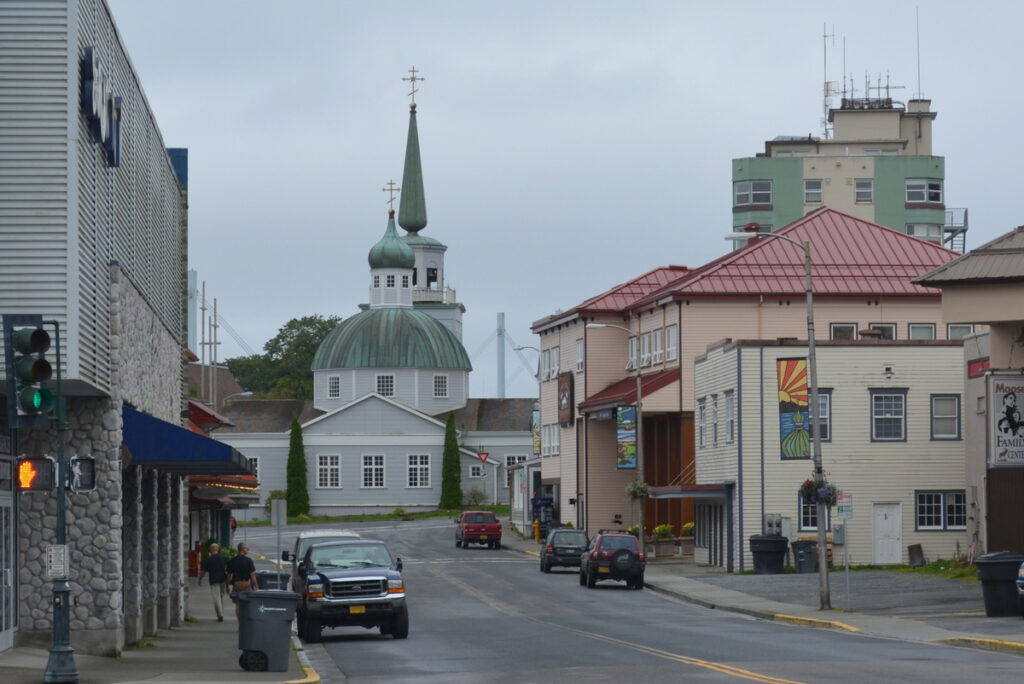
Sitka is a unified city and borough on the west side of Baranof Island in Southeast Alaska. It was the capital of Russian America as New Archangel, the site of the 1867 transfer ceremony for the Alaska Purchase, and the capital of Alaska until 1906. It is the largest city in the United States by total area, with 8,458 residents in 2020, and is known for St. Michael’s Cathedral, Sitka National Historical Park and its seafood industry [1].
| Location | West Baranof Island, Southeast Alaska |
|---|---|
| Population (2020) | 8,458 |
| Total area | About 4,815 square miles |
| Russian name | New Archangel (Novo-Arkhangelsk) |
| Transfer ceremony | October 18, 1867 |
| Landmark | St. Michael’s Cathedral, built 1848 |
| Volcano | Mount Edgecumbe, 3,200 ft |
Name and Tlingit Homeland
The name Sitka derives from the Tlingit Sheet’ká, referring to the people of the Shee, or Baranof Island, region [1]. The area has long been the homeland of the Tlingit people.
Russian Capital
The Russians founded the settlement as New Archangel (Novo-Arkhangelsk), which became the largest city in the region and the informal capital of Russian America from 1808 [1]. Alexander Baranov returned to the area in August 1804 with a large force, and after a bombardment, the Tlingit raised a white flag on August 22 and abandoned their fort on August 26. The Russians prevailed in the Battle of Sitka in 1804 [1].
Alaska Day
The Alaska Purchase transfer ceremony took place in Sitka on October 18, 1867, when the territory passed from Russia to the United States for $7.2 million. Sitka hosts an annual Alaska Day Festival, first held in 1949 [1].
St. Michael’s Cathedral
The original St. Michael’s Cathedral was built in 1848 and served as the seat of the Russian Orthodox bishop. It burned in 1966 and was restored to its original appearance [1].
Sitka National Historical Park
The National Park Service operates Sitka National Historical Park, which includes the restored Russian Bishop’s House [1]. The park preserves the history of the Tlingit and Russian encounter.
Population and Area
Sitka had 8,458 residents in 2020, making it the fifth-largest city in Alaska. It covers about 4,815 square miles in total, with roughly 2,870 square miles of land, making it the largest city in the United States by total area [1].
Mount Edgecumbe
Mount Edgecumbe is a 3,200-foot stratovolcano on Kruzof Island, about 15 miles west of Sitka. The Alaska Volcano Observatory classifies it as historically active. A swarm of earthquakes and ground uplift in 2022 suggested magma movement, but an eruption is not certain [1].
Sheldon Jackson
Sheldon Jackson (1834–1909) was a Presbyterian missionary in Alaska. Sheldon Jackson College suspended operations in 2007, and Outer Coast College is being developed on its former campus [1].
Economy and Climate
Seafood is the largest employment sector, and about 18 percent of residents earn some income from fishing or seafood. Sitka is the sixth-largest port in the United States by value of seafood harvest [1]. The oceanic climate brings cool, mild temperatures and average annual precipitation of about 132 inches [1].
The Battle of Sitka
The conflict between the Tlingit and the Russians at Sitka was one of the most significant confrontations of the Russian colonial period. After a bombardment in 1804, the Tlingit abandoned their fort, and the Russians built a new settlement at the site, which they called New Archangel [1]. The Tlingit later returned to the area, and their presence has continued ever since.
Capital of Russian America
As New Archangel, the town grew into the largest city in the region and the administrative center of Russia’s North American holdings [1]. The Russian Orthodox faith, introduced during this period, left a lasting influence that is still visible in Sitka’s architecture and community life.
The 1867 Transfer
The formal transfer of Alaska from Russia to the United States took place in Sitka on October 18, 1867. The date is observed as Alaska Day, and the Alaska Day Festival, first held in 1949, remains one of the town’s major annual events [1].
Setting and Climate
Sitka sits on the Pacific side of Baranof Island in the Tongass National Forest region. The oceanic climate gives mild winters by Alaska standards, with a record low of −1 °F recorded in 1948, and heavy rain throughout the year [1]. Mount Edgecumbe, visible across the water, is a prominent landmark.
Culture and Education
Sitka National Historical Park preserves Tlingit and Russian heritage, including the Russian Bishop’s House. Sheldon Jackson College suspended operations in 2007, and Outer Coast College is being developed on its former campus, continuing a tradition of higher education in the town [1].
FAQs
Why is Sitka historically important? It was the capital of Russian America and the site of the 1867 transfer of Alaska to the United States.
What is Alaska Day? October 18, the anniversary of the 1867 transfer ceremony in Sitka.
Is Sitka the largest city in the United States? By total area, yes, at about 4,815 square miles.
What is St. Michael’s Cathedral? A Russian Orthodox cathedral first built in 1848, burned in 1966 and restored.
What volcano is near Sitka? Mount Edgecumbe on Kruzof Island, classified as historically active.
Sources
Key facts
Quick checkWhat was Sitka called under Russian rule?Show answer
New Archangel
Sources
- Wikipedia. Sitka, Alaska. 2026 (accessed 2026-11-12)
Editorially reviewed by Specialty Digest Editorial TeamLast reviewed November 12, 2026Researched and drafted with AI assistanceReport an issue