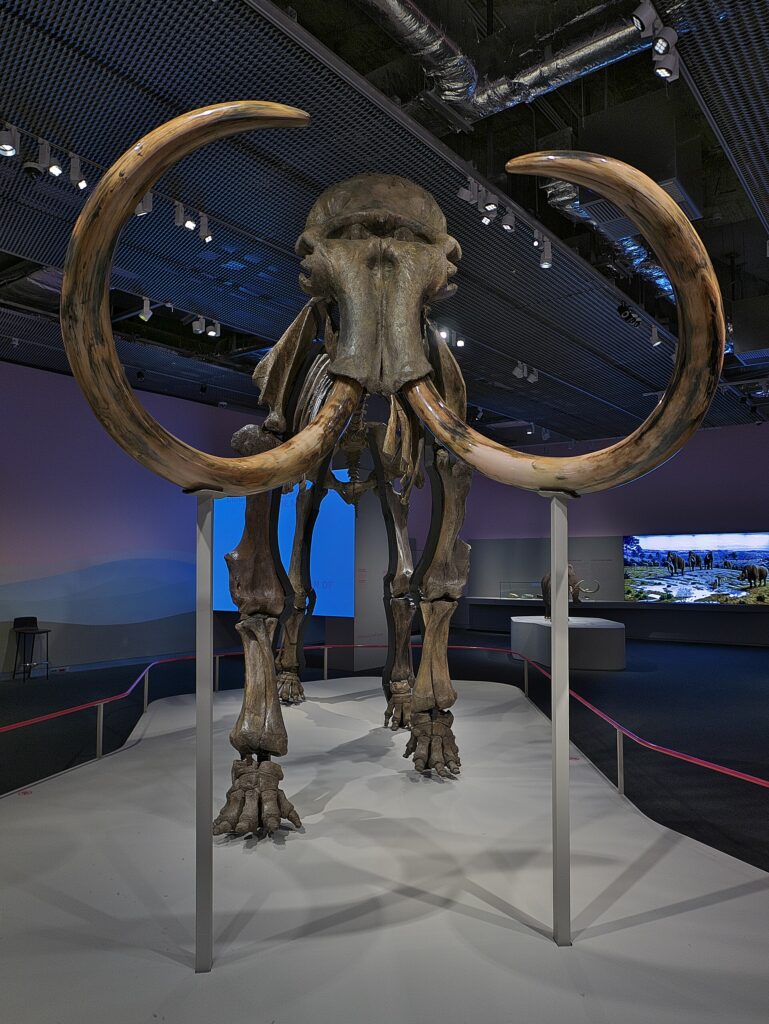
The woolly mammoth (Mammuthus primigenius) is an extinct elephant relative of the Ice Age mammoth steppe and the official state fossil of Alaska, designated in 1986. Males stood about 2.7 to 3.5 meters at the shoulder and weighed 3.9 to 8.2 tonnes. Mammoth bones, tusks and mummified remains are regularly found in the permafrost of Alaska and Yukon, including the 25,000-year-old calf “Effie,” found in 1948 [1][2].
| State fossil since | 1986 |
|---|---|
| Male shoulder height | 2.67–3.49 m |
| Male weight | 3.9–8.2 t |
| Longest known tusk | 4.05 m, 115.5 kg |
| Last population | Wrangel Island, about 4,000 years ago |
| Alaska calf “Effie” | About 25,000 years old (found 1948) |
Description
Males stood about 2.67 to 3.49 meters at the shoulder and weighed 3.9 to 8.2 tonnes, roughly the size of modern African elephants. Females stood 2.3 to 2.6 meters and weighed 2.8 to 4 tonnes, and a newborn calf weighed about 90 kilograms. The body was covered in fur, with outer guard hairs up to 90 centimeters long on the flanks and an under-layer up to 8 centimeters long, and a fat layer up to 10 centimeters thick lay under the skin. Small ears and a short tail reduced heat loss and frostbite risk [1].
Tusks
The long, strongly curved tusks grew 2.5 to 15 centimeters per year. The longest known male tusk is 4.05 meters and weighs 115.5 kilograms, while a typical male tusk is 2.4 to 2.7 meters and about 45 kilograms. Female tusks were 1.5 to 1.8 meters long [1].
Diet
Mammoths ate mainly forbs and grasses, with some sedges, shrubs and tree matter. A 2014 study of fossil dung estimated about 63 percent forbs and 27 percent grasses. An adult of about 6 tonnes needed roughly 180 kilograms of food a day and may have foraged up to 20 hours a day [1].
Range
They lived on the mammoth steppe across northern Eurasia and North America [1].
Extinction
Most mainland populations disappeared between 14,000 and 10,000 years ago. The last known population, on Wrangel Island, survived until about 4,000 years ago and numbered roughly 300 to 1,000 individuals that had lost much genetic diversity. The causes are debated, with hunting, climate change or both proposed [1].
Fossils in Alaska and the Yukon
The calf “Effie,” found in Alaska in 1948 and about 25,000 years old, preserves the head, trunk and a foreleg. In the Yukon, a complete female calf nicknamed “Nun cho ga,” found in the Klondike gold fields in 2022 and about 30,000 years old, is described as the best preserved woolly mammoth mummy found in North America [1].
State Fossil
Alaska designated the woolly mammoth its state fossil in 1986 [2]. See also the entry on the University of Alaska Fairbanks, whose museum holds many Ice Age fossils.
FAQs
What is the Alaska state fossil? The woolly mammoth, designated in 1986.
How big was a woolly mammoth? Males stood about 2.7 to 3.5 meters at the shoulder and weighed 3.9 to 8.2 tonnes.
When did woolly mammoths go extinct? Most mainland populations died out 14,000 to 10,000 years ago; the last, on Wrangel Island, about 4,000 years ago.
Where are mammoth fossils found in Alaska? In permafrost deposits; the calf “Effie,” found in 1948, is about 25,000 years old.
What did mammoths eat? Mostly forbs and grasses.
Sources
Key facts
Quick checkIn what year did Alaska name the woolly mammoth its state fossil?Show answer
1986
Sources
- Wikipedia. Woolly mammoth. 2026 (accessed 2026-11-12)
- Wikipedia. List of Alaska state symbols. 2026 (accessed 2026-11-12)
Editorially reviewed by Specialty Digest Editorial TeamLast reviewed November 12, 2026Researched and drafted with AI assistanceReport an issue