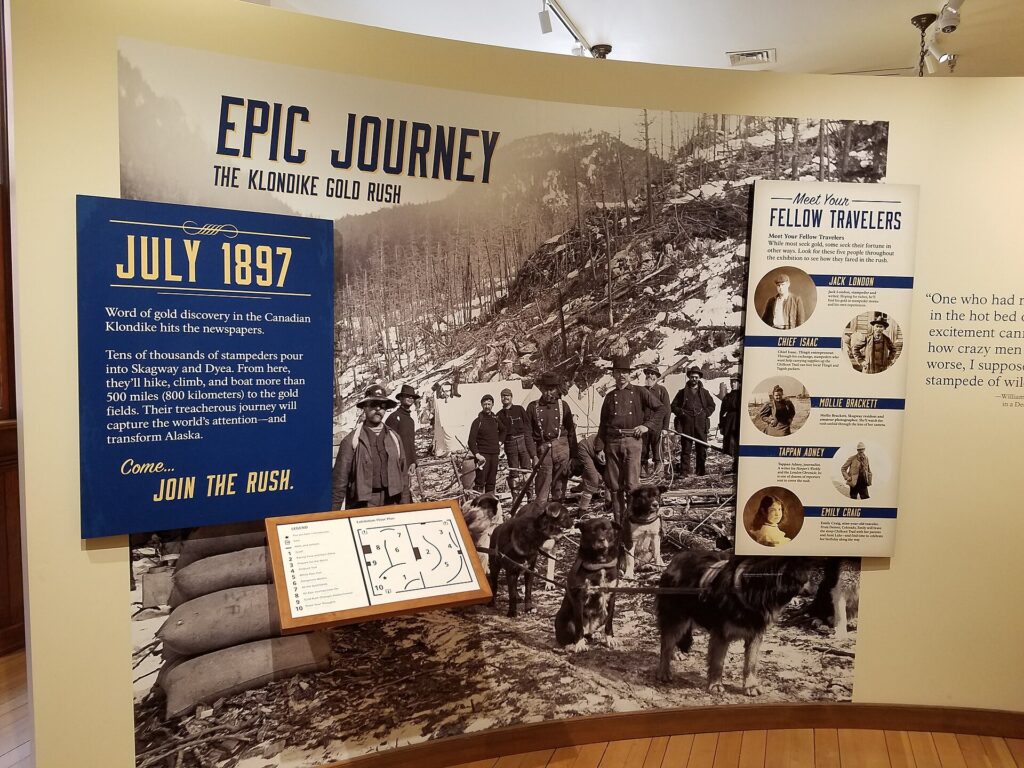
Klondike Gold Rush National Historical Park commemorates the 1897–1898 Klondike Gold Rush. Established on 30 June 1976, it has four units, three in Skagway, Alaska, and one in Seattle, Washington, and it recorded 1,489,935 visits in 2025.[1]
| Established | 30 June 1976 |
|---|---|
| Area | 12,996 acres |
| Units | Three in Skagway, one in Seattle |
| Visits (2025) | 1,489,935 |
| Chilkoot Trail | About 33 miles, Dyea to Bennett Lake |
| International park | Designated 5 Aug 1998 |
Purpose
The gold fields were in Yukon, Canada. The park preserves the staging areas and routes that led there. It was listed on the National Register of Historic Places on the day it was established, covering the Chilkoot Trail and Dyea Site, the Skagway Historic District and White Pass.[1]
Units
The Skagway units are the historic downtown, the White Pass Trail and the townsite of Dyea, where the Chilkoot Trail begins. The Seattle unit is in the Pioneer Square Historic District; its interpretive centre in the 1890 Cadillac Hotel was dedicated on 26 June 2006.[1]
Skagway buildings
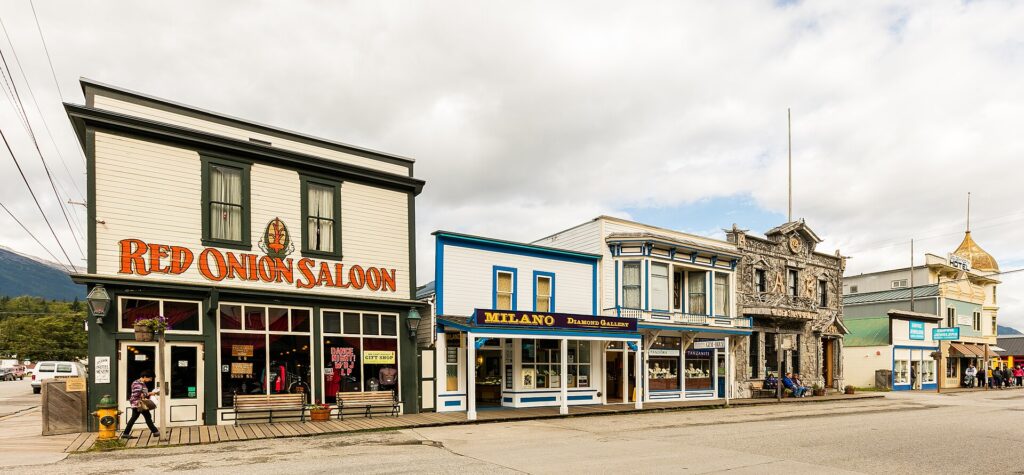
The visitor centre occupies the White Pass and Yukon Route depot, completed in December 1898 and restored by 1984. The Railway Administration Building, finished in 1900, houses the park museum. Restored buildings include the Mascot Saloon, the Pantheon Saloon, where the Junior Ranger programme is based, and Jeff Smith’s Parlor, linked to the con man Soapy Smith, which reopened in April 2016.[1]
Trails
The Chilkoot Trail runs about 33 miles from Dyea to Bennett Lake in British Columbia, from where prospectors generally rafted to Dawson City. A permit is required, and a trail centre in Skagway run by the National Park Service and Parks Canada gives current conditions. White Pass, the other main route, was served by the White Pass and Yukon Route railway, completed in 1900.[1]
International park
In 1969 the United States and Canada announced plans for an international park along the trail. The American park was established in 1976 and the Canadian side became Chilkoot Trail National Historic Site. On 5 August 1998, the gold rush centennial, they were jointly designated the Klondike Gold Rush International Historical Park, which also includes the Dawson Historical Complex.[1]
FAQs
Where is Klondike Gold Rush National Historical Park? In Skagway, Alaska, with a unit in Seattle, Washington.
How long is the Chilkoot Trail? About 33 miles, and a permit is required.
When was the park established? 30 June 1976.
How many visitors does it receive? 1,489,935 in 2025.
Sources
Key facts
- 12,996 acres
- 1,489,935 visits in 2025
Quick checkIn which year was the park established?Show answer
1976
Sources
- Wikipedia. Klondike Gold Rush National Historical Park. 2026 (accessed 2026-11-13)
Editorially reviewed by Specialty Digest Editorial TeamLast reviewed November 13, 2026Researched and drafted with AI assistanceReport an issue