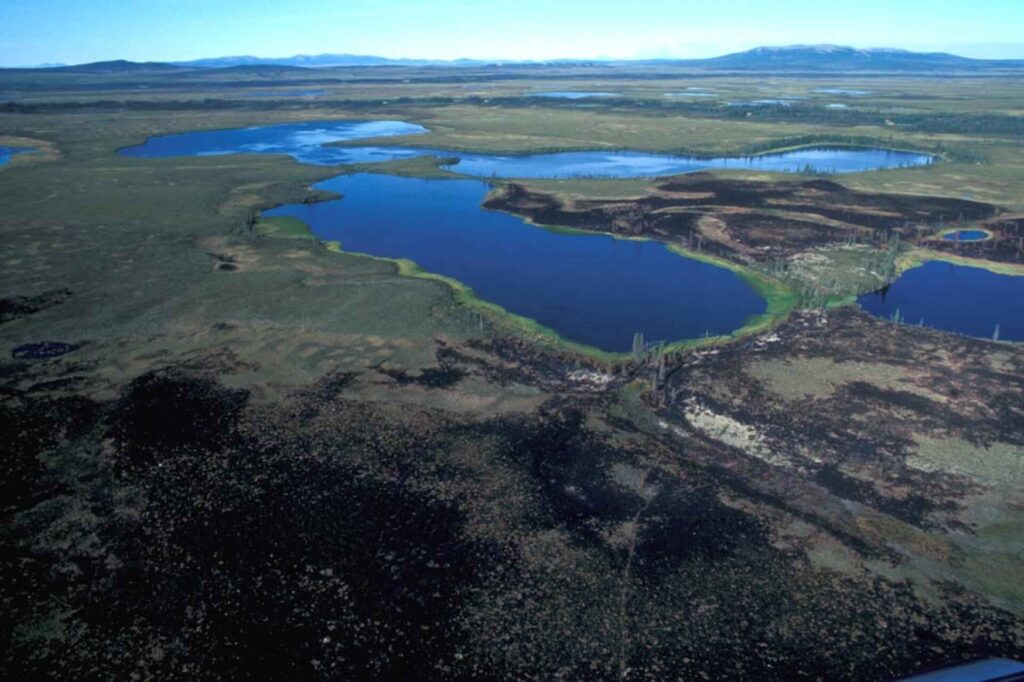
Selawik National Wildlife Refuge in northwest Alaska covers about 3,400 square miles on the Arctic Circle, east of Kotzebue Sound. It was established in 1980 by the Alaska National Interest Lands Conservation Act.[1]
| Area | About 3,400 sq mi |
|---|---|
| Established | 1980 |
| Wilderness | 240,000 acres |
| Offices | Kotzebue |
| Nearest city | Selawik |
| Lakes | About 21,000 |
Location and terrain
The refuge lies on the Arctic Circle and is bounded on the north by the Waring Mountains and Kobuk Valley National Park and on the south by the Selawik Hills and Purcell Mountains. It is a transition zone where the northernmost boreal forest gives way to Arctic tundra, with alpine and Arctic tundra, taiga, wetlands, river deltas, sedge meadows and glaciated valleys. Rolling vegetated sand dunes remain from a larger system that once included the Great Kobuk Sand Dunes.[1]
Rivers and lakes
The deltas of the Selawik and Kobuk Rivers lie on the eastern shores of Selawik Lake and Hotham Inlet. About 21,000 lakes dot the lowlands, forming a large Arctic tundra lake complex of freshwater and brackish waters, riparian areas and wet meadows.[1]
Wildlife
Mammals include caribou, muskox, moose, grizzly and black bears, wolves, wolverine, lynx, marten, river otter, beaver, porcupine and mink. The river deltas provide habitat for migratory birds such as snow geese, tundra swans and Canada geese.[1]
Wilderness
The Selawik Wilderness covers 240,000 acres in the northern part and has no trails or facilities, so access is difficult. The refuge is administered by the U.S. Fish and Wildlife Service from offices in Kotzebue.[1]
FAQs
How big is Selawik? About 3,400 square miles.
Where is it administered? Kotzebue.
When was it established? 1980.
How many lakes does it have? About 21,000.
Sources
Key facts
- About 3,400 sq mi
- About 21,000 lakes
Quick checkHow many acres is the Selawik Wilderness?Show answer
240,000
Sources
- Wikipedia. Selawik National Wildlife Refuge. 2026 (accessed 2026-11-12)
Editorially reviewed by Specialty Digest Editorial TeamLast reviewed November 12, 2026Researched and drafted with AI assistanceReport an issue