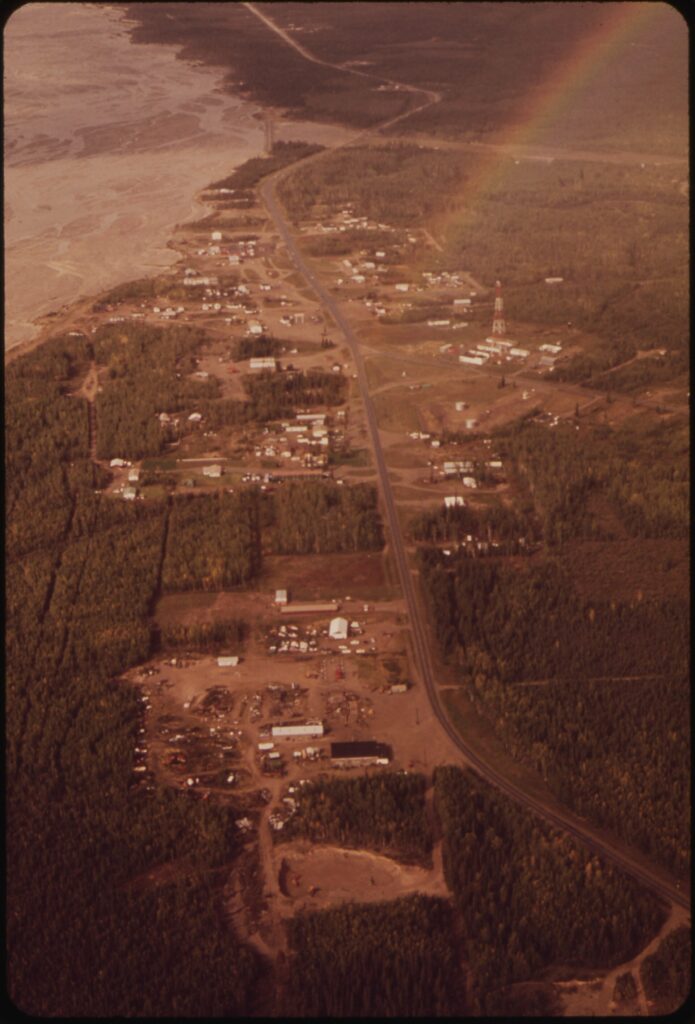
Delta Junction is a city about 99 miles south of Fairbanks where the Alaska Highway ends at mile 1422 and meets the Richardson Highway. It had 918 residents at the 2020 census.[1]
| Population (2020) | 918 |
|---|---|
| Alaska Highway end | Mile 1422 |
| Fort Greely | 5 miles south |
| Bison range | 90,000 acres |
Highways and Fort Greely
The Alaska Highway runs about 1,420 miles from Dawson Creek, British Columbia, to the city, where it meets the Richardson Highway on the Delta River. Fort Greely, a U.S. Army base about 5 miles south, trained soldiers for cold-weather combat during the Cold War and later hosted missile defense operations.[1]
Agriculture and bison
Farming in the Tanana Valley began with a 1980s effort called the Barley Project. Farms now produce hay and pasture, with limited barley, potatoes, carrots and wheat, and Alaska Range Dairy is the only dairy in Alaska. In 1928, 23 bison were brought from Montana, and the Delta Junction Bison Range, established in the early 1980s, covers 90,000 acres.[1]
Location
Delta Junction is a city about 99 miles south of Fairbanks, near where the Delta River meets the Tanana River, ringed by the White Mountains, Granite Mountains, and Alaska Range. The 2020 census counted 918 residents [2].
End of the Alaska Highway
The Alaska Highway, about 1,420 miles long and running from Dawson Creek, British Columbia, ends here where it meets the Richardson Highway. Its milepost marker is 1422, and the town motto is Crossroads of Alaska. The Richardson Highway was paved in 1957 and connects the town to Fairbanks [2].
History
Athabascan peoples have lived in the interior for at least 10,000 years. A telegraph station was established in 1904, and the Alaska Highway was built during World War II, along with nearby Allen Field for Lend-Lease supplies to the Soviet Union. Fort Greely trained soldiers for cold-weather warfare after the war. The city incorporated in 1960 [2].
Bison and agriculture
In 1928, 23 bison from Montana National Bison Range were brought to the area as a game species, and the 90,000-acre Delta Junction Bison Range was established in the early 1980s. A 1980s state-backed barley project failed when the planned rail link to Valdez was never built. Today farms grow hay and pasture, with limited barley, potatoes, carrots, and wheat [2].
Climate
The town has a subarctic climate. Winter lows typically reach minus 45 to minus 50 degrees F, and the official record low is minus 63 degrees F, set in 1947. Annual precipitation averages about 11.6 inches, with about 54 inches of snow [2].
FAQs
Where does the Alaska Highway end? At Delta Junction, mile 1422.
What is Fort Greely? A U.S. Army base south of the city.
What farms operate there? Hay, barley, dairy and bison.
Where does the Alaska Highway end? At Delta Junction, where it meets the Richardson Highway [2].
How many bison were brought to Delta Junction? 23 bison in 1928 [2].
Sources
Key facts
- 918 residents
- Fort Greely
- Bison range
In the news
Quick checkHighway end?Show answer
Mile 1422.
Sources
- Wikipedia. Delta Junction, Alaska. 2026 (accessed 2026-11-12)
- Wikipedia. Delta Junction, Alaska. 2026 (accessed 2026-11-14)
Editorially reviewed by Specialty Digest Editorial TeamLast reviewed November 12, 2026Researched and drafted with AI assistanceReport an issue