The Dolly Varden (Salvelinus malma) is a char, not a true trout, that lives in Alaska in both sea-run and freshwater forms. A northern form is mainly anadromous and a southern form may be stream-resident, lake-dwelling or anadromous.[1]
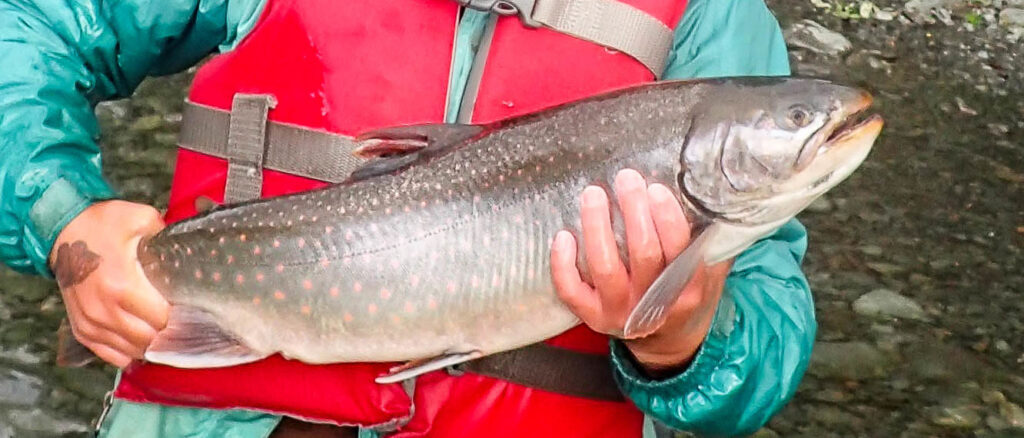
| Scientific name | Salvelinus malma |
|---|---|
| Southern form, typical | 12–16 in; ½–1 lb |
| Northern form, typical | 16–24 in; up to 9–12 lb |
| Spawning | September to November |
| Eggs hatch | March |
| Lifespan | Southern rarely over 8 years; northern up to 16 |
Description
Young fish have 8 to 10 wide, oval parr marks on an olive-brown body. Sea-run adults are silvery with an olive-green to brown back and red to orange spots on the sides. Spawning males turn bright red on the lower body and develop a hooked lower jaw, and as char they have light spots on dark sides, unlike trout and salmon, which usually have dark spots on light sides.[1]
Two forms and their range
The northern form lives on both sides of the Alaska Peninsula, along the coast to the Canadian border and in the Susitna River Basin, and is primarily anadromous, with most fish wintering in rivers. The southern form lives from the Aleutians to the southern tip of Southeast Alaska, including Kodiak Island and the south side of the Alaska Peninsula, and may be stream-resident, lake-dwelling or anadromous, with most wintering in lakes. The southern form matures at age 5 or 6 at typically 12 to 16 inches, while the northern form matures at age 5 to 9 at typically 16 to 24 inches.[1]
Diet
The Dolly Varden is not highly predatory and is not responsible for declines in salmon populations, despite a 1921 to 1939 bounty program based on that belief. Young fish feed mainly on the stream bottom, adults follow salmon runs to feed on salmon eggs, and in spring they feed on emigrating pink salmon fry.[1]
Spawning and survival
Spawning runs from September to November in small headwater streams. Females dig nests with their tails, eggs hatch in March, four to five months after fertilisation, and young rear in streams for two to four years, sometimes up to six, before migrating to sea as smolts of about five inches. Males have much higher post-spawning mortality than females, and fewer than half of fish likely spawn a second time.[1]
Sport fishery
The Dolly Varden is highly sought after throughout Alaska. Anglers fish lake outlets and stream mouths in spring, saltwater areas in summer where the fish follow salmon, coastal streams near spawning salmon from August to September and lakes through autumn, with ice fishing in winter.[1]
FAQs
Is a Dolly Varden a trout? No, it is a char.
How big do they get? Typically 12 to 24 inches depending on the form.
When do they spawn? September to November.
Sources
Key facts
- Spawns Sep–Nov
- Two forms
Quick checkIs the Dolly Varden a trout or a char?Show answer
A char
Sources
- Alaska Department of Fish and Game. Dolly Varden, Wildlife Notebook Series. 2026 (accessed 2026-11-14)
Editorially reviewed by Specialty Digest Editorial TeamLast reviewed November 14, 2026Researched and drafted with AI assistanceReport an issue