The wood frog (Lithobates sylvaticus) is the most widely distributed frog in Alaska and the only North American frog found north of the Arctic Circle. It survives winter by freezing, tolerating the freezing of about 65 to 70 percent of its body water.[1]
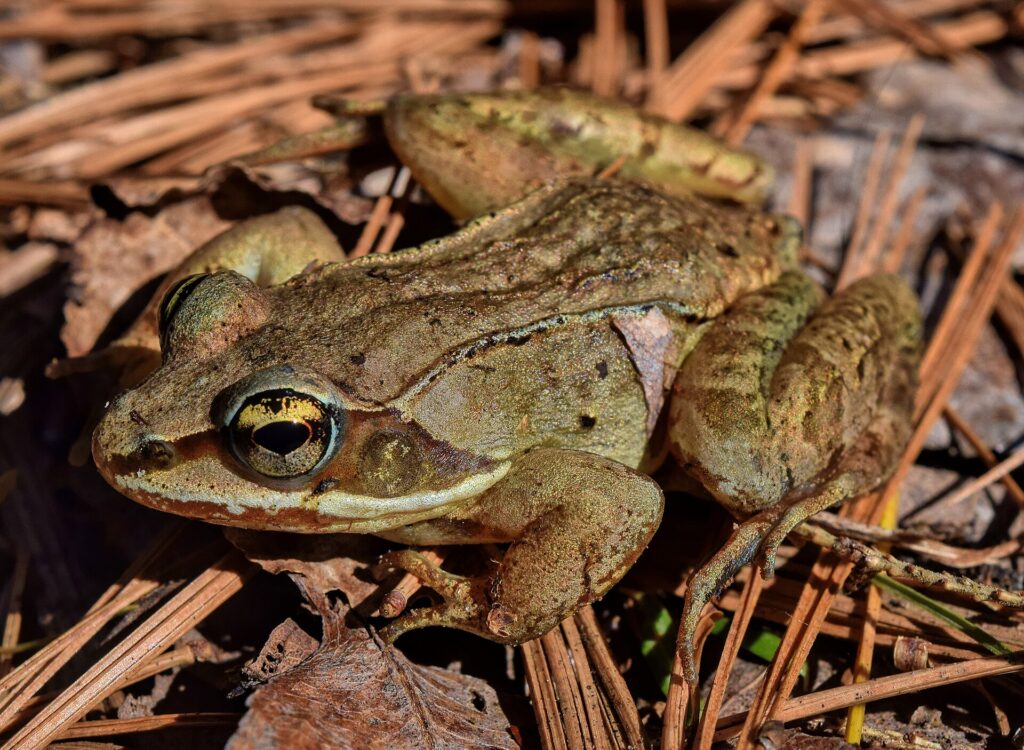
| Scientific name | Lithobates sylvaticus |
|---|---|
| Length | 51 to 70 mm (2.0 to 2.8 in) |
| Freeze tolerance | About 65 to 70% of body water |
| Hibernation freeze (study) | 193 ± 11 days |
| Breeding | Early spring after snowmelt |
| IUCN status | Least Concern |
Range and habitat
The contiguous range runs from northern Georgia and northeastern Canada west to southern British Columbia and Alaska, with an outlying population in the Medicine Bow National Forest of Wyoming and Colorado. It breeds mainly in temporary woodland pools, uses moist woodlands, forested swamps, ravines or bogs in summer, and overwinters on uplands, usually under leaf litter.[1]
Freeze tolerance
The frog converts liver glycogen to glucose in large quantities, and the glucose acts as a cryoprotectant, with urea also accumulating. Frogs in natural hibernation stayed frozen for 193 ± 11 consecutive days at an average temperature of −6.3°C from October to May. Interior Alaska frogs survive with part of their body water frozen and show greater tolerance than southern populations.[1]
Breeding and diet
Breeding is explosive and occurs in early spring right after snowmelt, with most mating in about a week in many populations. Males call from the pool with duck-like quacking sounds. Adults eat small forest-floor invertebrates, mainly insects, and tadpoles eat plant detritus, algae and other tadpoles.[1]
Conservation
It is listed as Least Concern by the IUCN. Urbanisation fragments populations in parts of its range, and dependence on small, isolated wetlands and road salt harming tadpole development are concerns.[1]
FAQs
How does the wood frog survive winter in Alaska? It freezes, tolerating about 65 to 70 percent of its body water turning to ice, protected by glucose.
Is it found north of the Arctic Circle? Yes, it is the only North American frog there.
What is its conservation status? Least Concern.
Sources
Key facts
- Only frog north of the Arctic Circle
- Least Concern
In the news
Quick checkHow much of its body water can the wood frog freeze?Show answer
About 65 to 70 percent
Sources
- Wikipedia. Wood frog. 2026 (accessed 2026-11-14)
Editorially reviewed by Specialty Digest Editorial TeamLast reviewed November 14, 2026Researched and drafted with AI assistanceReport an issue