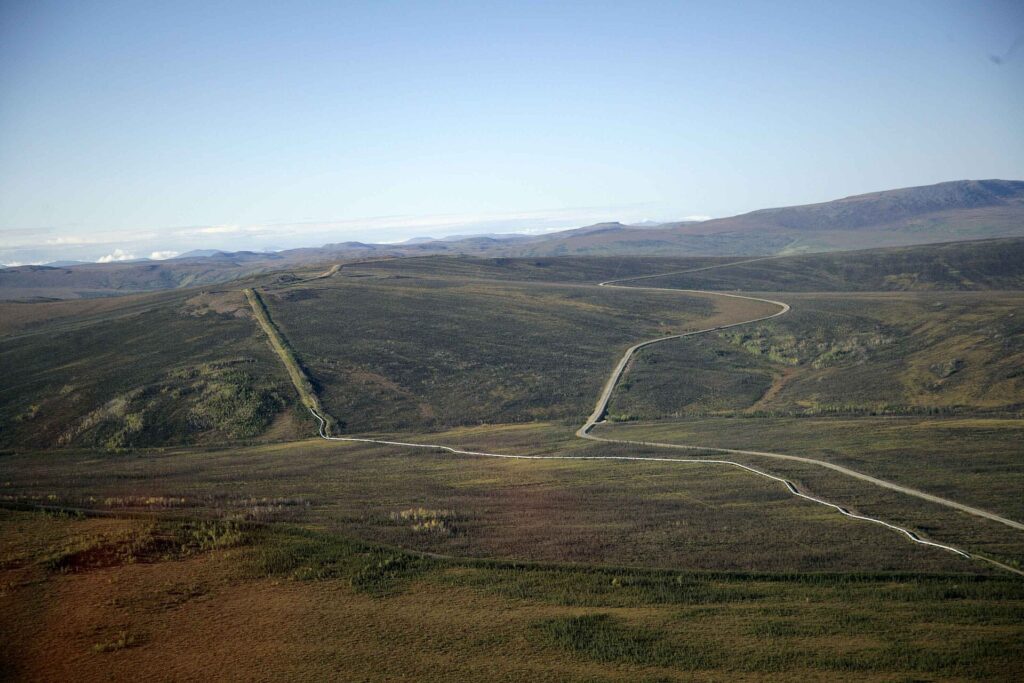
Interior Alaska is the central region of the state, roughly bounded by the Alaska Range to the south and the Brooks Range to the north. Largely wilderness, it has an estimated population of 113,154, with Fairbanks in the Tanana Valley as its largest city. The region has Alaska’s greatest temperature extremes, with a record high of 100 °F at Fort Yukon and a record low of −80 °F at Prospect Creek [1].
| Boundaries | Alaska Range to Brooks Range |
|---|---|
| Population | About 113,154 |
| Largest city | Fairbanks |
| Record high | 100 °F, Fort Yukon |
| Record low | −80 °F, Prospect Creek |
| Fairbanks precipitation | 11.3 inches a year |
Geography
Interior Alaska lies between the Alaska Range and the Brooks Range. Denali in the Alaska Range, the Wrangell Mountains and the Ray Mountains are among its mountains [1]. The Alaska Range runs about 600 miles and includes four major rivers crossing it, among them the Delta and Nenana [2]. Discontinuous permafrost underlies much of the Interior, becoming continuous toward the Arctic Circle [1].
Communities
Fairbanks is the largest city in the Interior and Alaska’s second-largest, in the Tanana Valley. Other towns include North Pole, Eagle, Tok, Glennallen, Delta Junction, Nenana, Anderson, Healy and Cantwell [1].
Peoples
Most of the Interior’s Native people are Alaskan Athabaskans, and more than 30 federally recognized tribes are grouped under the Council of Athabascan Tribal Governments, the Tanana Chiefs Conference and the Tanana Tribal Council. Large Yup’ik and Iñupiaq populations also live in Fairbanks [1]. See the entries on the Athabaskans and the Gwich’in.
Climate
Fairbanks winter temperatures average about −12 °F and summer temperatures about 62 °F, with records from −66 °F to 99 °F. Fairbanks averages 11.3 inches of precipitation per year, mostly snow, and about 64.6 inches of snowfall. The Alaska Range creates a rain shadow that limits moisture from Gulf of Alaska storms. Chinook winds can bring above-freezing warmth after cold snaps of 40 below zero [1].
Daylight and Aurora
Fairbanks gets about 21 hours of daylight from May 10 to August 2 and less than four hours from November 18 to January 24, and the aurora borealis is often visible on clear winter nights [1]. See the entries on the midnight sun and the Aurora Borealis in Alaska.
Wildfire
The 2004 fire season set a record, burning over 6,600,000 acres [1].
History
The Fairbanks Gold Rush of 1902 gave the Interior a mining economy, and Fairbanks later became the home of the University of Alaska Fairbanks; see the entries on the Fairbanks Gold Rush and the University of Alaska Fairbanks.
FAQs
Where is Interior Alaska? Between the Alaska Range and the Brooks Range.
What is the largest Interior city? Fairbanks.
How cold does it get? Prospect Creek recorded −80 °F, the state’s lowest temperature.
How hot does it get? Fort Yukon recorded 100 °F, the state’s highest.
Who lives in the Interior? Mostly Alaskan Athabaskans, plus a mixed population in Fairbanks.
Sources
More in Human Geography
Key facts
Quick checkWhich is the largest city in Interior Alaska?Show answer
Fairbanks
Sources
- Wikipedia. Interior Alaska. 2026 (accessed 2026-11-12)
- Wikipedia. Alaska Range. 2026 (accessed 2026-11-12)
Editorially reviewed by Specialty Digest Editorial TeamLast reviewed November 12, 2026Researched and drafted with AI assistanceReport an issue