Diabetes is often called a silent condition, and the description fits. Blood sugar can stay too high for years before a person feels unwell, while quiet damage builds in the body. World Diabetes Day, observed every year on November 14, exists to close the gap between what is happening in the body and what people know about it. It asks a simple question of every community: how many of your neighbors have diabetes, and how many of them know? Another health observance in this series, World Pneumonia Day, turns on the same idea, that reaching people early saves lives.
From a birthday to a United Nations day
The date honors a discovery. November 14 is the birthday of Sir Frederick Banting, who co-discovered insulin with Charles Best in 1922. Insulin is the hormone that people with type 1 diabetes must replace every day, so the day links a scientific milestone to the daily reality of living with the condition.
The International Diabetes Federation (IDF) and the World Health Organization (WHO) created World Diabetes Day in 1991. It became an official United Nations day in 2006 with the passage of United Nations Resolution 61/225. According to UN News, landmarks around the world lit up in blue to mark the first UN World Diabetes Day.
Governments have since turned awareness into policy. WHO launched its Global Diabetes Compact in April 2021. In May 2021 the World Health Assembly agreed a resolution on strengthening the prevention and control of diabetes, known as WHA 74.4, and in May 2022 it endorsed five global diabetes coverage targets to be reached by 2030.
What diabetes is, and its two main kinds
After a meal, the body breaks food down into glucose, a sugar that fuels every cell. Insulin, a hormone made in the pancreas, helps move glucose from the blood into cells. In diabetes, the body either makes too little insulin or cannot use it well, so glucose builds up in the blood. Over time, high blood glucose harms the heart, blood vessels and kidneys.
WHO describes type 1 diabetes as marked by deficient insulin production and a need for daily insulin. In 2025 around 9.5 million people lived with type 1, with more than 500,000 new cases diagnosed, and most of them in high-income countries. IDF estimates that 1.8 million children and young adults under 20 live with it. More than 95 percent of all people with diabetes have type 2.
The numbers behind the day
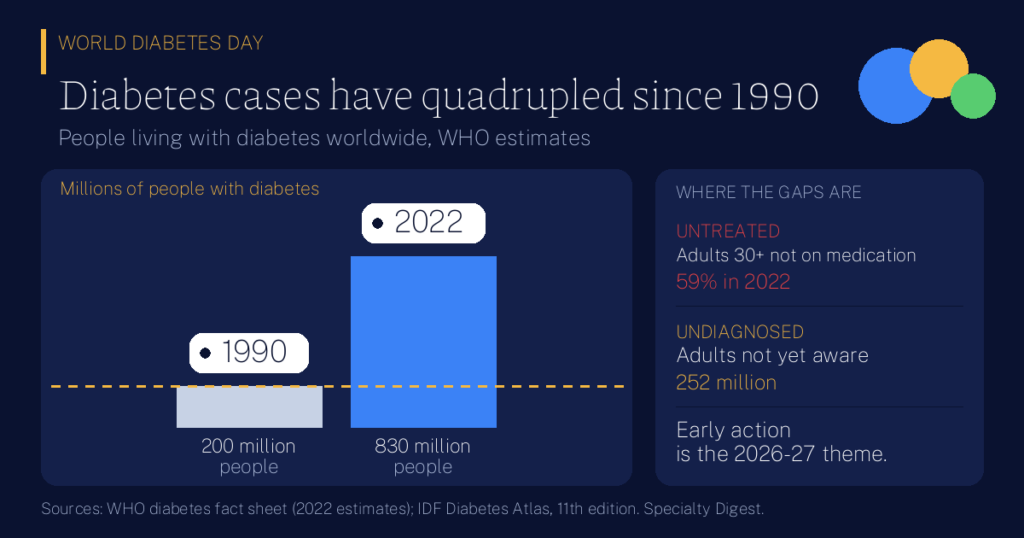
WHO reports that the number of people living with diabetes rose from 200 million in 1990 to 830 million in 2022, more than a fourfold increase. Among adults 18 and older, the share with diabetes doubled from 7 percent to 14 percent.
IDF counts adults aged 20 to 79 and reaches a different total. Its 11th Diabetes Atlas, released in April 2025, estimates 589 million adults living with diabetes and projects 853 million by 2050. Of today’s total, an estimated 252 million do not yet know they have it. The two sets of estimates use different age ranges and methods, so read them side by side rather than adding them together.
Money follows illness. IDF reports that global diabetes-related health spending passed one trillion US dollars in 2024 for the first time, up from $966 billion in 2021.
Why it matters: the cost of silence
WHO reports that diabetes was the direct cause of 2.0 million deaths in 2023, and 44 percent of all deaths due to diabetes occurred before the age of 70. Another 390,000 kidney disease deaths were caused by diabetes, so diabetes and the kidney disease it causes together accounted for around 2.4 million deaths. High blood glucose also causes around 10 percent of cardiovascular deaths. IDF, using its own methods, states that diabetes is responsible for over 3.4 million deaths annually.
- 2.0 milliondeaths directly caused by diabetes, 2023 (WHO)
- 44%of diabetes deaths came before age 70, 2023 (WHO)
- 252 millionadults not yet aware they have diabetes (IDF)
- $1 trillion+global diabetes health spending, 2024 (IDF)
Example 1: a screening day. Suppose a town has 8,000 adults. If IDF’s figure that 1 in 8 people worldwide is at high risk of type 2 diabetes held there, about 1,000 adults would deserve a closer look. Offering them a simple blood glucose test costs little next to years of untreated disease. The numbers are round and illustrative.
Who is left behind
The treatment gap is wide. WHO reports that 59 percent of adults aged 30 and over living with diabetes were not taking medication for it in 2022, and that treatment coverage was lowest in low- and middle-income countries. The diagnosis gap is wide too, with IDF noting that over 4 in 10 people with diabetes are not yet diagnosed. For people with type 1 diabetes, who depend on daily insulin, a gap in access is a danger, not an inconvenience.
Example 2: closing the treatment gap. Picture 100 adults over 30 with diabetes in a region that matches the 2022 global pattern. About 59 would not be on medication and 41 would be. If outreach brings 20 of the 59 into care, coverage rises from 41 to 61 out of 100. The numbers are round and illustrative.
Early action: the 2026-27 theme
IDF has opened a two-year theme, Early Action on Diabetes, with this year’s campaign. IDF notes that diabetes affects over half a billion people, that almost 1 in 2 remain undiagnosed and that 1 in 8 people worldwide are at high risk of developing type 2 diabetes. Early action means finding diabetes sooner and acting on risk before it becomes disease. WHO uses the day for guidance too: on November 14, 2025, it launched global guidelines on diabetes during pregnancy.
Example 3: finding the missing. Imagine a district with 1,000 people who have diabetes. At 4 in 10 undiagnosed, about 400 do not know. If outreach finds half of them, 200 more people can begin care sooner. The numbers are round and illustrative.
What can you do? Learn the common risk factors from your local health service, ask a clinician whether a glucose test is right for you, and share the day’s message with family and colleagues. Anyone with symptoms or health concerns should speak with a qualified health professional.
Key Takeaways
- Insulin gave the day its date. November 14 is Banting’s birthday, and he co-discovered insulin with Best in 1922.
- Cases have more than quadrupled. WHO counts 830 million people with diabetes in 2022, up from 200 million in 1990.
- Many people do not know. IDF estimates 252 million adults have diabetes without a diagnosis.
- Many are untreated. In 2022, 59 percent of adults aged 30 and over with diabetes were not taking medication.
- The toll comes early. Diabetes directly caused 2.0 million deaths in 2023, and 44 percent of diabetes deaths came before age 70.
- The bill keeps growing. Global diabetes-related health spending passed $1 trillion in 2024.
- Early action is the 2026-27 theme. Finding diabetes and acting on risk sooner gives people the best chance at a healthy life.
How solid is this? WHO figures come from 2022, 2023 and 2025 estimates, and IDF figures from its 11th Diabetes Atlas. They are modeled estimates that use different age ranges and methods, and they will be revised. The three worked examples use round, made-up numbers to show an idea. See also the International Days hub and the International Days Calendar.
More in Health
- World Health Organization, Diabetes fact sheet
- International Diabetes Federation, IDF Diabetes Atlas 11th edition (April 2025)
- World Diabetes Day, About WDD (IDF)
- International Diabetes Federation, World Diabetes Day 2026-27: Early action on diabetes
- UN News, Global landmarks light up in blue to mark first UN World Diabetes Day