Few human stories ask for more care and less curiosity than that of conjoined twins. They are rare, medically complex and, for much of history, widely misunderstood. World Conjoined Twins Day, observed every year on November 24, exists to replace myth and spectacle with accurate information, respect and practical support for the babies, the families and the clinicians who look after them. It is also a lesson in how rare conditions are counted: the numbers are small, the data are thin, and the United Nations itself says reliable information is lacking. Like World Children’s Day, it begins with a simple idea: every child counts, however uncommon their circumstances.
A new day with a clear mandate
This is one of the newest observances on the UN calendar. In 2024 the General Assembly adopted resolution A/RES/78/313 and decided to proclaim November 24 as World Conjoined Twins Day. The resolution emphasizes addressing the condition by raising awareness at all levels and through a life-course approach, meaning attention that follows a person from before birth through childhood and into adult life. It points to work with UN agencies and other stakeholders, to advocacy for well-being and social inclusion, and to following agreed international standards. No yearly theme is attached to the day, so the observance rests on the resolution itself rather than on a slogan.
What the term means
Conjoined twins are identical twins whose bodies remain joined at birth. Ordinary identical twins arise when one fertilized egg divides in the first days of development and each half grows into a separate baby. In conjoined twins the division comes late, about 13 to 15 days after conception according to the UN, and it is incomplete. A medical reference from the US National Institutes of Health gives a slightly wider window of 13 to 17 days and notes that the exact mechanism, whether a late split or a partial fusion, is still described as proposed rather than settled.
Equally important is what the evidence does not show. The UN notes that no association has been observed with maternal age, race, the number of earlier pregnancies or heredity, and that the chance of recurrence in a family is negligible. Nothing in the evidence points to anything a parent did or did not do.
The numbers behind the day
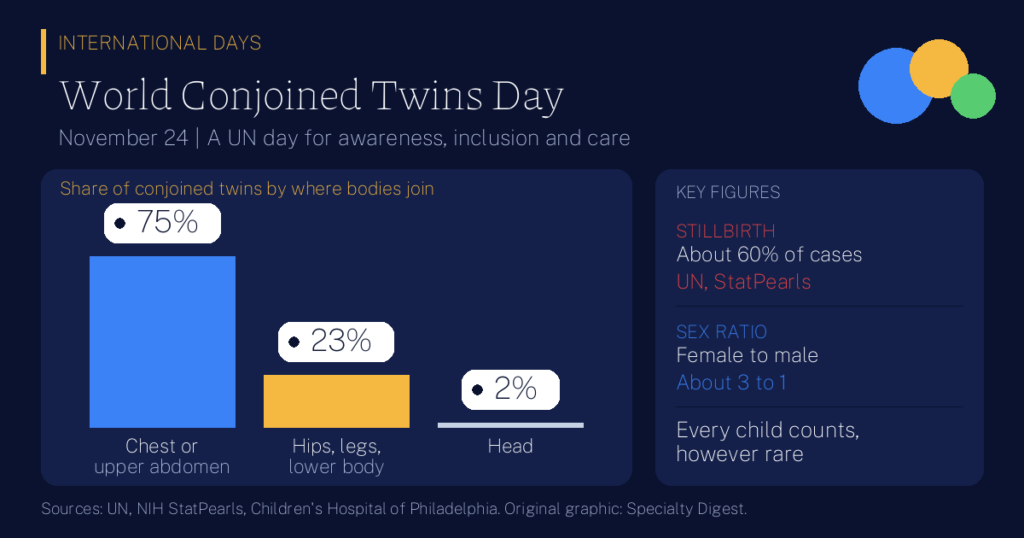
The condition is rare, and the exact rate depends on the source and on whether stillbirths are counted. The UN gives 1 in 50,000 to 100,000 live births. The NIH StatPearls review, updated in December 2025, gives 1 in 50,000 to 200,000 births, while Children’s Hospital of Philadelphia (CHOP) says about 1 in 50,000 to 60,000. The sources agree more on the pattern than on the rate: females outnumber males about three to one, and roughly 60 percent of cases end in stillbirth. CHOP reports that about 70 percent are female and that most are stillborn.
- 1 in 50,000the common starting point of quoted rates, or rarer
- 3 to 1female to male ratio (UN, StatPearls)
- About 60%of cases are stillborn (UN, StatPearls)
- 13 to 15 daysafter conception when the division occurs (UN)
Example 1: a rare event in a big city. Suppose a country has 2 million births a year and a rate of 1 in 100,000. That would mean about 20 cases a year, spread across thousands of hospitals. The figures are round and illustrative, but they show why most doctors will never meet a case and why specialized knowledge is thinly spread.
Why the point of joining matters
Doctors name the condition by where the bodies are joined, using the Greek ending pagus, meaning fixed. In one StatPearls breakdown, thoraco-omphalopagus (chest and abdomen) accounts for 28 percent, thoracopagus (chest) 18.5 percent, omphalopagus (abdomen) 10 percent and craniopagus (head) 6 percent, while about 10 percent are parasitic, where a smaller incomplete twin depends on the other. CHOP groups the same reality more simply.
That last line is the key. Shared surface can often be managed, but shared vital organs are the deciding factor. Both CHOP and StatPearls state that twins who share a single heart typically cannot be separated, and CHOP reports no known survivors where the hearts are joined at the pumping chambers. Shared liver, bowel or other organs call for detailed imaging and long planning.
Example 2: following 20 cases. Take 20 illustrative pairs. If about 60 percent are stillborn, 12 are lost before birth and 8 are born alive. If roughly 25 percent of live births live long enough to be candidates for surgery, that is about 2 pairs. If about 60 percent of separated twins survive, about 1 pair remains. These are round numbers, not a forecast, but they show how steeply each stage narrows the group.
Medicine, surgery and honest limits
History explains why a day like this is needed. The US National Library of Medicine traces the path in its title, “From Monsters to Medical Miracles,” a shift from fear and display toward treatment and dignity. Modern care is led by specialized children’s hospitals and large teams. CHOP, for instance, reports that it has separated 32 pairs since its first in 1957 and has evaluated 72 pairs before birth since 1995.
The honest picture has limits. StatPearls reports that historically only 5 to 25 percent of conjoined twins survived long term, that about 60 percent of surgically separated cases survive, and that complications can include organ failure, infection, bleeding and long stays in intensive care. Surgery is not always possible or wise, and the decision belongs to families working with experienced clinicians.
Respect, data and support
The UN resolution links awareness to well-being and social inclusion. For twins who live joined, or who are separated and grow up, that means treating each twin as an individual person with a name, a mind and a future, and using plain, respectful language rather than the vocabulary of spectacle. It also means better data. The UN observance page says that quality, timely and reliable data are lacking, and rare conditions are hard to study when each hospital sees so few cases.
Families facing a diagnosis, before or after birth, can ask their obstetrician or pediatrician for a referral to a children’s hospital with experience in this area, and rare-disease patient organizations can offer peer support. Readers can mark the day by sharing accurate facts, challenging stares and jokes, and supporting research and family services.
Example 3: reading the ratio. If 40 affected babies follow the reported three-to-one pattern, about 30 would be girls and 10 boys. The numbers are illustrative only, since small groups vary, but they show how a ratio translates into real children.
Key Takeaways
- It is a very new UN day. Resolution A/RES/78/313 set November 24 as World Conjoined Twins Day in 2024.
- The condition is rare. Quoted rates start at about 1 in 50,000 births, and sources differ on the exact figure.
- Timing is the cause that science describes. The division happens about 13 to 15 days after conception and is incomplete.
- No parental cause is known. The UN reports no link to age, race, parity or heredity, and negligible recurrence.
- Shared organs decide the options. Twins sharing a single heart typically cannot be separated.
- Outcomes are hard and uneven. About 60 percent of cases are stillborn and about 60 percent of separated twins survive.
- Dignity and data come first. Respectful language, inclusion and better data are what the day asks for.
How solid is this? Rates and percentages vary between the UN, StatPearls and CHOP, and the UN says reliable data are lacking, so treat every figure as an estimate. Classification percentages come from one review and may not sum to 100. The three worked examples use round, made-up numbers. See also World Children’s Day, the International Days hub and the International Days Calendar.
More in Health
- United Nations, World Conjoined Twins Day observance page
- UN General Assembly resolution A/RES/78/313, World Conjoined Twins Day (2024)
- Pal A, Montero FJ. Conjoined Twins. StatPearls, NIH NCBI Bookshelf (updated December 2025)
- Children’s Hospital of Philadelphia, Conjoined Twins (reviewed September 2026)
- US National Library of Medicine, From “Monsters” to Medical Miracles