Every March 20, the United Nations pauses to celebrate one of the most widely shared languages on Earth. French Language Day, also marked as the International Day of La Francophonie, is not only a salute to grammar and literature. It is a reminder that the UN does its work in six official languages, and that language decides who can take part in the conversation. French is spoken on all continents, and, as you will see, its center of gravity is shifting toward Africa.
How the day began
In 2010, the UN’s Department of Public Information launched “Language Days” to promote multilingualism across the organization. UN News reported the first French language day that March, with Kiyo Akasaka, then head of the department and the UN’s Coordinator for Multilingualism, describing French as a working language of the UN spoken on all continents. The same report noted that the March 20 date coincided with the 40th anniversary of the International Organization of La Francophonie.
Today the UN’s Department of Global Communications keeps one language day for each of the six official languages. The Secretary-General also issues a message for the day each year, including in 2026. The idea is simple: an organization with members from every region cannot speak with one voice, so it celebrates many.
What “francophone” means
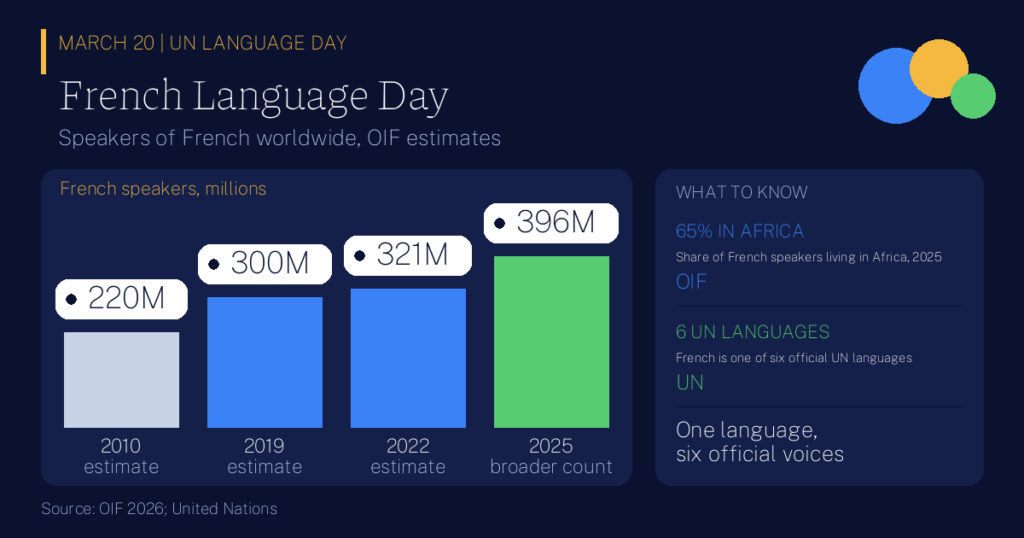
A francophone is a French speaker, and “La Francophonie” is also the name of a community of countries. The International Organization of La Francophonie (OIF) counted 93 member states and governments, including observers, until September 2025, and 56 countries with full member status. The OIF also publishes the best-known estimates of how many people speak French, and its numbers depend on method. Its 2026 report gives about 396 million francophones for 2025 under a broader method that counts children aged 6 to 9 learning French in the Global South. Under the earlier, narrower method, the 2025 figure is 348 million.
Example 1: why two counts can both be right. Imagine a town of 100,000 people where 40,000 use French daily and 10,000 more are young children now learning it at school. A narrow count says 40,000 speakers. A broader count says 50,000. The figures are round and illustrative, but they show why the OIF reports 348 million and 396 million for the same year without contradicting itself.
The numbers behind the day
The OIF’s estimates have climbed steadily: 220 million in 2010, 274 million in 2014, 300 million in 2019, 321 million in 2022 and 396 million in 2025. Some of that rise reflects the change in counting method, so the trend is best read as real growth plus a wider lens, not a pure jump. On this basis, the OIF’s 2026 report describes French as the fourth most spoken language in the world and the second most learned on five continents. Its 2022 edition ranked French fifth, with 321 million speakers.
- 396 millionFrench speakers, OIF estimate for 2025
- 65%of them in Africa, 2025
- 51 millionlearners of French as a foreign language, 2022
- 93 millionpupils schooled partly in French, 2022
A language whose future is African
The most striking fact about French today is geographic. The OIF reports that close to 65 percent of French speakers live in Africa. Its 2022 report found that most French speakers and most children schooled in French live on the African continent. Because Africa’s population is growing fast, the OIF’s reference scenario sees francophones reaching 557 million by 2070, while a weaker schooling scenario still reaches nearly 500 million. In the most optimistic scenarios, where school systems recover and expand, the total passes 700 million. The outcome depends largely on whether children across Africa get a good education in French, and in their home languages as well.
Example 2: reading the share. If 65 percent of 396 million speakers live in Africa, that is about 257 million people. The remaining 35 percent, roughly 139 million, live in Europe, the Americas, Asia and elsewhere. This is simple arithmetic on the OIF’s rounded figures, offered as an illustration, not as a new estimate.
Learning, school and the digital shelf
French is also a language people choose. In 2022, the OIF counted more than 50 million learners of French as a foreign language, making it the second most learned foreign language in the world, and more than 93 million pupils who had French among their languages of schooling. Beyond the classroom, the OIF’s 2022 report placed French fourth among languages used online, after English, Spanish and Arabic. The 2026 report notes that the share of French content on the internet remains low, which is why translation, publishing and open educational resources in French matter.
Six languages, one organization
The UN has six official languages: Arabic, Chinese, English, French, Russian and Spanish. Each has its own day, spread through the year. Arabic was approved as an official language by the General Assembly in 1973, and its day falls on December 18. French opens the sequence on March 20, as shown in the UN’s current listing.
Having six languages is not the same as using them equally. The OIF’s 2022 report stated that 98.7 percent of UN job offers required English, compared with 10.4 percent for French. That is the OIF’s own measurement, and it shows why a day devoted to multilingualism still has work to do.
Example 3: the cost of speaking six ways. Suppose a 10,000-word report must be available in all six official languages. Five translations are needed, so translators handle about 50,000 words on top of the original. The numbers are made up for illustration, but they show that multilingualism is a daily operating cost the UN accepts so that more people can read, vote and argue in a language they know.
How the day is marked
Around March 20, schools, cultural centers and embassies hold readings, film nights and language workshops, and the UN joins in with events and the Secretary-General’s message. You do not need an official event to take part. Read a short story in French, learn ten words, or notice which languages your own city uses. For a companion day on another language, see Arabic Language Day, or explore International Mother Language Day.
Key Takeaways
- The day is a UN idea. It began in 2010 as part of the UN’s Language Days, one for each official language.
- French is a UN official language. It sits beside Arabic, Chinese, English, Russian and Spanish.
- The numbers depend on method. The OIF gives 396 million speakers for 2025, or 348 million by its earlier count.
- The center of gravity is Africa. About 65 percent of French speakers live there, according to the OIF.
- Growth rests on schools. Projections for 2070 range from nearly 500 million to over 700 million, depending on education.
- Multilingualism is unfinished. English still dominates UN hiring, so equal language use remains a goal.
How solid is this? Speaker numbers are estimates from the OIF, they depend on counting method, and the 2025 projections rest on UN population data and scenarios, not certainty. The UN language-day dates come from the UN’s current listing, which differs from some 2010 announcements. The three worked examples use round, made-up numbers to show an idea. See the International Days hub and the International Days Calendar.
More in Education
- UN News, “First-ever French language day celebrated at UN” (2010)
- United Nations, Official Languages
- UN Secretary-General, message on the International Day of La Francophonie and French Language Day (2026)
- OIF, La langue française dans le monde, 2026 summary
- OIF, La langue française dans le monde, 2022 summary