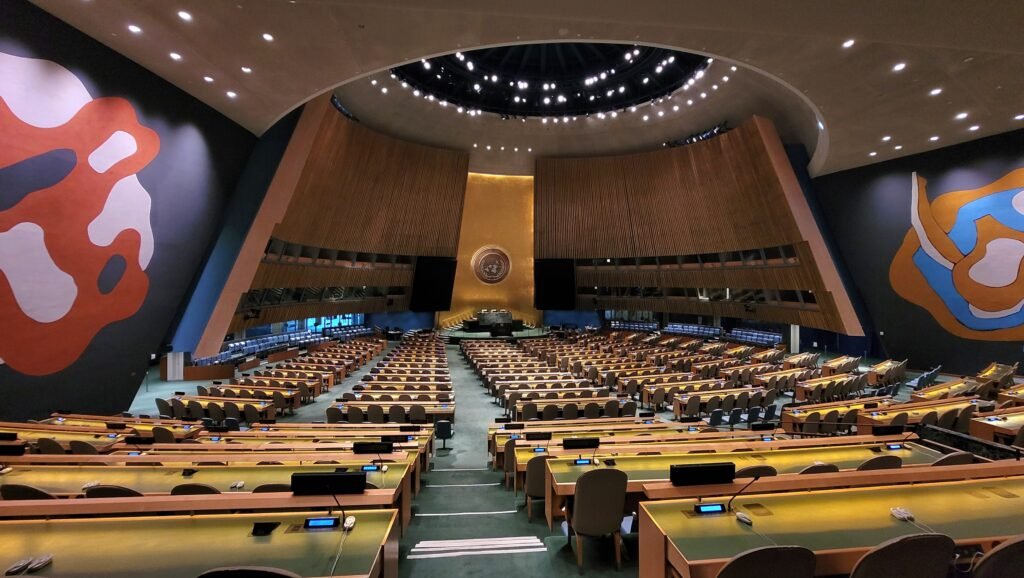
In simple terms
The General Assembly is the meeting of every country in the United Nations. All 193 member states sit in it, and each one has a single vote.
It was established in 1945 under the UN Charter as the organization chief deliberative, policymaking and representative organ.
How it works
The Assembly runs in yearly sessions. The main part sits from September to December, and a resumed part carries on from January to September as required.
Each September the session opens with the general debate, when states take the floor in turn to set out their views on the major issues of the year. That is the week that fills the news.
Voting weight does not follow population, wealth or military strength. One state, one vote. Important questions, which include recommendations on peace and security, elections to the Security Council and budgetary matters, need a two thirds majority. Other questions need a simple majority. In practice most resolutions are adopted without any vote at all, by consensus reached in informal negotiation first.
Because the agenda is long, items are handed to six main committees: disarmament and international security, economic and financial questions, social and humanitarian issues, special political and decolonization matters, administration and budget, and legal affairs.
The Charter sets limits too. Under Article 12, while the Security Council is dealing with a dispute, the Assembly does not make recommendations on it unless the Council asks.
Why it matters
The Assembly considers and approves the UN budget and sets what each member state pays, which is real leverage over what the organization can do.
It elects the non permanent members of the Security Council and, on the Council recommendation, appoints the Secretary General.
It is also the one place where a small state carries the same formal vote as a large one, so it records global opinion in a way no other body does.
Its resolutions are recommendations to states rather than binding orders, which is the point most often missed.
Where you will see it
- September news coverage of world leaders speaking in New York.
- Resolution numbers such as A/RES/70/1 cited in reports and treaties.
- The adoption of the Sustainable Development Goals in 2015.
- Recorded votes listed as in favor, against and abstaining.
Example
In September 2015 the Assembly agreed a set of 17 Sustainable Development Goals in resolution 70/1, a document negotiated among all member states rather than imposed by a few.
Often confused with
The Security Council is a smaller body whose decisions bind states and whose permanent members hold a veto. The General Assembly includes every member, and its resolutions are recommendations.
Key facts
- Established in 1945 under the UN Charter, the General Assembly is the chief deliberative, policymaking and representative organ of the United Nations.1
- It comprises all 193 UN member states, and each member has one vote.1
- Important questions, such as peace and security, Security Council elections and budgetary questions, require a two thirds majority; other questions are decided by a simple majority.1
- The majority of resolutions are adopted without a vote, by consensus, following informal consultations among member states.1
- Under Article 9 of the Charter, each member may have no more than five representatives in the General Assembly.2
- Because of the number of agenda items, work is allocated among six main committees, from disarmament and international security to legal matters.3
Related concepts
In the news
Quick checkHow many votes does each UN member state have in the General Assembly?Show answer
One. Voting weight does not depend on population, wealth or military power, though important questions need a two thirds majority to pass.
Sources
- United Nations. Functions and powers of the General Assembly. Undated (accessed 27 September 2026)
- United Nations. Charter of the United Nations, Chapter IV: The General Assembly (Articles 9 to 22). Undated (accessed 27 September 2026)
- George Washington University Law Library. United Nations Research: General Assembly. Undated (accessed 27 September 2026)
Editorially reviewed by Specialty Digest Editorial TeamLast reviewed September 27, 2026Researched and drafted with AI assistanceReport an issue