A poem can be spoken in under a minute, yet it can hold a lullaby, a protest, a prayer or the last words of a fading language. That is why the world sets aside a day for it. World Poetry Day, observed every year on March 21, honors poets and the oldest of the literary arts. It also carries a practical purpose that surprises many readers: keeping the world’s languages alive, especially the ones that few people still speak.
March 21 is a busy date on the international calendar. It also hosts the International Day of Forests and the International Day of Nowruz, and the poetry observance fits naturally beside them, since all three celebrate how people relate to nature, renewal and shared heritage.
A day born in Paris
UNESCO first adopted March 21 as World Poetry Day during its 30th General Conference in Paris in 1999. The decision is recorded in the resolutions of that conference, which met from October 26 to November 17, 1999. The stated aim was to support linguistic diversity through poetic expression and to increase the opportunity for endangered languages to be heard.
Notice what that aim does not say. It does not only ask people to admire famous poems. It links poetry to the survival of languages, because poems are among the first things a community creates in its own tongue and among the last things it forgets. Songs, chants, riddles and verses are how many cultures hold history in memory, especially where little is written down.
What the day asks of us
UNESCO describes five practical goals for the day. They are modest and easy to act on, which is part of their strength. Anyone with a voice or a bookshelf can take part.
The second aim, reviving oral traditions, deserves attention. Long before printing, poetry was a spoken art, performed and passed from person to person. Today recitals, open microphones and spoken word nights keep that habit alive, and they let people hear poems in languages that rarely reach a bookstore.
Example 1: a classroom recital. Imagine a class of 30 pupils in which 10 speak another language at home. The teacher invites each child to bring a short verse, rhyme or lullaby from home and say it aloud, then explain it in the school language. The numbers are round and illustrative. The result is that a third of the class sees its home language treated as a source of beauty, not a problem to be fixed.
Why poetry and languages travel together
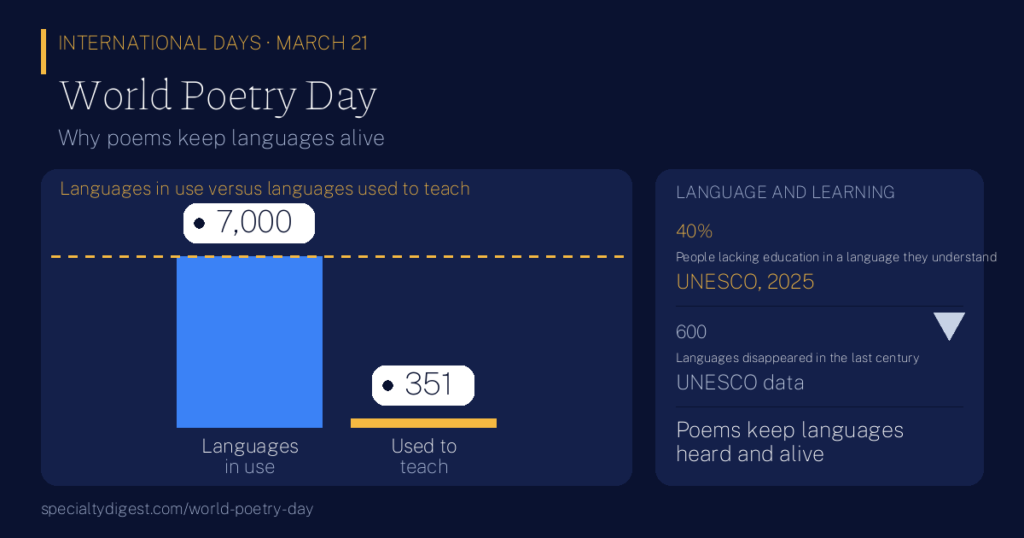
To see why UNESCO ties poetry to languages, look at the scale of the world’s linguistic wealth. According to UNESCO’s World Atlas of Languages, there are 7,000 languages, spoken or signed, in use today. Only 351 of them are used as a medium of instruction. The UN’s own observance page for International Mother Language Day gives a wider count of about 8,324 languages ever spoken or signed, with around 7,000 still in use, which shows that exact totals depend on how languages are counted.
Do the arithmetic and the gap is plain: 351 out of 7,000 is about 5 percent. Most of the world’s languages live in homes, markets, songs and verses, not in textbooks. Poetry is one of the ways they are heard in public at all.
Languages at risk
UNESCO data indicates that around 600 languages have disappeared in the last century. UNESCO has also stated that if current trends continue, up to 90 percent of the world’s languages may become extinct by the end of this century, and its 2025 coverage states that one language disappears every two weeks. These are projections and estimates, not counts of events that have already happened, so they are best read as a warning about direction.
When a language goes quiet, its poems go with it. A proverb, a charm for the harvest or a naming song can be impossible to translate fully, because it relies on sounds and shades of meaning that exist in one tongue only.
Example 2: a village of 200. Suppose a community has 200 speakers of a small language, but only 20 of them are under 30. If those 20 move away and none of their children learn the language, the community is a generation from silence. Add a yearly poetry night where elders recite and young people record and translate, and the language gains a reason to be used. The figures are round and illustrative.
Learning in a language you understand
The same issue appears in classrooms. UNESCO reports that 40 percent of people globally lack access to education in the language they speak and understand fluently. In some low- and middle-income countries, that figure rises to 90 percent, and more than a quarter of a billion learners are affected.
This is where poetry earns its place in the argument. A child who meets verse in the home language learns early that her language can hold beauty, memory and argument. UNESCO’s 2024 reading of its own data links multilingual education to quality and inclusive learning, and it points to the International Decade of Indigenous Languages, 2022 to 2032, as the global frame for action.
Poetry, identity and peace
Speaking on World Poetry Day in 2018, then UNESCO Director-General Audrey Azoulay said that to cultivate art and the mind is also to cultivate peace. UN News reported that the day recognizes poetry as one of humanity’s most treasured forms of cultural and linguistic expression and identity, and it draws attention to poetic traditions that are in danger of disappearing. The same message named living poetic forms recognized by UNESCO as intangible heritage, including Ca tru from Viet Nam, Al’azi from the United Arab Emirates, Baul songs from Bangladesh and Gelede from Togo, Benin and Nigeria.
She also noted that the poetry of Langston Hughes is inseparable from his commitment to civil rights, a reminder that verse often carries a community’s claim to be heard. In 2026, the day was marked again with a message from UNESCO Director-General Khaled El-Enany dated March 21, 2026.
How to mark it
You do not need a stage. Read a poem aloud to someone, ask a grandparent for a verse from their childhood, or look up a poem from a language you cannot read and read the translation beside the original. Libraries, schools and cultural centers often host recitals, and many people simply share a favorite line with a friend.
Example 3: a library evening. Say a town library plans 10 poems, each read in the original and then in translation, in 5 languages, at about 3 minutes per poem. That is roughly 30 minutes of programming that gives 5 language communities a place on the same stage. The numbers are round and illustrative, but the lesson is real: translation turns a recital into an exchange.
Key Takeaways
- The day is about languages as well as poems. UNESCO adopted it in 1999 to support linguistic diversity and give endangered languages a chance to be heard.
- The date is fixed. World Poetry Day falls on March 21 every year.
- Most languages are not taught. Of about 7,000 languages in use, only 351 are used as a medium of instruction.
- Loss is a live risk. Around 600 languages have disappeared in the last century, and UNESCO warns that up to 90 percent could go by 2100 if trends continue.
- Learning language matters. About 40 percent of people lack education in a language they understand fluently, per UNESCO in 2025.
- Poetry builds peace. UNESCO leaders have framed verse as a bridge across differences and a path to dialogue.
- You can take part today. Recite, translate or share one poem from a language other than your own.
How solid is this? The language counts come from UNESCO’s World Atlas of Languages as cited in 2024 and 2025 UNESCO coverage, and sources differ on the total number of languages depending on how they are counted. The 90 percent extinction figure is a projection that depends on current trends, and the “every two weeks” rate is an estimate. The three worked examples use round, made-up numbers to show an idea. See also the International Days hub and the International Days Calendar.
More in Education
- UNESCO, World Poetry Day
- UN News, “To cultivate art and mind is also to cultivate peace, UNESCO chief says on World Poetry Day” (March 21, 2018)
- UNESCO, Multilingual education: A key to quality and inclusive learning (2024)
- UNESCO, New UNESCO report calls for multilingual education to unlock learning and inclusion (February 2025)
- United Nations, International Mother Language Day