Most children learn to run, jump and climb stairs without anyone noticing how much muscle work those skills demand. For boys with Duchenne muscular dystrophy, they slowly fade, because the muscles lack a protein that protects them from the wear of everyday movement. Duchenne is rare, yet it is the best known muscular dystrophy of childhood, it reaches nearly every muscle in the body, and it has no cure today. World Duchenne Awareness Day, observed every year on September 7, asks the world to understand it, to diagnose it sooner and to stand with the families who live with it. Like World Diabetes Day, it is a reminder that a long-term condition is lived by a whole family, not only by one patient.
From a kitchen table to the General Assembly
The condition is named for the French physician Guillaume Duchenne de Boulogne, who described it in detail in the 1860s. The day is much younger. According to World Duchenne, it began as an idea at a kitchen table in Amsterdam about a decade before 2023, with founders Elizabeth Vroom and Nicoletta Madia, and grew into an annual awareness effort led by families and patient groups.
In November 2023, the UN General Assembly adopted resolution A/RES/78/12 by consensus. It designated September 7 as World Duchenne Awareness Day, to be observed every year beginning in 2024. Kuwait tabled the resolution, and World Duchenne reports that it drew 128 co-sponsors, the most for a resolution tabled by a single country in that session at the time. The same group calls it the UN’s first formal acknowledgment of a day devoted to a rare disease. The resolution encourages stakeholders to raise awareness of the needs of individuals and families in the rare diseases community through national campaigns, educational programs and the sharing of information, with the aim of greater understanding, empathy and global solidarity.
What Duchenne actually is
Healthy muscle fibers are stretched and squeezed every time we move, and a protein called dystrophin acts as a kind of shock absorber that helps keep them intact. In Duchenne, the gene carrying the instructions for dystrophin is faulty, so the protein is missing or does not work. Without it, fibers are damaged by ordinary use and are gradually replaced by scar tissue and fat.
The gene is called DMD. According to a StatPearls review updated in 2024, it sits at position Xp21 on the X chromosome and is the largest gene in the human genome, with 79 exons. Because it lies on the X chromosome, the UN notes that mainly males are affected. The same review reports that about a third of cases arise from a spontaneous new mutation, while about two thirds are passed on through maternal X-linked transmission. That is why many families have never heard of Duchenne before a diagnosis, and why it can appear in a family with no earlier history.
Example 1: how inheritance works. Suppose a mother carries the faulty gene on one of her two X chromosomes. Each son she has then has a 1 in 2 chance of inheriting it and being affected, and each daughter has a 1 in 2 chance of being a carrier. Out of four children, the round, illustrative expectation is two who inherit the gene. Real families vary, and genetic counseling gives a precise picture for each one.
The numbers behind the day
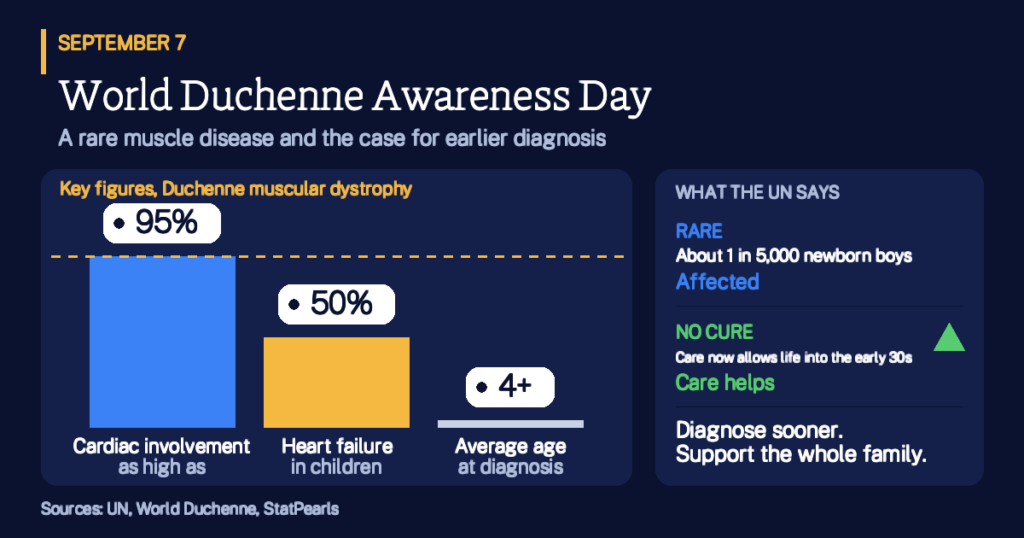
The UN observance page states that one in 5,000 newborn boys in the world is affected by Duchenne. StatPearls gives a slightly wider range, about 1 in 3,500 to 1 in 5,000 male births. Both describe a rare condition, but a rare condition still means a steady stream of children in every country.
Early signs usually appear between ages 3 and 5, such as slow motor development, according to StatPearls. Yet the UN notes that in most countries the average age at diagnosis is above 4 years, with a diagnostic delay of around 2.5 years. Every month of delay is a month in which a family cannot plan and a child cannot be monitored.
- 1 in 5,000newborn boys affected, per the UN observance page
- Above 4average age at diagnosis in most countries
- 2.5 yearstypical diagnostic delay cited by the UN
- 128co-sponsors of the 2023 resolution, per World Duchenne
Example 2: the cost of delay. Imagine a boy whose parents first notice frequent falls at age 4. If diagnosis takes the 2.5 years the UN cites, he is diagnosed at about 6.5. In those two and a half years the family has no diagnosis to guide choices about school, activity or monitoring. The ages are round and illustrative, but they show why reaching parents and doctors is one of the day’s most practical goals.
Example 3: rare, but not few. Suppose a country has 100,000 boys born in a year. At the UN’s figure of 1 in 5,000, that is about 20 boys, and at StatPearls’ wider 1 in 3,500 it is about 29. These numbers are made up for illustration, yet they show why even a small country needs trained clinics, since each year’s new patients join those already growing up.
Why the heart and lungs matter
Duchenne is not only a condition of the legs. The heart is also a muscle, and StatPearls reports that cardiac involvement in Duchenne is as high as 95 percent, with chronic heart failure possible in about half of children. Breathing muscles weaken too, which is why a care team reviews the heart and lungs over time, not only mobility.
International care guidelines in The Lancet Neurology show how broad the task is. Part one, published in 2010, covers diagnosis and pharmacological and psychosocial management, and part two of the 2018 update covers respiratory, cardiac, bone health and orthopedic management. In practice that means many specialists and the family working as one team.
Living longer, living fully
The UN observance page says that with current standards of care, people with Duchenne can live into their early 30s, and that there is no cure. Older descriptions are shorter: the StatPearls review says most people with Duchenne survive into their late teens or early 20s. Figures differ by source and period, so treat any single number as a snapshot, not a verdict. Milestones such as using a wheelchair by about age 12 are also averages. Adult life with Duchenne is now a real subject, and it was the theme of the day in 2021.
Families at the center
The 2025 theme, Family: the heart of care, highlights the role of relatives not just in caregiving but in shaping quality of life and emotional well-being, according to World Duchenne. Parents are advocates, siblings are companions, grandparents and others a steadying presence, and family can include friends and the wider community. The resolution itself speaks of greater understanding, empathy and global solidarity with the rare diseases community.
- 2021Adult Life and Duchenne
- 2023Duchenne: Breaking Barriers
- 2025Family: the heart of care
If a young child falls often, is slow to walk or struggles to get up from the floor, a conversation with a pediatrician is the right first step. Families already living with Duchenne can find information and support through patient organizations such as World Duchenne and Parent Project Muscular Dystrophy.
Key Takeaways
- The cause is one missing protein. Without dystrophin, muscle fibers are damaged by ordinary use and slowly lost.
- It is rare, not tiny. About 1 in 5,000 newborn boys is affected, according to the UN.
- Delay is a hidden problem. Diagnosis averages above age 4 in most countries, about 2.5 years after first signs.
- It reaches the heart. Cardiac involvement is reported as high as 95 percent, so regular heart care matters.
- Care has changed the picture. The UN says people can now live into their early 30s, though there is no cure.
- The day is recent and unanimous. A/RES/78/12 was adopted by consensus in 2023 and first observed in 2024.
- Family is part of the treatment. Support for parents, siblings and friends shapes quality of life.
How solid is this? Incidence and survival figures vary by study, country and era, and the sources cited here do not always agree, so ranges are shown where they differ. The StatPearls figures are a 2024 review and some may reflect older studies. Dates, resolution details and themes come from the UN and World Duchenne pages. The three worked examples use round, made-up numbers to show an idea. This article is general information, not medical advice. See also the International Days hub and the International Days Calendar.
More in Health
- United Nations: World Duchenne Awareness Day
- World Duchenne: United Nations officially designates September 7 as World Duchenne Awareness Day
- World Duchenne: The 2025 theme is Family: the heart of care
- StatPearls (NCBI Bookshelf): Muscular Dystrophy, updated February 2024
- The Lancet Neurology: Diagnosis and management of Duchenne muscular dystrophy, part 1 (2010)
- The Lancet Neurology: Diagnosis and management of Duchenne muscular dystrophy, part 2 (2018)