Every suicide is a personal loss before it is a statistic, and that is why this subject needs care as well as facts. World Suicide Prevention Day, observed each year on September 10, exists because suicide is preventable and because silence and stigma keep people from reaching help. It asks the public to do something simple and hard at the same time: to talk about suicide openly, kindly and accurately. This article gives the history, the best available numbers and the actions that evidence supports. If you are struggling, the section near the end lists where to find help.
From a Stockholm meeting to a global day
The day was established in 2003 by the International Association for Suicide Prevention, working in partnership with the World Health Organization. The first World Suicide Prevention Day took place in Stockholm on September 10, 2003. In 2004 WHO agreed again to co-sponsor it, and it became an annual event. Unlike many observances in this series, it did not begin with a General Assembly resolution. It grew out of a professional association and a health agency choosing to act together.
IASP reports that in recent years the day has been observed in more than 60 countries, with hundreds of events, and that its film Step Closer was viewed over 30 million times. A well-known custom is the Light a Candle campaign: on September 10 people are invited to light a candle near a window at 8 p.m. to show support for suicide prevention, to remember a lost loved one and to stand with survivors of suicide.
Why the theme is about words
For 2024 to 2026 the theme is “Changing the Narrative on Suicide,” with the call to action “Start the Conversation.” WHO notes that 2026 is the third and final year of this triennial theme. The idea is that the stories a society tells shape whether a person in distress feels able to speak. Narratives that treat suicide as shameful, as a moral failure or as unavoidable push people into silence. Narratives that treat it as a preventable public health problem, with real routes to help, make it easier to ask a friend how they are and to answer honestly.
The numbers behind the day
WHO’s global estimates put suicide deaths at about 727,000 in 2021. WHO’s current fact sheet describes the toll as more than 740,000 people a year and says suicide is a leading cause of death among young people. For 2021, WHO reported that it was the third leading cause of death among people aged 15 to 29, ranking second for females and third for males. These are modeled estimates, because only about 80 WHO Member States have vital registration data of high enough quality to calculate suicide rates directly.
- 727,000estimated suicide deaths worldwide in 2021
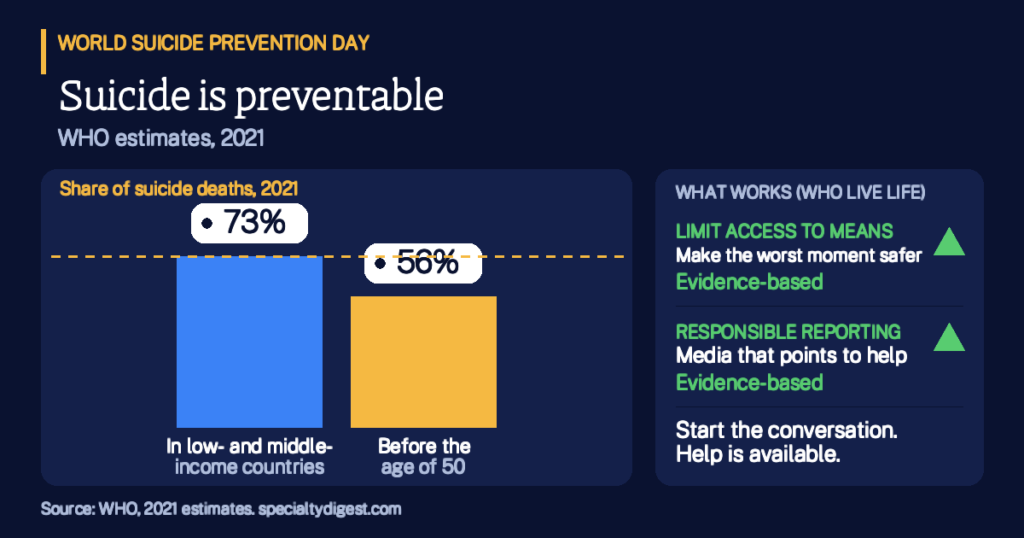
- 73%of suicides occurred in low- and middle-income countries, 2021
- 56%of suicides happened before age 50, 2021
- 60+countries observe the day, according to IASP
These figures carry a plain message. Suicide is not mainly a problem of a few places, and it is not mainly a problem of old age. It touches families in every region and takes many people in the middle of their working lives. For every death, WHO notes, many more people attempt suicide, and each loss reaches relatives, friends, classmates and coworkers.
Why it is preventable
The link between suicide and mental disorders, especially depression and alcohol use disorders, and a previous attempt is well established in high-income countries. But WHO also stresses that many suicides happen impulsively, in a moment of crisis, and that triggers can include financial problems, relationship breakdowns, or chronic pain and illness. That matters, because a crisis often passes. A person who gets through the worst hours or days, with time, support and distance from the means of harm, frequently goes on to live a long life.
Example 1: time and distance. Imagine a district where 40 out of every 100 suicides involve one dangerous item that is easy to reach. The numbers are round and illustrative. If safer storage makes that item harder to get, some people in crisis will not have it within reach during the worst moment, and the moment can pass. This is the logic behind restricting access to means, one of WHO’s recommended interventions.
What works: the LIVE LIFE approach
In 2021 WHO launched LIVE LIFE, an approach for countries. WHO lists four key interventions that are effective and evidence-based. They need to go hand in hand with foundations such as situation analysis, collaboration across sectors, awareness raising, capacity building, financing, and monitoring and evaluation.
The media item shows why the day’s theme is about narrative. Responsible reporting avoids sensational headlines and detailed descriptions of methods, and it points readers to help. Guidance of this kind is a core part of WHO’s approach, and it applies to families and social media posts as much as to newsrooms.
Example 2: a school. Suppose a school of 1,000 students trains teachers to notice and respond to warning signs, and teaches all students skills for handling stress and asking for help. If 20 students are in serious distress in a given year, a school that knows how to listen and refer each one gives all 20 a better chance of reaching support. The numbers are illustrative, but the principle matches WHO’s call to foster life skills in adolescents and to identify and follow up people at risk.
Who is affected and who is left behind
Because 73 percent of suicides occurred in low- and middle-income countries in 2021, the places with the fewest mental health services carry the largest share of the burden. Data gaps are part of the problem: when deaths are not recorded well, needs are not seen. WHO reports that 38 countries have a national suicide prevention strategy. Reducing the global suicide mortality rate by a third by 2030 is a target in both the UN Sustainable Development Goals and WHO’s Comprehensive Mental Health Action Plan, and the rate is the only mental health indicator in the SDGs.
Example 3: a workplace. Picture a company of 200 people where managers learn to ask “Are you thinking about suicide?” calmly and to connect people with professional help. If even a handful of employees each year feel able to speak up sooner, the company has changed its narrative in practice. The numbers are made up for illustration. Asking directly, with care, does not plant the idea; it opens the door to help.
How the day is marked, and where to find help
People mark the day with candles in windows, community walks, school and workplace conversations, and local events organized by crisis centers and health agencies. You can take part simply by checking in on someone, listening without judgment and sharing accurate information. If you or someone near you may be in danger, contact local emergency services right away. In the United States you can call or text 988, the Suicide and Crisis Lifeline. The directory at findahelpline.com lists free, confidential support lines by country, and IASP maintains a list of crisis centers worldwide. Reaching out is a sign of strength, and help is available.
Key Takeaways
- The day began in 2003. IASP and WHO launched it in Stockholm, and it became annual after WHO co-sponsored it in 2004.
- Suicide is a major public health issue. WHO estimates 727,000 deaths in 2021, and 73 percent occurred in low- and middle-income countries.
- It is preventable. Many suicides occur in moments of crisis that can pass with time, support and safety.
- Four interventions have strong evidence. Limit access to means, report responsibly, build life skills in adolescents, and follow up people at risk.
- The theme is about words. “Changing the Narrative on Suicide” and “Start the Conversation” run through 2026.
- Asking is a gift. A calm, caring question can open the way to help.
- Help exists. Call local emergency services, call or text 988 in the United States, or find a line at findahelpline.com.
How solid is this? Global totals are modeled WHO estimates for 2021 and are revised as new data arrive; WHO’s current fact sheet cites a slightly higher yearly figure. Percentages are from the same 2021 report. The three worked examples use round, made-up numbers to illustrate an idea. If you want to read more, see the International Days hub and the International Days Calendar.
More in Health