Most people picture growth as a straight line: the same amount added each year. Money that earns compound interest does not behave that way. Each year the interest joins the balance, so the next interest payment is larger. Economists call the habit of ignoring this exponential growth bias. Research suggests it is common, costly and hard to correct.
How far off is a straight-line guess?
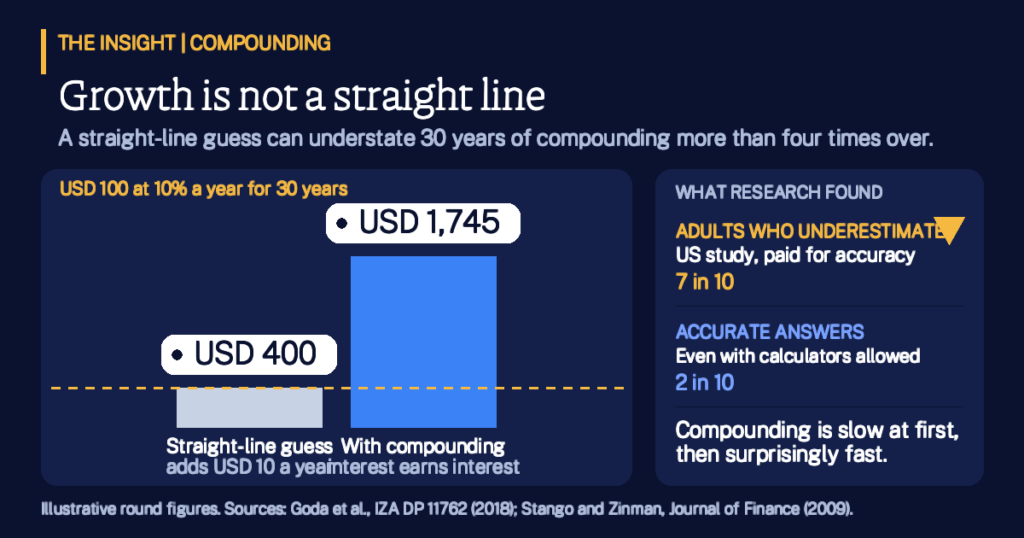
Take USD 100 earning 10 percent a year. A straight-line guess adds USD 10 each year and reaches USD 400 after 30 years. Compounding, where interest earns interest, gives about USD 1,745. The guess is not slightly wrong: it is less than a quarter of the true figure.
Example 1: the five-year trap. After five years the gap looks harmless: USD 150 by the straight-line guess, about USD 161 in truth. Short horizons hide the error. For the mechanics, see what compound interest is.
The difficulty is global. The S&P Global Financial Literacy Survey interviewed more than 150,000 adults in over 140 economies in 2014 and asked a version of Example 1. Only one in three adults passed its test of three correct answers out of four topics, one of them compound interest. National results ranged from 13 percent in Yemen to 71 percent in Denmark, Norway and Sweden.
How common is exponential growth bias?
A United States study of 2,315 adults, led by Gopi Shah Goda, paid people for accurate answers to five compound-interest questions and let them use any tools they wished. Only 20 percent answered accurately. About 32 percent reasoned as if growth were a straight line, 39 percent fell in between, and 9 percent overestimated. So about seven in ten adults underestimated compounding, even with money at stake and calculators allowed. Matthew Levy and Joshua Tasoff found a similar pattern in another experiment, and a simple chart of growth did not change it.
Why does it matter?
Victor Stango and Jonathan Zinman reported in the Journal of Finance in 2009 that more-biased households borrow more and save less, after adjusting for household characteristics. Goda and colleagues found that a one standard deviation difference in accuracy went with about USD 20,000, or 11 percent, of retirement savings at age 65, after controlling for financial literacy and cognitive ability. These are associations, not proof of cause. Prices compound too, which is why a slower inflation rate is not a lower price level.
Example 2: debt that compounds. Suppose USD 1,000 is borrowed at an interest rate of 20 percent a year, and unpaid interest is added to the balance, as with some credit cards. A straight-line guess says USD 3,000 is owed after ten years. Compounding gives about USD 6,192. The same bias that understates savings can understate debt.
Example 3: a shortcut that corrects the instinct. Divide 72 by the yearly rate in percent to estimate how long money takes to double. At 3 percent that is about 24 years, at 6 percent about 12, and at 9 percent about 8. It is a rule of thumb; exact values are 23.4, 11.9 and 8.0 years.
How solid is this? Well-supported: independent studies, two in peer-reviewed journals, find the bias in representative United States samples. Limits: most evidence comes from one country, the IZA paper is a discussion paper, links with savings are associations, and rates, products and rules vary by country. The examples use round, illustrative figures.
Key Takeaways
- Distrust straight-line guesses. Over long periods the true figure can be several times larger.
- Use a tool for long horizons. In one study, people who used online calculators were more accurate, though skill may explain part of that.
- Remember that debt compounds too. Judge borrowing by its total cost over time, not only by its yearly rate.
- Give time credit. The same rate does far more in 30 years than in five.
- Check local rules. Rates, products and public understanding of compounding vary widely between countries.
More in Business
- Goda, G. S., Levy, M., Manchester, C. F., Sojourner, A., and Tasoff, J. “Predicting Retirement Savings Using Survey Measures of Exponential-Growth Bias and Present Bias.” IZA Discussion Paper No. 11762, August 2018.
- Klapper, L., Lusardi, A., and van Oudheusden, P. “Financial Literacy Around the World: Insights from the Standard & Poor’s Ratings Services Global Financial Literacy Survey.” World Bank Development Research Group and GFLEC, 2015.
- Levy, M. R., and Tasoff, J. “Exponential-Growth Bias and Lifecycle Consumption.” Journal of the European Economic Association 14(3), 2016. Author preprint.
- Stango, V., and Zinman, J. “Exponential Growth Bias and Household Finance.” The Journal of Finance 64(6), 2009, pp. 2807-2849.