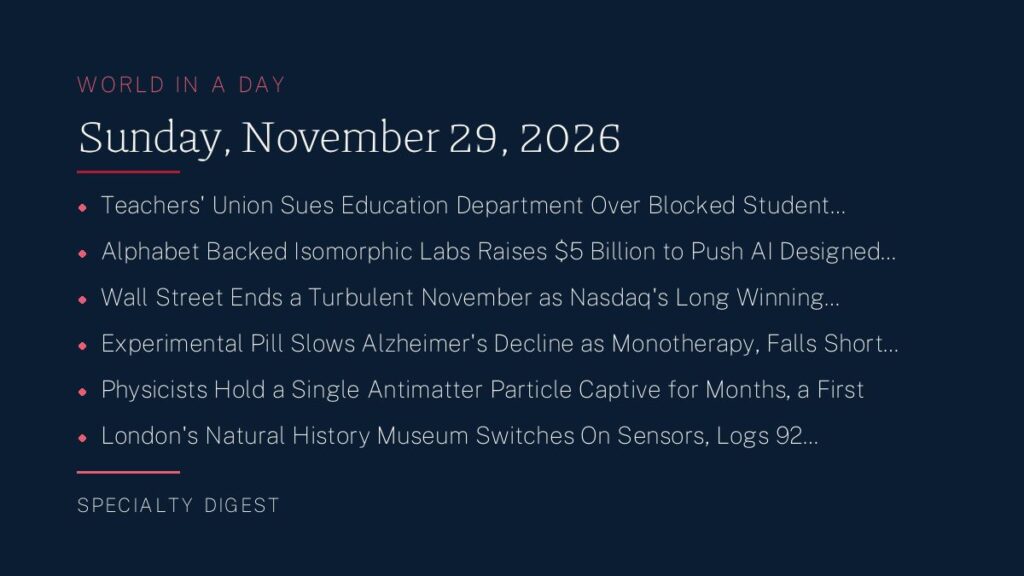
WORLD IN A DAY · SUNDAY, NOVEMBER 29, 2026
Billions of dollars moved toward unproven science this week, from a $5 billion bet on AI designed drugs to a single trapped particle built to test one of physics’ oldest puzzles.
Teachers’ Union Sues Education Department Over Blocked Student Loan Plans
The American Federation of Teachers sued the U.S. Department of Education this month, arguing the agency unlawfully removed online applications for income driven repayment plans and is blocking student loan borrowers, including public school teachers, from enrolling in affordable federal loan payments. The union says members have lost access to repayment options tied to Public Service Loan Forgiveness and that some now face default risk while the applications stay offline. The Department has defended changes to federal loan servicing as part of a broader overhaul of federal student aid. The case, AFT v. U.S. Department of Education, joins several pending legal challenges over how the administration manages student loans.
Why it matters A win for the union would force the government to restore income driven repayment access for millions of borrowers immediately; a loss would hand the Department wide discretion to redesign loan servicing without new legislation from Congress.
Source: AFT
Alphabet Backed Isomorphic Labs Raises $5 Billion to Push AI Designed Drugs Into Trials
Isomorphic Labs, the Alphabet owned drug discovery company led by Demis Hassabis and Colin Murdoch, said November 17 it had raised a $5 billion Series C led by Sequoia Capital and Greenoaks, more than double the $2.1 billion round it closed only six months earlier. The company, which spun out of DeepMind using its AlphaFold protein structure models, says the new funding will carry its first AI designed drug candidates, including an oncology program, through human clinical trials. The raise ranks among the largest private funding rounds ever closed by a company based in the United Kingdom.
Why it matters Doubling a funding round in months shows investors are now pricing AI drug discovery as a near term business rather than a decade away experiment, which raises the cost of any early clinical disappointment.
Source: Fierce Biotech
Wall Street Ends a Turbulent November as Nasdaq’s Long Winning Streak Breaks
U.S. stocks closed out November with a late month rally, but the month still broke the Nasdaq Composite’s multi month winning streak after repeated bouts of selling tied to AI spending concerns and shifting expectations for the Federal Reserve’s December rate decision. The S&P 500 and the Dow both gained in the final sessions of the month, recovering part of the ground lost during several sharply lower trading days earlier in November. Traders pointed to megacap technology stocks tied to AI spending as the biggest swing factor in an otherwise choppy month for the broader market.
Why it matters A broken streak is not a crash, but it shows how much of the market’s recent gains rest on a small group of AI linked stocks, leaving major indexes exposed to any stumble in that trade.
Source: Yahoo Finance
Experimental Pill Slows Alzheimer’s Decline as Monotherapy, Falls Short Overall
AriBio’s oral drug AR1001 met its main goal among Phase 3 POLARIS AD trial patients who took it alone, slowing cognitive decline compared with placebo, the company reported. The trial’s larger combined population, which included patients also taking approved Alzheimer’s medications, did not reach statistical significance, leaving the overall result mixed. Fosun Pharma, which licenses the drug in parts of Asia, is now weighing whether to seek regulatory approval based on the monotherapy subgroup alone. Unlike the infused antibody drugs currently approved for early Alzheimer’s, AR1001 is taken as a daily pill.
Why it matters A pill that works as well as an infusion would be a major access improvement for Alzheimer’s patients, but regulators have historically been cautious about approving drugs on subgroup results alone, so AriBio will have to make that case explicitly.
Source: Fierce Pharma
Physicists Hold a Single Antimatter Particle Captive for Months, a First
Northwestern University physicists trapped a single positron, the antimatter counterpart of the electron, inside a quantum cyclotron and kept it isolated for months, long enough to measure its quantum properties one particle at a time. Earlier antimatter experiments typically held only clouds of particles, and only for seconds or minutes, before they escaped or annihilated. The extended confinement lets researchers test whether antimatter obeys the same physical laws as ordinary matter with far greater precision than before. So far, the particle’s behavior matches what the Standard Model predicts, the researchers said.
Why it matters Physics still cannot explain why the universe is made almost entirely of matter rather than equal parts matter and antimatter, and a confirmed difference in how antimatter behaves, however small, would point toward an answer.
Source: Chicago Sun-Times
London’s Natural History Museum Switches On Sensors, Logs 92 Species in New Gardens
The Natural History Museum in London has switched on a network of environmental sensors and AI assisted monitoring tools, built with Amazon Web Services, across its redesigned gardens as part of its Urban Nature Project. Automated audio recorders, cameras and soil sensors have already logged 92 species of insects, birds, bats and fungi without requiring constant manual surveys by staff. Researchers say the continuous data will let them measure whether specific habitat changes, such as new ponds and wildflower meadows, are actually improving urban biodiversity rather than simply assuming that they do.
Why it matters Cities are increasingly betting on small urban greening projects to slow biodiversity loss, and this is one of the few that will have its results measured continuously rather than assumed, giving other cities a template for proving what actually works.
Source: Natural History Museum
More in Business