Most people can name the fear before they can name the disease. It is the fear of forgetting: a familiar face, a street, one’s own story. World Alzheimer’s Day, observed every year on September 21, turns that private fear into a public conversation. It is not a United Nations day. It was created by a federation of patient and family associations, and it anchors a full month of awareness each September. The day asks the world to understand dementia, to stop treating it as a normal and shameful part of aging, and to support the people who live with it and the families who carry much of the load.
From a conference hall to a global month
Alzheimer’s Disease International (ADI) was founded in 1984 and has grown from 4 members to a worldwide federation of over 100 Alzheimer associations. On September 21, 1994, at the opening of ADI’s annual conference in Edinburgh, the federation marked the first World Alzheimer’s Day to celebrate its tenth anniversary. ADI’s president at the time, Princess Yasmin Aga Khan, and a World Health Organization representative were present.
One day was not enough for member associations that wanted to run longer programs. World Alzheimer’s Month was launched in 2012 so that associations could extend their awareness work beyond a single date. ADI says the day remains the focal point of the month, when most global activity takes place. ADI’s own pages differ on the exact pilot year of the month, so this article uses 2012, the year both its FAQ and its history timeline give.
Alzheimer’s disease and dementia are not the same thing
The words are often used as if they mean one thing. They do not. Dementia is the broad term for a group of conditions that damage the brain and erode memory, thinking and the ability to manage daily life. Alzheimer’s disease is the most common form, and WHO says it may account for 60 to 70 percent of cases. Other forms exist, and young-onset dementia, which begins before age 65, accounts for up to 9 percent of cases.
This matters because the day’s numbers are usually counted for dementia as a whole, and this article does the same. When a figure below says dementia, it covers Alzheimer’s disease and every other cause together. Dementia is also not an inevitable result of growing old. It is a disease process, and WHO describes it as one of the major causes of disability and dependency among older people worldwide.
The numbers behind the day
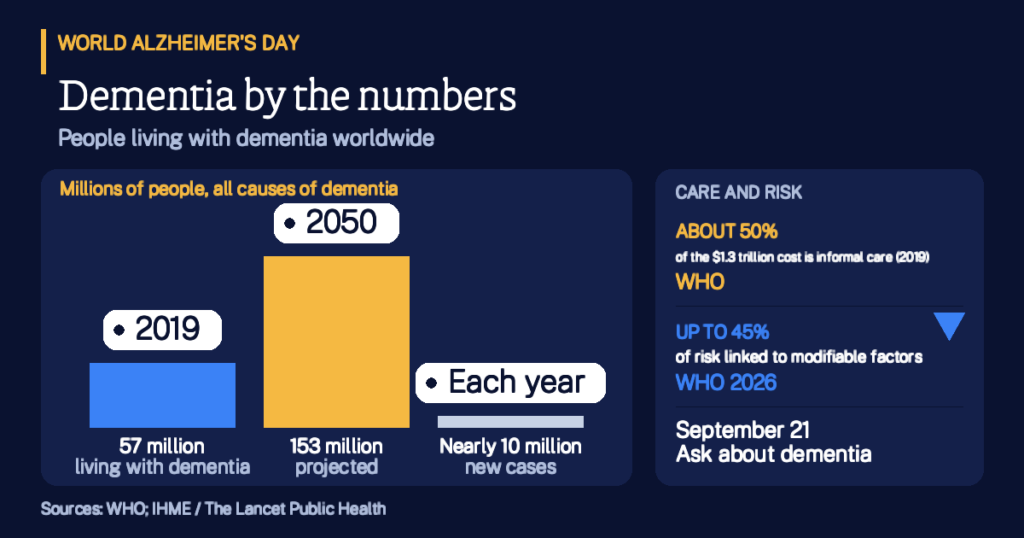
WHO’s 2026 fact sheet reports that in 2021, 57 million people were living with dementia worldwide, and more than 60 percent of them live in low- and middle-income countries. Nearly 10 million new cases appear every year, and dementia is currently the fifth leading cause of death globally.
The direction of travel is the larger concern. A study from the Institute for Health Metrics and Evaluation, published in The Lancet Public Health in January 2022 for 204 countries, estimated 57 million people with dementia in 2019 and projected 153 million by 2050. That is about 2.7 times as many. The same study found that rising obesity, smoking and high blood sugar would add 6.8 million cases, while better education would prevent 6.2 million. Projections are modeled estimates, not predictions carved in stone.
- 57 millionpeople with dementia worldwide in 2021
- Nearly 10 millionnew cases every year
- 60 to 70%of cases may be Alzheimer’s disease
- $1.3 trillionglobal cost of dementia in 2019
Who carries the weight of care
Dementia cost economies an estimated $1.3 trillion in 2019, and WHO says about half of that is attributable to care given by informal carers, meaning family members and close friends. Those carers provide on average 5 hours of care and supervision per day. Women are affected twice over: WHO reports that they experience higher disability and mortality from dementia, and that they also provide 70 percent of care hours for people living with it.
Example 1: the hours add up. Take WHO’s average of 5 hours of care and supervision a day. Over a week that is 35 hours, which is close to a full-time job, and over a year it is about 1,825 hours. If a family valued those hours at a round $10 each, the unpaid care would be worth roughly $18,000 a year. The $10 rate is made up for illustration, but it shows why unpaid care makes up so much of the real cost.
Support for carers is part of broader health access. The same idea sits behind Universal Health Coverage Day: care of this kind should not push families into hardship.
Can the risk be lowered?
Partly, and that is the hopeful half of the story. On July 15, 2026, WHO released updated guidelines on reducing the risk of cognitive decline and dementia. It states that up to 45 percent of the risk can be attributed to modifiable factors such as tobacco, alcohol use, social isolation, physical inactivity, air pollution, and noncommunicable diseases including high blood pressure and diabetes. The guidelines recommend more physical activity, stopping tobacco, less alcohol, a healthy diet, lower exposure to air pollution, and managing hypertension, diabetes and high cholesterol. They do not recommend vitamin or omega-3 supplements without a diagnosed deficiency, because evidence of benefit is lacking.
The wording is careful, and so should we be. “Up to 45 percent” is a share of risk across populations, not a promise to any one person. Healthy habits can delay or reduce dementia, but they cannot guarantee that it will not occur.
Example 2: reading the 45 percent. Imagine 100 people in a group of older adults who will develop dementia. If up to 45 percent of the risk is tied to modifiable factors, then the best case is that up to 45 of those 100 cases could be prevented or delayed by better health habits and care, and at least 55 would not. The 100 is a round number made up for illustration.
Stigma, a plan and the work ahead
Awareness campaigns focus on talking, because silence delays help. ADI’s 2019 theme said that conversations have the power to break down stigma and can be the first step toward support and services. The 2024 campaign sought to address stigma and discrimination. WHO’s Global action plan on the public health response to dementia was endorsed in May 2017 for 2017 to 2025 and has been extended to 2031. It tracks 35 key indicators on how countries are responding.
If you or someone close to you is worried about memory changes, the sensible step is to talk to a doctor or contact a local Alzheimer’s or dementia association, many of which belong to ADI. Early conversations open the door to diagnosis, support and planning.
Example 3: what one conversation can do. Suppose a community health center runs a September awareness evening for 200 residents. If just 10 percent of them, 20 people, go home and ask a family doctor about memory changes or about their blood pressure, the event has created 20 early conversations that would not otherwise have happened. The numbers are round and illustrative, but this is the logic of an awareness day.
- 2018Every 3 Seconds, noting that someone develops dementia every three seconds
- 2019Let’s Talk About Dementia (also the 2020 theme)
- 2021Know Dementia, Know Alzheimer’s (also the 2022 theme)
- 2024Time to act on dementia, Time to act on Alzheimer’s
- 2025Ask About Dementia, with the hashtags #AskAboutDementia and #AskAboutAlzheimers
Key Takeaways
- Alzheimer’s is one cause of dementia. It may account for 60 to 70 percent of cases, and the other cases have other causes.
- The day belongs to families as much as to science. It was started by an association of patient and family groups in 1994.
- The numbers are large and growing. 57 million people had dementia in 2021, with nearly 10 million new cases a year.
- Care falls on families. Informal carers give about 5 hours a day, and women provide 70 percent of care hours.
- Risk can be lowered, not erased. WHO says up to 45 percent of risk is linked to modifiable factors.
- Talking reduces stigma. Asking about memory changes early opens the way to support.
- Policy matters. WHO’s global action plan on dementia now runs to 2031.
How solid is this? The 2021 prevalence and 2019 cost figures come from WHO. The 2019 and 2050 counts are modeled estimates from an IHME study and will change as methods are updated. The 45 percent figure is a population-level estimate. The three worked examples use round, made-up numbers to show an idea. This article gives general information, not medical advice. See also the International Days hub and the International Days Calendar.
More in Health
- WHO, Dementia fact sheet (October 2026 edition)
- WHO, New guidelines: up to 45% of dementia risk could be prevented or delayed (July 15, 2026)
- Alzheimer’s Disease International, World Alzheimer’s Month FAQ
- Alzheimer’s Disease International, Our history
- Alzheimer’s Disease International, Previous World Alzheimer’s Month campaigns
- Alzheimer’s Disease International, reporting the IHME study in The Lancet Public Health (2022)