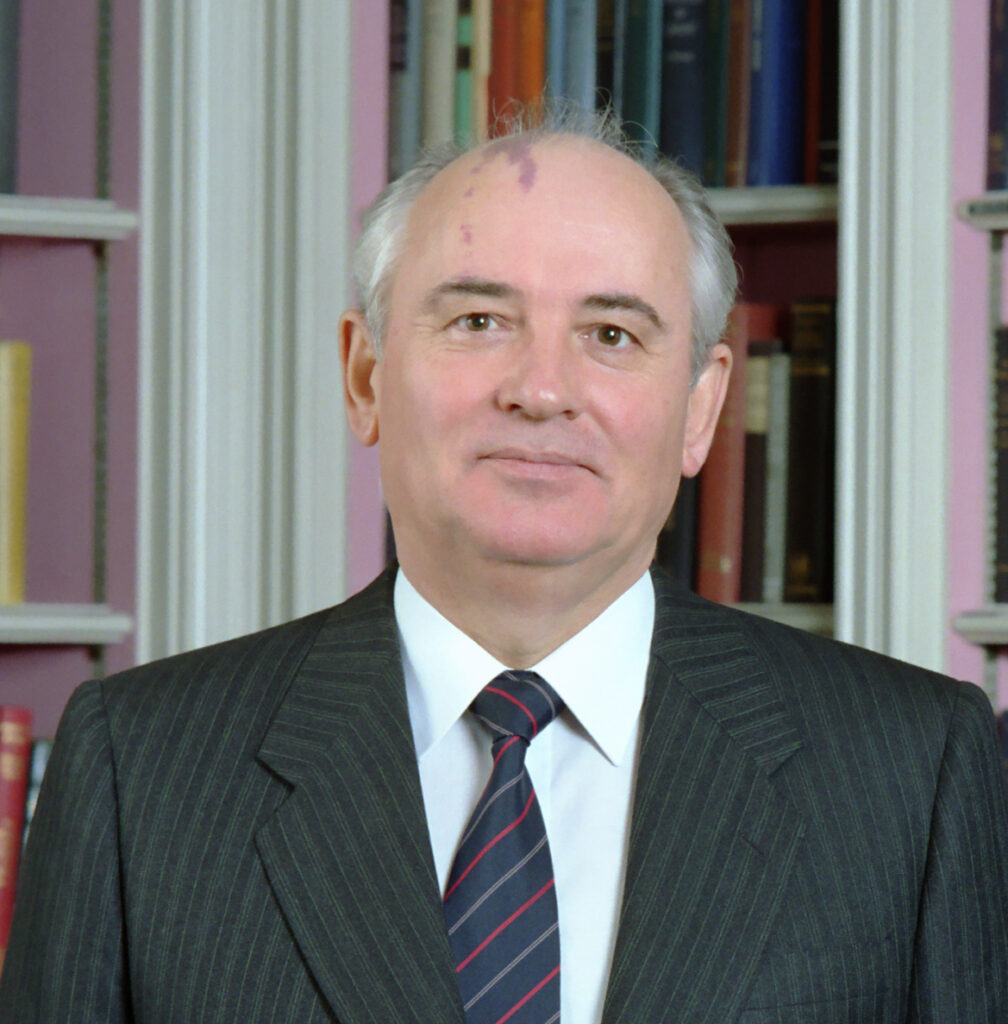
Mikhail Gorbachev (1931 – 2022) was a Soviet statesman who served as the last leader of the Soviet Union from 1985 until its dissolution in 1991, introducing sweeping reforms known as glasnost and perestroika that transformed Soviet society and ultimately led to the end of the Cold War. His efforts to liberalize the Soviet system and reduce international tensions earned him the Nobel Peace Prize in 1990 and reshaped the course of global history.
Mikhail Gorbachev at a Glance
| Full name | Mikhail Sergeyevich Gorbachev |
| Born | March 2, 1931, Privolnoye, Russian SFSR, Soviet Union |
| Died | August 30, 2022, Moscow, Russia |
| Known for | Last leader of the Soviet Union; glasnost and perestroika reforms; ending the Cold War |
| Occupation | Statesman, politician |
| Major events | Introduction of glasnost and perestroika; fall of the Berlin Wall in 1989; dissolution of the Soviet Union in 1991 |
| Nationality | Soviet/Russian |
Early Life and Education
Gorbachev was born into a peasant family in the village of Privolnoye in southern Russia, experiencing the hardships of collectivization and famine during his early childhood years. He studied law at Moscow State University, where he also became active in the Communist Party, before returning to his home region to begin a career within the party apparatus.
Rise Through the Communist Party
Gorbachev rose steadily through the ranks of the Communist Party of the Soviet Union over several decades, serving in various regional leadership positions in the Stavropol region before being brought to Moscow to join the party’s national leadership. His reputation as an effective and relatively younger administrator distinguished him from the aging leadership that had long dominated Soviet politics.
Becoming General Secretary
Gorbachev was elected General Secretary of the Communist Party in March 1985 following the deaths of three elderly predecessors in rapid succession, bringing a notably younger and more dynamic leader to the top of the Soviet hierarchy. His selection reflected a recognition among party leaders that the aging Soviet system required significant renewal to address its mounting economic and social challenges.
Glasnost and Political Openness
Gorbachev introduced the policy of glasnost, or openness, which relaxed state censorship and encouraged greater transparency in government and public discourse, allowing previously suppressed historical and political discussions to enter public life. This policy fundamentally altered the relationship between the Soviet state and its citizens, enabling a level of public debate and media freedom unprecedented in Soviet history.
Perestroika and Economic Reform
Gorbachev launched perestroika, meaning restructuring, as a program of economic reforms intended to introduce elements of market mechanisms and decentralized decision-making into the rigid Soviet planned economy. These reforms aimed to revitalize a stagnating economy but ultimately proved difficult to implement smoothly, contributing to significant economic disruption during the transition period.
Foreign Policy and the End of the Cold War
Gorbachev pursued a dramatically different foreign policy approach than his predecessors, engaging in arms reduction negotiations with the United States and pursuing improved relations with Western nations through summit diplomacy with American President Ronald Reagan. His willingness to reduce Soviet military commitments and support political change in Eastern Europe played a central role in bringing the decades-long Cold War to a peaceful conclusion.
The Fall of the Berlin Wall
Gorbachev’s policy of non-intervention in the internal affairs of Soviet-aligned Eastern European states allowed the dramatic political changes of 1989 to unfold, including the fall of the Berlin Wall and the collapse of communist governments across the region. His decision not to use Soviet military force to suppress these movements, in contrast to previous Soviet interventions, marked a historic departure in Soviet foreign policy.
The Nobel Peace Prize
Gorbachev was awarded the Nobel Peace Prize in 1990 in recognition of his leading role in the peace process that fundamentally changed the political landscape of Europe and reduced the threat of nuclear conflict between the superpowers. The award reflected international recognition of his contributions to ending the Cold War and reducing global military tensions.
The August Coup and Soviet Collapse
Gorbachev faced an attempted coup by hardline Communist Party officials in August 1991 who opposed his reform agenda, briefly placing him under house arrest before the coup collapsed amid public resistance led by Russian President Boris Yeltsin. The failed coup accelerated the disintegration of Soviet central authority, and Gorbachev resigned as Soviet president in December 1991 as the Soviet Union formally dissolved into independent states.
Post-Soviet Life and Legacy Work
Gorbachev remained active in public life following the Soviet collapse, founding the Gorbachev Foundation to promote research on social, economic, and political issues, and continuing to comment on international affairs. He received widespread recognition internationally for his role in ending the Cold War, even as his legacy remained more contested within Russia itself due to the economic hardships that followed the Soviet collapse.
Domestic Political Reforms
Gorbachev introduced significant political reforms during his tenure, including the establishment of a new Congress of People’s Deputies with competitive elections and the creation of the office of President of the Soviet Union, which he himself assumed in 1990. These institutional changes represented a significant departure from the one-party authoritarian structure that had defined Soviet governance since the 1920s.
Relations with Western Leaders
Gorbachev developed notably productive working relationships with Western leaders, including British Prime Minister Margaret Thatcher, who famously remarked that she could “do business” with him after their first meeting in 1984, and United States President Ronald Reagan, with whom he conducted a series of landmark summit meetings. These relationships helped build the mutual trust necessary to negotiate significant arms control agreements, including the Intermediate-Range Nuclear Forces Treaty signed in 1987.
German Reunification
Gorbachev played a decisive role in enabling the reunification of East and West Germany in 1990, agreeing not to oppose German unity within NATO in exchange for economic assistance and security guarantees from Western governments. This decision removed one of the central geopolitical divisions of the Cold War era and was widely regarded as a significant act of statesmanship that prioritized European stability over Soviet strategic advantage.
Legacy
Mikhail Gorbachev remains one of the most significant political figures of the late twentieth century, remembered for his pivotal role in ending the Cold War and introducing reforms that fundamentally transformed Soviet society. His policies of glasnost and perestroika, while contributing to the ultimate collapse of the Soviet Union, are widely credited by historians with facilitating a largely peaceful transition away from decades of Cold War confrontation between the world’s nuclear superpowers.
References
- New World Encyclopedia – Mikhail Gorbachev
- History.com – Mikhail Gorbachev
- History.com – Mikhail Gorbachev (Cold War)
Frequently Asked Questions
What is Mikhail Gorbachev best known for? He is best known as the last leader of the Soviet Union and for introducing the reforms of glasnost and perestroika, which helped bring an end to the Cold War.
What were glasnost and perestroika? Glasnost was a policy of political openness and reduced censorship, while perestroika was a program of economic restructuring aimed at introducing market elements into the Soviet economy.
Did Gorbachev win the Nobel Peace Prize? Yes, he was awarded the Nobel Peace Prize in 1990 for his role in reducing Cold War tensions and reshaping European politics.
How did Gorbachev’s leadership end? He resigned as Soviet president in December 1991 following an attempted coup and the subsequent dissolution of the Soviet Union into independent states.
Editorially reviewed by Specialty Digest Editorial TeamLast reviewed November 29, 2026Researched and drafted with AI assistanceReport an issue