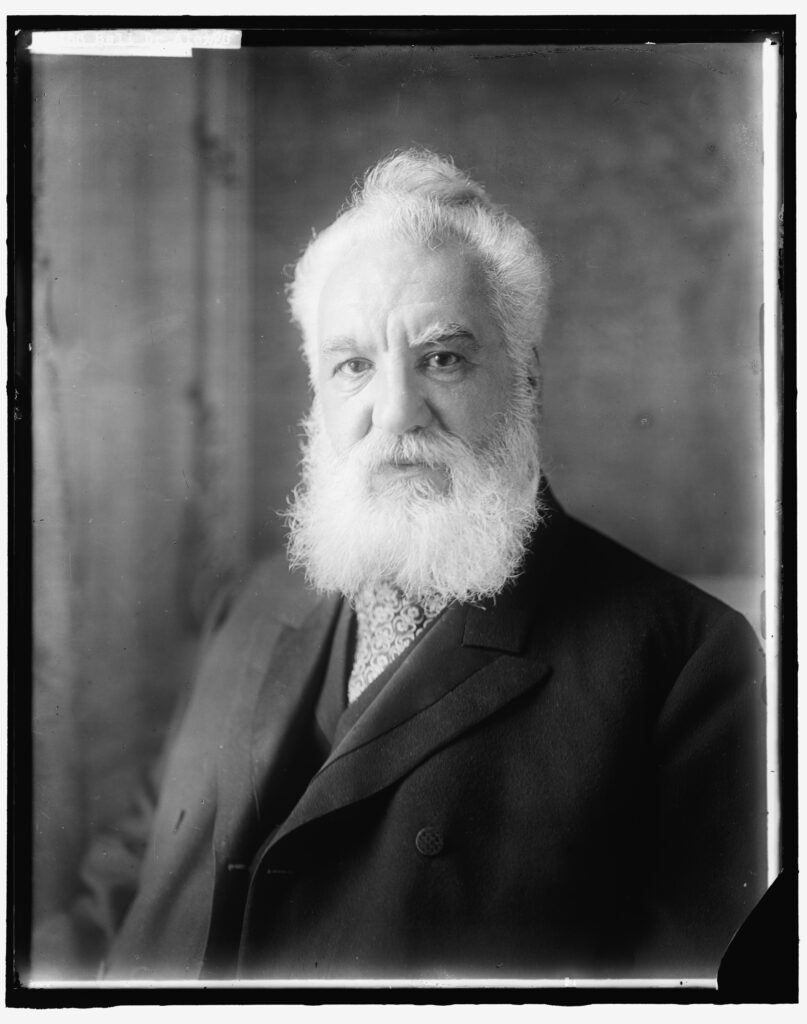
Alexander Graham Bell (1847-1922) was a Scottish-born scientist and inventor best known for patenting the telephone, a device that fundamentally transformed long-distance communication. Beyond his most famous invention, Bell pursued extensive work in fields including sound transmission, aeronautics, and education for the deaf, establishing a varied legacy as one of the most prolific inventors of the late nineteenth and early twentieth centuries.
Alexander Graham Bell at a Glance
| Full name | Alexander Graham Bell |
| Born | March 3, 1847, Edinburgh, Scotland |
| Died | August 2, 1922, Beinn Bhreagh, Nova Scotia, Canada |
| Known for | Patenting the telephone; co-founding the Bell Telephone Company |
| Occupation | Scientist, inventor, educator |
| Major events | Patented the telephone 1876; founded Bell Telephone Company 1877; founded the National Geographic Society 1888 |
| Nationality | Scottish, later American and Canadian citizen |
Early Life and Education
Alexander Graham Bell was born in Edinburgh, Scotland, into a family with a strong background in elocution and speech, as his father and grandfather had both worked extensively in the field of speech correction and vocal physiology. This family tradition profoundly shaped Bell’s early education and interests, instilling in him a lasting fascination with sound, speech mechanics, and communication that would influence his later scientific work.
Work with the Deaf Community
Following his family’s tradition, Bell became deeply involved in teaching speech to deaf students, a pursuit that was partly inspired by his own mother’s hearing loss and that remained a central part of his professional life throughout his career. His work in this field brought him into contact with numerous students and families, including that of his future wife, Mabel Hubbard, who had lost her hearing in childhood, and this experience gave him practical insight into the mechanics of sound and hearing.
Emigration to North America
In the early 1870s, Bell emigrated first to Canada and then to the United States, where he continued his work teaching speech to the deaf while also pursuing independent research into the transmission of sound through electrical means. He eventually secured a position at Boston University, which provided him with an academic base while he conducted his experiments in the evenings and developed the technical foundations for his later inventions.
Invention of the Telephone
In 1876, Bell was granted a patent for an apparatus capable of transmitting speech electrically, an invention that would become known as the telephone, achieved through years of experimentation with sound transmission and electrical circuits. The successful transmission of intelligible speech over an electrical wire represented a major technical breakthrough, and Bell’s patent for this technology became one of the most valuable and extensively litigated patents in American history.
Founding of the Bell Telephone Company
Following the success of his invention, Bell co-founded the Bell Telephone Company in 1877, an organization established to commercialize and expand telephone service, which grew rapidly in the following years as demand for the new communication technology increased across the United States. The company Bell helped establish eventually became the foundation for a vast telecommunications industry that would transform how people communicated across distances for generations to come.
Patent Disputes and Legal Battles
The enormous commercial value of the telephone patent led to numerous legal disputes, as rival inventors and companies challenged Bell’s claim to priority in the invention, resulting in extensive litigation that occupied much of Bell’s time and resources during the years following his initial patent filing. These legal battles, among the most significant patent disputes of the era, ultimately upheld Bell’s patent claims, cementing his legal and historical standing as the telephone’s inventor.
Later Scientific Pursuits
Beyond the telephone, Bell continued an active career of scientific experimentation and invention throughout his life, working on projects related to aeronautics, hydrofoil watercraft, and various methods of sound recording and transmission. His later research interests reflected a broad scientific curiosity that extended well beyond the field of telecommunications, with his aeronautical experiments in particular contributing to the early development of powered flight technology.
Founding of the National Geographic Society
Bell played a significant role in the founding and early development of the Natioal Geographic Society, serving as its second president and contributing to the establishment of National Geographic Magazine as a major vehicle for popular science and exploration writing. His involvement with the organization reflected his broader interest in scientific education and the dissemination of knowledge to the general public.
Advocacy for Deaf Education
Throughout his life, Bell remained deeply engaged with issues related to deaf education, founding organizations dedicated to teaching speech to deaf individuals and advocating for educational approaches that emphasized oral communication. His sustained commitment to this field, which predated and continued alongside his work on the telephone, reflected the personal and professional importance he placed on communication technologies and techniques of all kinds.
Later Life and Estate in Nova Scotia
In his later years, Bell spent considerable time at his estate in Nova Scotia, Canada, where he continued his scientific experiments and research projects in a dedicated laboratory while also engaging with the local community and various intellectual pursuits. This estate became an important site for several of his later inventions and experiments, reflecting his continued dedication to scientific inquiry well into his later decades.
International Honors and Recognition
Bell received numerous honors and widespread recognition throughout his lifetime and after his death for his contributions to science and technology, including honorary degrees from universities and memberships in prestigious scientific societies across multiple countries. These honors reflected the broad international recognition of his achievements, extending well beyond the telephone to encompass his wider contributions to scientific research and education.
Technological Legacy
The telephone technology that Bell pioneered fundamentally transformed global communication, enabling real-time conversation across distances that had previously required days or weeks of correspondence, and laying the technical groundwork for the extensive telecommunications infrastructure that followed. The principles underlying his original invention continued to influence telecommunications technology for well over a century, even as the specific mechanisms evolved dramatically with subsequent technological advances.
Demonstrations and Public Reception
Bell’s early demonstrations of the telephone, including a notable exhibition at the 1876 Centennial Exposition in Philadelphia, helped generate public interest in the new technology and drew attention from scientists, journalists, and business figures who recognized its transformative potential. These demonstrations played an important role in establishing credibility for the invention at a time when the idea of transmitting speech over wires struck many observers as remarkable, helping to accelerate both scientific acceptance and commercial investment in the emerging telephone industry.
Legacy
Alexander Graham Bell remains one of the most significant inventors in the history of communication technology, remembered primarily for his invention of the telephone but also for his broader contributions to deaf education, aeronautics, and scientific exploration. His work fundamentally reshaped how people across the world communicate, establishing a technological foundation that profoundly influenced the subsequent development of telecommunications throughout the twentieth century and beyond.
References
- New World Encyclopedia – Alexander Graham Bell
- History.com – Alexander Graham Bell
- History.com – Telephone
Frequently Asked Questions
What is Alexander Graham Bell best known for? He is best known for inventing and patenting the telephone in 1876, a device that transformed long-distance communication.
Where was Alexander Graham Bell born? He was born in Edinburgh, Scotland, in 1847, before later emigrating to Canada and the United States.
What other work did Bell pursue besides the telephone? He was deeply involved in deaf education, aeronautics, hydrofoil watercraft research, and helped found the National Geographic Society.
Why was Bell’s telephone patent so significant? It became one of the most valuable and extensively litigated patents in American history due to the enormous commercial value of telephone technology.
Editorially reviewed by Specialty Digest Editorial TeamLast reviewed November 29, 2026Researched and drafted with AI assistanceReport an issue