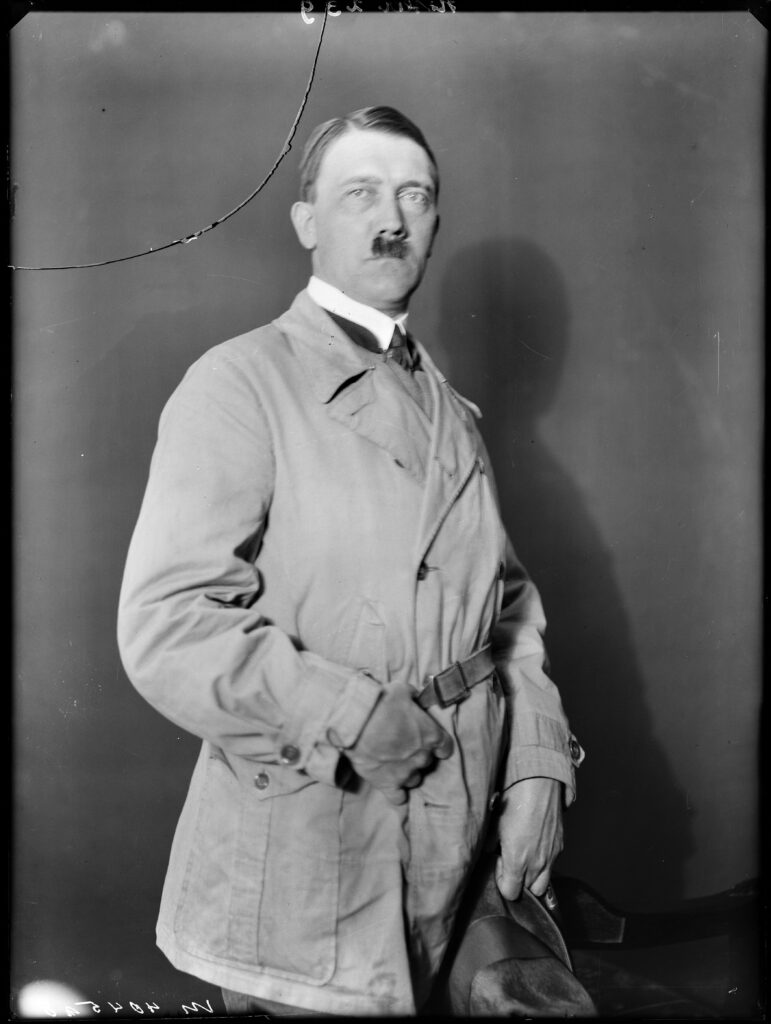
Adolf Hitler (1889-1945) was a German politician and leader of the Nazi Party who served as Chancellor and later Fuhrer of Germany from 1933 until his death in 1945. His rule initiated the Second World War in Europe and oversaw the systematic genocide known as the Holocaust, making him one of the most historically significant and consequential figures of the twentieth century.
Adolf Hitler at a Glance
| Full name | Adolf Hitler |
| Born | April 20, 1889, Braunau am Inn, Austria-Hungary |
| Died | April 30, 1945, Berlin, Germany |
| Known for | Leader of Nazi Germany 1933-1945; instigator of World War II in Europe and the Holocaust |
| Occupation | Politician, head of state and government |
| Major events | Became Chancellor of Germany 1933; invaded Poland 1939, starting World War II in Europe; died by suicide 1945 |
| Nationality | Austrian-born German |
Early Life
Adolf Hitler was born in Braunau am Inn, a town in Austria-Hungary near the German border, into a middle-class family headed by his father, a customs official. His early years included an unremarkable academic record and failed attempts to gain admission to the Vienna Academy of Fine Arts, after which he spent several years living a marginal existence in Vienna before relocating to Munich, Germany, in 1913.
First World War Service
With the outbreak of the First World War in 1914, Hitler volunteered for service in the German army, serving on the Western Front throughout the conflict and receiving decorations including the Iron Cross for his service. Germany’s defeat and the subsequent Treaty of Versailles left a deep impression on Hitler, who came to view the outcome as a betrayal and subsequently became involved in the nationalist political movements that proliferated in Germany’s unstable postwar period.
Rise within the Nazi Party
In 1919, Hitler joined the German Workers’ Party, a small nationalist political group that was soon renamed the National Socialist German Workers’ Party, commonly known as the Nazi Party, and he quickly rose to become its leader through his skills as a public speaker and organizer. The party’s early program combined German nationalism, antisemitism, and opposition to the Treaty of Versailles and the Weimar Republic’s democratic government, themes that would remain central to Hitler’s political platform throughout his career.
The Beer Hall Putsch and Imprisonment
In 1923, Hitler led an attempted coup in Munich known as the Beer Hall Putsch, seeking to seize control of the Bavarian government as a prelude to a broader national takeover, an effort that failed and resulted in his arrest and conviction for treason. During his subsequent imprisonment, which lasted less than a year due to a lenient sentence, Hitler dictated the first volume of Mein Kampf, a book outlining his political ideology and ambitions that would later become central to Nazi doctrine.
Path to Power
Following his release from prison, Hitler rebuilt the Nazi Party throughout the 1920s, and the party’s electoral fortunes grew substantially amid the economic devastation of the Great Depression, which severely weakened public confidence in Germany’s existing political institutions. By 1932, the Nazi Party had become the largest party in the German parliament, and in January 1933, President Paul von Hindenburg appointed Hitler as Chancellor of Germany, a position from which he rapidly consolidated absolute power.
Consolidation of Dictatorship
After becoming Chancellor, Hitler moved quickly to eliminate political opposition and establish a one-party totalitarian state, using the Reichstag Fire of February 1933 to justify emergency decrees that suspended civil liberties, followed by the Enabling Act that granted him the power to enact laws without parliamentary approval. Following Hindenburg’s death in 1934, Hitler combined the offices of Chancellor and President into the single position of Fuhrer, becoming the unchallenged head of the German state, government, and armed forces.
Domestic and Foreign Policy
Throughout the mid-1930s, Hitler’s government pursued aggressive rearmament in violation of the Treaty of Versailles, implemented sweeping antisemitic legislation including the Nuremberg Laws of 1935, and pursued territorial expansion, including the annexation of Austria and the Sudetenland region of Czechoslovakia in 1938. These actions were accompanied by extensive propaganda efforts and the construction of a totalitarian state apparatus that suppressed dissent and sought to control nearly all aspects of German public and cultural life.
The Outbreak of World War II
On September 1, 1939, Germany invaded Poland under Hitler’s direction, prompting Britain and France to declare war and beginning the Second World War in Europe, a conflict that would eventually engulf much of the world and result in the deaths of tens of millions of people. German military forces achieved rapid early successes, conquering much of continental Europe through 1940 and 1941, before the war’s course began to shift following the invasion of the Soviet Union in 1941 and the entry of the United States into the conflict.
The Holocaust
Under Hitler’s direction, the Nazi regime carried out the systematic genocide now known as the Holocaust, in which approximately six million European Jews were murdered alongside millions of other victims including Roma people, disabled individuals, political dissidents, and other groups targeted by Nazi ideology. This genocide, implemented through a network of concentration and extermination camps across German-occupied Europe, stands as one of the largest and most thoroughly documented atrocities in human history and remains central to any historical assessment of Hitler’s rule.
Military Defeat and Death
By 1943, the military tide had decisively turned against Germany, and the following two years saw a sustained Allied advance from both the east and west that gradually overwhelmed German forces despite Hitler’s continued direction of the war effort from increasingly desperate circumstances. As Soviet forces closed in on Berlin in April 1945, Hitler took his own life in his underground bunker on April 30, 1945, shortly before Germany’s unconditional surrender brought the war in Europe to its end.
Historical Assessment and Legacy
Adolf Hitler’s rule and the war and genocide it produced resulted in the deaths of tens of millions of people worldwide and reshaped the political, territorial, and moral landscape of the twentieth century in ways that continue to influence international law, human rights discourse, and historical memory. His regime’s atrocities led directly to the postwar development of international legal frameworks addressing war crimes and genocide, including the Nuremberg trials and subsequent international human rights conventions designed to prevent the recurrence of such events.
Propaganda and the Nazi State Apparatus
Central to Hitler’s exercise of power was an extensive propaganda apparatus, directed in large part by Joseph Goebbels, that employed mass rallies, film, radio broadcasts, and controlled press to promote Nazi ideology and cultivate a cult of personality around Hitler as national leader. This propaganda machinery worked alongside the Gestapo secret police and other instruments of state control to suppress dissent, enforce ideological conformity, and maintain the regime’s grip on German society throughout its twelve years in power.
Postwar Historical Reckoning
In the decades following the war, extensive historical, legal, and archival scholarship has documented the mechanisms of Hitler’s rule and the Holocaust in substantial detail, drawing on captured Nazi records, survivor testimony, and the proceedings of the Nuremberg trials that prosecuted surviving Nazi leadership for war crimes and crimes against humanity. This body of historical documentation has made Hitler’s regime among the most thoroughly studied periods in modern history, informing both academic scholarship and public education about the causes and consequences of totalitarianism and genocide.
References
- New World Encyclopedia – Adolf Hitler
- History.com – Adolf Hitler
- United States Holocaust Memorial Museum – Adolf Hitler
Frequently Asked Questions
What is Adolf Hitler known for? He is known as the leader of Nazi Germany from 1933 to 1945, whose actions initiated World War II in Europe and directed the Holocaust, the systematic genocide of six million European Jews.
How did Hitler come to power? He was appointed Chancellor of Germany in January 1933 after the Nazi Party became the largest party in parliament, then rapidly consolidated absolute power through emergency decrees and the Enabling Act.
What started World War II in Europe? Germany’s invasion of Poland on September 1, 1939, under Hitler’s direction prompted Britain and France to declare war, beginning the European theater of World War II.
How did Hitler’s rule end? As Soviet forces advanced on Berlin in April 1945, Hitler took his own life in his underground bunker on April 30, 1945, shortly before Germany’s surrender.
Editorially reviewed by Specialty Digest Editorial TeamLast reviewed November 29, 2026Researched and drafted with AI assistanceReport an issue