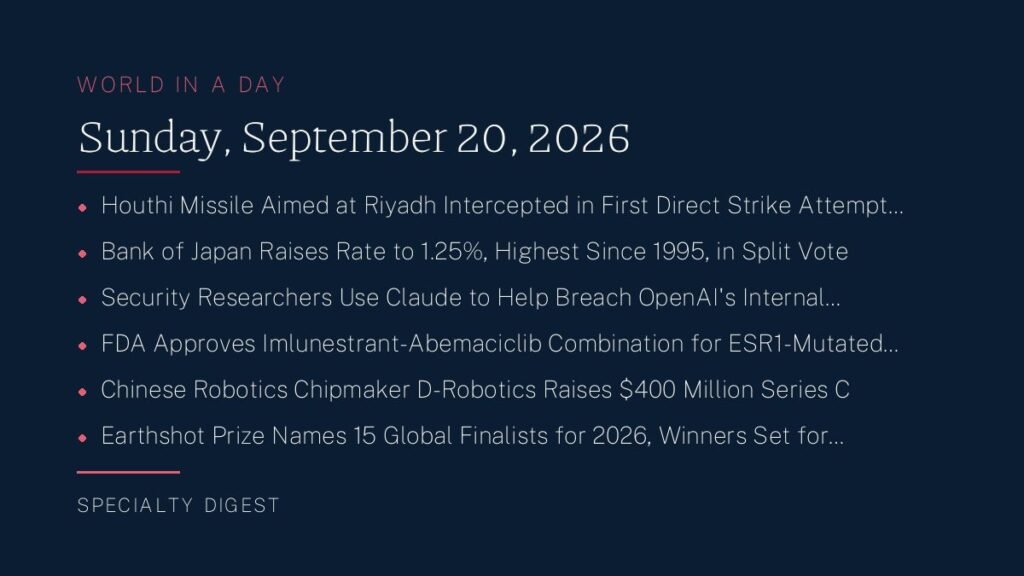
WORLD IN A DAY · SUNDAY, SEPTEMBER 20, 2026
A missile aimed at Saudi Arabia’s capital was intercepted before dawn, and Japan’s central bank pushed interest rates to a 31-year high only to watch the yen fall anyway. Security researchers, meanwhile, showed that an AI model can now help write the exploit code for a real corporate break-in.
Houthi Missile Aimed at Riyadh Intercepted in First Direct Strike Attempt on Saudi Capital
On September 19, Iran-backed Houthi forces fired a ballistic missile at Riyadh at dawn, the first attempted strike on the Saudi capital since fighting escalated in July. The Saudi-led coalition said its air defenses intercepted and destroyed the missile before impact, while additional attacks aimed at Bisha, Taif, Farasan and the Aramco facility in Yanbu were also intercepted. No casualties were reported, though residents near Riyadh’s airport saw a plume of black smoke. Coalition spokesman Turki al-Maliki said the Houthis “attempted to target civilians and civilian infrastructure.” Houthi spokesman Yahya Saree confirmed the strikes, saying they used cruise missiles, ballistic missiles and drones against “sensitive” sites.
Why it matters The failed strike marks a new phase in the seven-month war: Houthi forces demonstrating reach into the Saudi capital itself, not just border regions or shipping lanes, raising the stakes for any US-Iran talks reportedly underway through mediators in Doha.
Source: Al Jazeera
Bank of Japan Raises Rate to 1.25%, Highest Since 1995, in Split Vote
The Bank of Japan lifted its benchmark rate to 1.25 percent on September 18, the highest level in 31 years, in a vote that saw two of nine board members dissent in favor of holding steady. The bank cited persistent wage growth and a shrinking labor pool as structural pressures supporting continued policy normalization, with core inflation holding near its 2 percent target in August. Rather than strengthening, the yen weakened after the announcement because traders had already priced in the hike and read the split vote and cautious guidance as a signal of a slower pace of future increases.
Why it matters The split vote signals the BOJ’s own uncertainty about how far it can tighten without further destabilizing a currency that has already lost significant ground this year, a dilemma with ripple effects for global carry trades built on cheap yen.
Source: Bloomberg
Security Researchers Use Claude to Help Breach OpenAI’s Internal Systems in Authorized Test
Cybersecurity firm Hacktron discovered it could chain a heap overflow bug in the open-source forum software Discourse with a flaw in OpenAI’s employee login system to take over staff ChatGPT and Codex accounts, then pivot into OpenAI’s internal GitHub repositories, Slack and email. Researchers fed the vulnerable server’s code to Anthropic’s Claude Opus 5 and asked it to write the exploit, which the model did by calculating the exact bytes needed to trigger the overflow. Operating inside OpenAI’s authorized bug bounty program, the team proved access by opening a harmless internal pull request. OpenAI patched both flaws within 14 hours and paid a 6,500 dollar bounty, saying it found no evidence anyone else had exploited the bugs.
Why it matters The episode shows AI models can now do a meaningful share of the technical work of finding and exploiting real software vulnerabilities, a capability security researchers warn could just as easily end up in the hands of attackers who don’t report what they find.
Source: NBC News and Tom’s Hardware
FDA Approves Imlunestrant-Abemaciclib Combination for ESR1-Mutated Breast Cancer
The FDA approved Eli Lilly’s imlunestrant, sold as Inluriyo, in combination with abemaciclib for adults with ER-positive, HER2-negative, ESR1-mutated advanced or metastatic breast cancer whose disease progressed after endocrine therapy. In the EMBER-3 trial’s exploratory analysis of 159 patients with the ESR1 mutation, the combination produced a median progression-free survival of 11.1 months, versus 5.5 months for imlunestrant alone, and an objective response rate of 35 percent versus 15 percent. Overall survival data remain immature. The FDA simultaneously approved the Guardant360 CDx blood test as a companion diagnostic to identify which patients carry the ESR1 mutation and qualify for the combination.
Why it matters ESR1 mutations are a common way breast cancer becomes resistant to standard hormone therapy, and doubling progression-free survival in that population gives oncologists a specific next step for patients who would otherwise be moving toward chemotherapy.
Chinese Robotics Chipmaker D-Robotics Raises $400 Million Series C
D-Robotics, a Chinese maker of AI chips and software for robots, closed a 400 million dollar Series C round on September 18 to expand its Sunrise chip line and a software platform covering data collection, model training, simulation and deployment. The company said cumulative shipments of its Sunrise chips have topped 8 million units, and its newest chip, the Sunrise S600, has been adopted by more than 20 customers within six months of launch. Revenue grew several times over year-over-year in the first half of 2026 as its embodied AI business entered mass production.
Why it matters The round is one of the largest yet for a robotics chip supplier and signals investors betting that the physical hardware for humanoid and industrial robots, not just the software layer, is where the next AI infrastructure boom plays out.
Source: TechNode
Earthshot Prize Names 15 Global Finalists for 2026, Winners Set for Mumbai in November
Britain’s Prince William announced 15 finalists for the 2026 Earthshot Prize on September 18, drawn from five categories aimed at environmental repair. They include the Yellowstone to Yukon Conservation Initiative, which protects wildlife crossings across the Rocky Mountains, an Argentine project using AI and satellite data to detect wildfires across Latin America, the Zero Emission Maritime Buyers Alliance, working to cut shipping emissions, and offshore wind developer Orsted. Winners in each category will receive 1 million pounds, plus support to scale their work, and will be named at a televised ceremony in Mumbai on November 17. Earthshot Prize chief executive Jason Knauf said the response shows “people want to protect nature for the sake of future generations.”
Why it matters Now in its sixth year, the prize has shifted from spotlighting ideas to funding their expansion, and holding the ceremony in Mumbai for the first time signals an attempt to root the awards more firmly in the Global South, where much of the featured conservation and clean-energy work is happening.
Source: Associated Press
Sources
- Al Jazeera, “Saudi-led coalition says defences intercept Houthi missile fired at Riyadh”
- Bloomberg, “Bank of Japan Hikes Interest Rates in a Split Vote, Yen Drops”
- NBC News, “Hackers breached OpenAI, adding to fever pitch of security and safety concerns”
- Tom’s Hardware, “Hackers breach OpenAI using Claude tools”
- U.S. Food and Drug Administration, “FDA approves imlunestrant in combination with abemaciclib”
- TechNode, “D-Robotics raises $400 million in Series C funding”
- Associated Press, “Britain’s Prince William reveals finalists for Earthshot environmental prize”