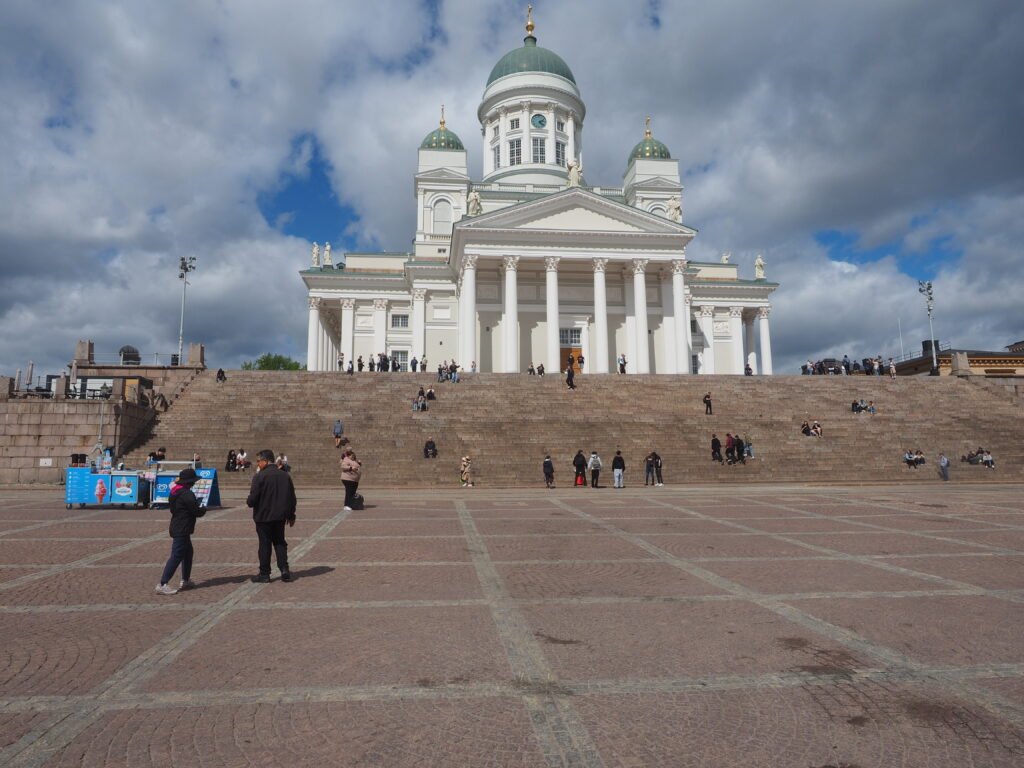
Finland is a Nordic country in Northern Europe known for its tens of thousands of lakes, extensive forests, and a distinctive neoclassical skyline in its capital, Helsinki, where the white-domed Helsinki Cathedral overlooks Senate Square as the city’s most recognizable landmark.
Where Is Finland Located?
Finland lies in Northern Europe, bordered by Sweden to the west, Norway to the north, and Russia to the east, with the Gulf of Bothnia and Gulf of Finland forming its western and southern coastlines. A significant portion of the country lies within the Arctic Circle, and its northern region, Lapland, is one of the best-known places in the world to view the aurora borealis.
Geography of Finland
Finland is often called the “Land of a Thousand Lakes,” though the true figure is far higher, with roughly 188,000 lakes across the country, alongside extensive boreal forest that covers most of its land area. The terrain is generally low and flat to gently rolling, shaped heavily by glaciation during the last ice age, which also left behind the thousands of islands found along its southwestern archipelago.
A Brief History of Finland
Finland was part of the Kingdom of Sweden for roughly six centuries before being ceded to Russia in 1809, becoming an autonomous Grand Duchy under the Russian tsar. Finland declared independence in 1917 amid the Russian Revolution, then fought the Soviet Union twice during the Second World War, in the Winter War of 1939-1940 and the Continuation War of 1941-1944, ultimately preserving its independence while ceding some eastern territory. Finland joined the European Union in 1995 and, after decades of military non-alignment, joined NATO in 2023 following Russia’s full-scale invasion of Ukraine.
Government and Economy
Finland is a parliamentary republic and a high-income European Union member state. The World Bank regards Finland as a development partner rather than a borrowing client, reflecting its status as an advanced economy. Finland is consistently ranked among the world’s leaders in education outcomes, and its economy has historically drawn strength from forestry, engineering, and technology, including the global rise of the mobile phone company Nokia in the 1990s and 2000s.
Culture and People
Finnish and Swedish are both official languages, with Finnish, a Finno-Uralic language unrelated to most other European tongues, spoken by the large majority of the population. Sauna culture is deeply embedded in Finnish daily life, with saunas outnumbering cars in the country, and Finnish design, from Alvar Aalto’s architecture to Marimekko’s textiles, has had an outsized influence on twentieth-century Nordic aesthetics.
What Is Finland Known For?
Finland is known for its lakes and forests, its sauna tradition, its high-performing education system, and Lapland’s reputation as the official home of Santa Claus. In Helsinki, Helsinki Cathedral, a Lutheran cathedral completed in 1852 and designed by architect Carl Ludvig Engel, dominates Senate Square with its neoclassical white facade and green domes, making it the single most photographed landmark in the capital.
Why Finland Matters
Finland’s 2023 accession to NATO marked one of the most significant shifts in European security policy in decades, ending more than seven decades of military non-alignment, while its long-standing achievements in education and design continue to make it a frequent international point of reference in both fields.
Key Takeaways
- Finland borders Sweden, Norway, and Russia, with roughly 188,000 lakes across its territory.
- It was part of Sweden until 1809, then an autonomous Russian Grand Duchy until independence in 1917.
- Finland fought the Soviet Union in the Winter War and Continuation War during the Second World War.
- Helsinki Cathedral, completed in 1852, is Finland’s most iconic landmark.
- Finland joined NATO in 2023 after decades of military non-alignment.
Sources
Key facts
- Roughly 188,000 lakes across the country2
- Part of Sweden until 1809, then a Russian Grand Duchy until independence in 19172
- Fought the USSR in the Winter War (1939-1940) and Continuation War (1941-1944)2
- Joined the EU in 1995 and NATO in 20232
- Helsinki Cathedral, completed 1852, is the country's most iconic landmark2
Quick checkWhen did Finland join NATO?Show answer
2023, following Russia's full-scale invasion of Ukraine, ending decades of military non-alignment.
Sources
- World Bank. Finland Overview. Undated (accessed 2026-09-23)
- Encyclopaedia Britannica. Finland. Undated (accessed 2026-09-23)
Editorially reviewed by Specialty Digest Editorial TeamLast reviewed September 23, 2026Researched and drafted with AI assistanceReport an issue