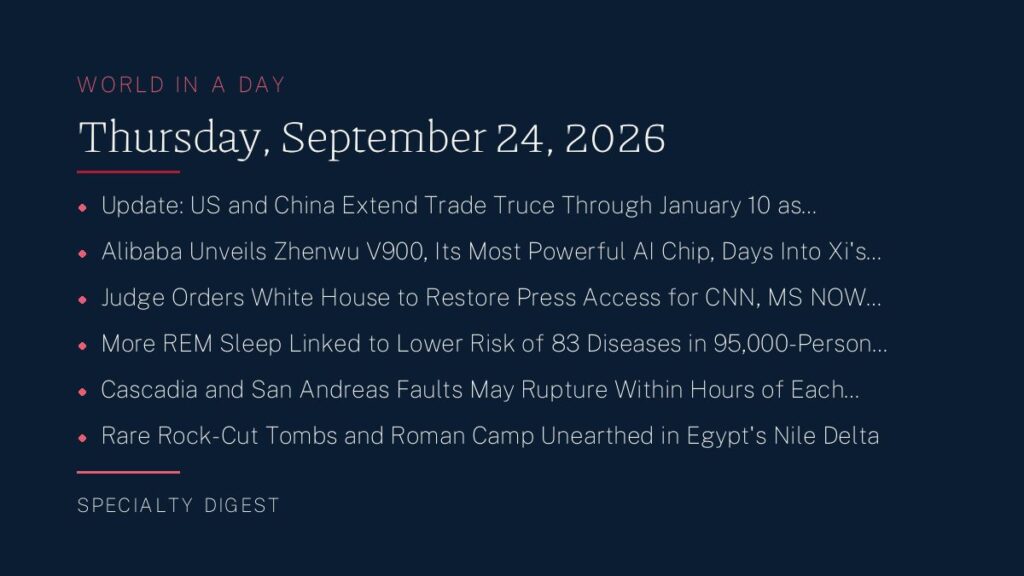
WORLD IN A DAY · THURSDAY, SEPTEMBER 24, 2026
Washington delivered two verdicts today: a US-China trade truce pushed out to January 10, and a federal judge’s order forcing the White House to let three newsrooms back into the briefing room within 14 days.
Update: US and China Extend Trade Truce Through January 10 as Treasury Yields Hit 19-Year High
Treasury Secretary Scott Bessent announced Thursday that the United States and China have extended their trade truce through January 10, keeping tariffs and export controls frozen while President Trump hosted Xi Jinping for a three day state visit in Washington. The extension buys negotiators more time on rare earths, soybean purchases and technology trade after the original Busan truce had been set to expire November 10. The announcement landed the same morning the 10 year Treasury yield climbed to 5.11%, its highest level since 2007, with the 2 year at 4.897% and the 30 year at 5.438%, as investors priced in sustained economic growth rather than war driven inflation alone.
Why it matters Two more months without a tariff cliff gives both governments room to negotiate, but a bond market pricing in strength, not panic, tells Washington the economy can absorb higher borrowing costs whether or not a deeper deal ever gets signed.
Alibaba Unveils Zhenwu V900, Its Most Powerful AI Chip, Days Into Xi’s Washington Visit
Alibaba CEO Eddie Wu unveiled the Zhenwu V900 chip at the company’s annual Hangzhou conference this week, calling it the most powerful AI chip built in China and claiming triple the performance of its predecessor, the Zhenwu M890. Alibaba also announced plans to train a new Qwen model scaled to 5 trillion to 10 trillion parameters, up from the current Qwen3.8 Max’s 2.4 trillion, and said it will expand data center capacity past 20 gigawatts by 2032. Wu said the company is “mobilizing every resource” to meet AI demand even as global supply chain shortages slow the buildout.
Why it matters The timing, days before Xi sat down with Trump, underscores that Beijing is racing to prove US export controls on advanced chips have not stalled its AI ambitions, whatever gets negotiated across the table this week.
Judge Orders White House to Restore Press Access for CNN, MS NOW and Politico
US District Judge Timothy Kelly, a Trump appointee, issued a temporary restraining order Wednesday requiring the White House to immediately restore press credentials it had revoked from CNN, MS NOW and Politico. Kelly found the outlets were likely to succeed in showing their passes were pulled without due process, calling the administration’s stated conduct standard “so vague it hardly does the trick,” and rejected its national security justification after noting Trump initially cited only negative coverage. The order runs 14 days pending further review. Attorney Theodore Boutrous Jr., representing the outlets, called it “a strong ruling vindicating freedom of the press, due process and the rule of law.”
Why it matters A Trump-appointed judge siding with the press on due process grounds, not just First Amendment sympathy, makes the ruling harder for the administration to wave off as partisan on appeal.
More REM Sleep Linked to Lower Risk of 83 Diseases in 95,000-Person Study
Researchers led by Shengzhi Sun of Capital Medical University tracked 95,559 UK Biobank participants who wore wrist accelerometers for a week, then followed their health records for a median of 8.9 years. Using deep learning to classify sleep stages, the team tested more than 1,000 disease outcomes and found 156 significant associations. Every additional 47.6 minutes of REM sleep was linked to lower risk for 83 conditions, including notably lower risk of heart failure, dementia and Parkinson’s disease, while sleeping under five hours a night raised risk across 37 conditions. The study, published in PLOS Medicine, found six to eight hours nightly was the sweet spot for disease protection overall.
Why it matters A dataset this large lets researchers rank which sleep stage matters for which disease, moving sleep advice beyond a single duration target toward something doctors could eventually screen for directly.
Source: PLOS Medicine and ScienceDaily
Cascadia and San Andreas Faults May Rupture Within Hours of Each Other, Study Finds
Marine geologist Chris Goldfinger of Oregon State University and colleagues analyzed deep sea sediment cores spanning 3,100 years off the Pacific Northwest and Northern California coasts, looking for turbidite layers left by earthquake triggered underwater landslides. They found three instances in the past 1,500 years, including the well documented 1700 event, where reversed layer “doublet” patterns suggest the Cascadia subduction zone and the northern San Andreas fault ruptured within minutes to hours of each other rather than independently. The findings, published in the journal Geosphere, suggest the two fault systems may be seismically linked rather than isolated hazards.
Why it matters Emergency planners have historically modeled a Cascadia “Big One” and a San Andreas rupture as separate disasters; evidence they could strike together would strain federal disaster response across Seattle, Portland and San Francisco all at once.
Source: Oregon State University and ScienceDaily
Rare Rock-Cut Tombs and Roman Camp Unearthed in Egypt’s Nile Delta
Archaeologists led by Hisham El Leithy of Egypt’s Supreme Council of Antiquities uncovered the remains of a Roman military camp alongside rock cut burial chambers at Tell el Yahudiya, ancient Leontopolis, in the eastern Nile Delta’s Qalyubia province. The tombs, cut directly into bedrock rather than built up from brick, took two forms: staircases descending to burial halls, or rectangular shafts leading to paired chambers, a construction style rarely found in the Delta’s clay heavy soil. Artifacts recovered from inside span from Egypt’s New Kingdom through its Late Period, indicating the site was reused across more than a thousand years.
Why it matters Rock-cut tombs this far into the Delta are unusual enough that the find is already reshaping assumptions about how far Upper Egyptian funerary traditions spread into the north.
Source: Archaeology Magazine
Sources
- CNBC: U.S.-China trade truce extended, Bessent says, as Xi begins state visit
- NBC News: U.S. and China agree to extend trade truce through Jan. 10
- ABC News: China’s Alibaba unveils new powerful chip and ambitious AI model plans
- TechNode: Alibaba unveils Qwen Book agentic computer and new AI wearables
- MPR News: Judge orders White House to restore access to CNN, MS NOW and Politico
- Axios: White House press ban set to continue for now after hearing ends without ruling
- PLOS Medicine: Accelerometer-derived real-world sleep stages and risk of incident diseases
- ScienceDaily: More REM sleep linked to lower risk of 83 diseases
- Oregon State University: Twin threat: Cascadia and San Andreas faults may be seismically linked
- Archaeology Magazine: Roman Camp and Rock-Cut Tombs Uncovered in Egypt’s Nile Delta
More in Business