Kosovo is a partially recognized state in the Balkans that declared independence from Serbia in 2008, following a war and a period of United Nations administration in the 1990s. Its status remains disputed by Serbia and a number of other countries, even as Kosovo has built its own institutions and economy over the past two decades.
Where Is Kosovo Located?
Kosovo lies in the western Balkans in Southeastern Europe, bordered by Serbia to the north and east, North Macedonia to the southeast, Albania to the southwest, and Montenegro to the west. It is landlocked and largely mountainous, with two major plains, the Kosovo Plain and the Metohija/Dukagjini basin, forming its main lowland and agricultural areas. Pristina, in the country’s northeast-central region, is the capital and largest city.
A Brief History
The region was historically part of the medieval Serbian kingdom before falling under Ottoman rule for roughly five centuries, and it later became part of Serbia and then Yugoslavia in the twentieth century. By the late twentieth century, Kosovo’s population was overwhelmingly ethnic Albanian, and tensions with Serbian central authorities escalated into the Kosovo War of 1998 and 1999, during which a NATO bombing campaign against Yugoslav forces led to Yugoslavia’s withdrawal and the territory’s administration by the United Nations under Security Council Resolution 1244. Kosovo’s assembly unilaterally declared independence from Serbia on February 17, 2008. According to the World Bank, Kosovo is recognized as an independent country by more than 100 United Nations member states, but Serbia does not recognize the declaration and continues to regard Kosovo as part of its own territory, a position shared by several other countries including Russia and China; Kosovo is not a member of the United Nations as a result, and a NATO-led peacekeeping force has remained in the country since 1999.
Government and Economy Today
Kosovo is a parliamentary republic. According to the World Bank, the country has experienced steady economic progress since independence, including a nearly 50 percent increase in per-capita income, and has moved away from heavy dependence on foreign aid, supported by diaspora remittances, public infrastructure investment and financial-sector deepening, alongside low inflation. Kosovo signed a Stabilization and Association Agreement with the European Union, in force since 2016, and is a potential candidate for EU membership. The World Bank classifies Kosovo as an upper-middle-income economy.
Culture and People
Kosovo’s population was approximately 1.6 million in 2025, according to the World Bank, and is predominantly ethnic Albanian, with a Serb minority concentrated particularly in the north of the country. Albanian and Serbian are both official languages. The population is largely young by European standards, and Kosovo’s culture reflects a blend of Albanian traditions with the region’s broader Balkan and Ottoman-influenced history.
What Is Kosovo Known For?
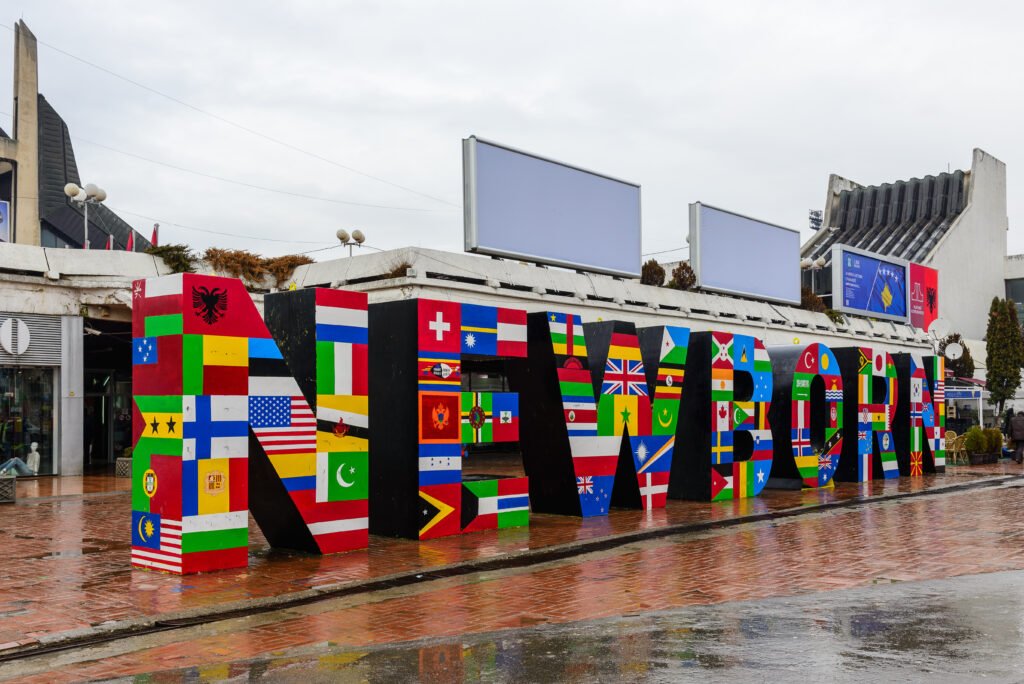
Kosovo is internationally known for its recent and contested emergence as a state, and for the diplomatic and legal debate its 2008 declaration of independence generated, including a 2010 advisory opinion from the International Court of Justice that found the declaration did not violate international law without ruling on the underlying question of statehood. Its most recognizable landmark is the Newborn Monument in Pristina, a large sculpture spelling out the word “NEWBORN” that was unveiled on the day of the 2008 independence declaration and has since become the country’s most photographed symbol.
Key Takeaways
- Kosovo lies in the western Balkans, bordered by Serbia, North Macedonia, Albania and Montenegro, with Pristina as its capital.
- It declared independence from Serbia in 2008 after the 1998-99 Kosovo War and a period of UN administration; Serbia does not recognize this independence.
- More than 100 UN member states recognize Kosovo, but it is not itself a UN member, and a NATO-led force has remained in the country since 1999.
- Kosovo is an upper-middle-income economy that has grown steadily since independence and holds EU candidate potential.
- The Newborn Monument in Pristina, unveiled on independence day in 2008, is Kosovo’s most recognizable landmark.
Key facts
Quick checkIs Kosovo's independence universally recognized?Show answer
No. Kosovo declared independence from Serbia in 2008 and is recognized by more than 100 UN member states, but Serbia and some other countries, including Russia and China, do not recognize it, and Kosovo is not a UN member.
Sources
- World Bank. Kosovo, Population total. 2025 (accessed Accessed 2026)
- World Bank. Kosovo Overview. Accessed 2026 (accessed 2026)
Editorially reviewed by Specialty Digest Editorial TeamLast reviewed September 27, 2026Researched and drafted with AI assistanceReport an issue