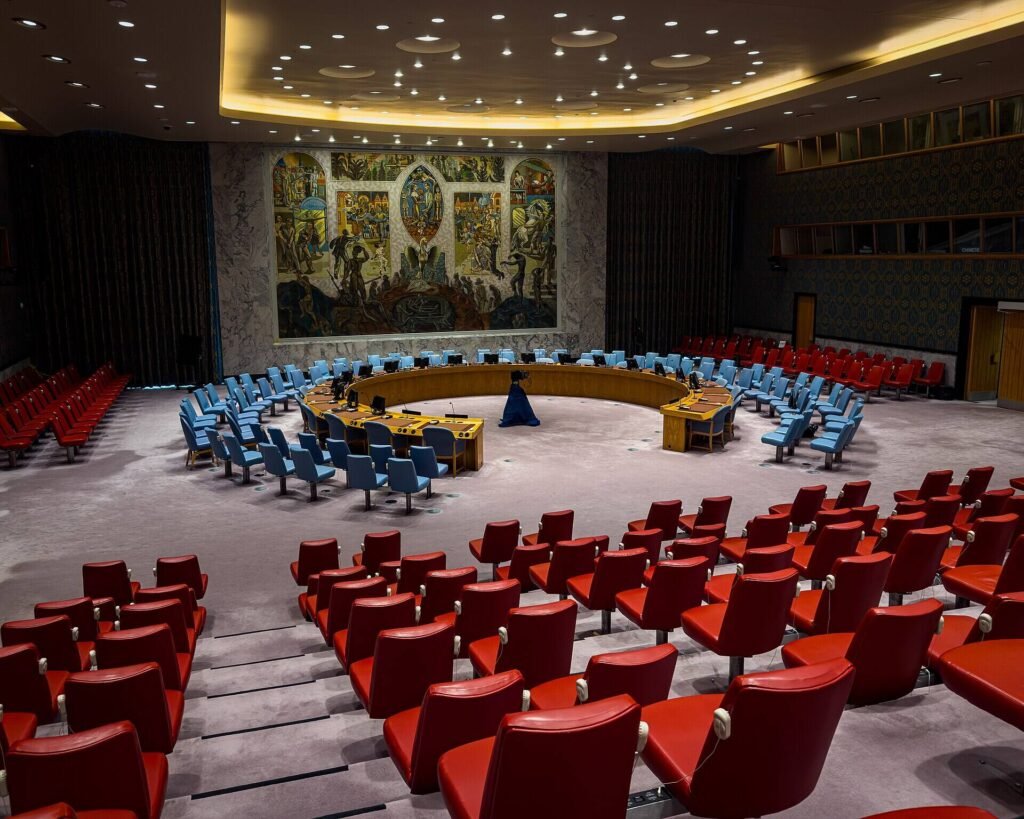
The United Nations Security Council is the organ of the United Nations with primary responsibility for maintaining international peace and security. It has 15 members, five of them permanent with veto power, and it is the only UN body whose decisions member states are obligated to carry out under the Charter.
History of the Security Council
The Council was created by the UN Charter as one of six principal organs. It held its first session on 17 January 1946 at Church House, Westminster, London. It later took up permanent residence at UN headquarters in New York, though it has also met elsewhere, including Addis Ababa in 1972, Panama City and Geneva in 1990.
The original Charter named five permanent members: the Republic of China, France, the Soviet Union, the United Kingdom and the United States. According to the Council on Foreign Relations, President Franklin Roosevelt insisted on China’s inclusion, while Winston Churchill championed France’s restoration to great-power status. In 1971 the People’s Republic of China took over the China seat, and the Russian Federation later succeeded the Soviet Union.
The Council had eleven members until it was enlarged to fifteen in 1965. That expansion added four non-permanent seats and led to the regional groups the UN has used for elections since. The structure has otherwise stayed largely unchanged since 1945.
Structure and membership of the Security Council
Article 23 of the Charter says the Council consists of fifteen UN members. The five permanent members are China, France, Russia, the United Kingdom and the United States. The General Assembly elects the other ten for two-year terms by a two-thirds majority, and a retiring member is not eligible for immediate re-election.
The Charter tells the Assembly to consider each candidate’s contribution to international peace and security and equitable geographical distribution. Seats are divided by region: three for Africa, two for Asia-Pacific, one for Eastern Europe, two for Latin America and the Caribbean, and two for Western Europe and other states. By informal agreement an Arab seat alternates between the African and Asia-Pacific groups.
The ten elected members listed by the UN in 2026 are Bahrain, Colombia, the Democratic Republic of the Congo, Latvia and Liberia, whose terms end in 2027, and Denmark, Greece, Pakistan, Panama and Somalia, whose terms end in 2026. More than 50 UN member states have never served on the Council.
The presidency rotates monthly among the fifteen members. Each member must keep a representative at UN headquarters at all times so the Council can meet whenever needed. States that are not members may take part in discussions without a vote when the Council considers their interests affected, and parties to a dispute may be invited in the same way.
What does the Security Council do?
Under Article 24, UN members confer on the Council primary responsibility for international peace and security and agree that it acts on their behalf. When a complaint about a threat to peace reaches it, the Council usually first recommends that the parties seek agreement by peaceful means, as Chapter VI of the Charter provides. It can set out principles for a settlement, investigate, mediate, send a mission, appoint special envoys or ask the Secretary-General to use his good offices.
If fighting breaks out, its main concern is to end it quickly. It can issue ceasefire directives and send military observers or a peacekeeping force to separate opposing forces. Under Chapter VII it may go further with enforcement measures such as economic sanctions, arms embargoes, financial restrictions, travel bans, severance of diplomatic relations, a blockade or collective military action. The Council says it tries to target those responsible for condemned policies while limiting harm to the wider population.
All UN members agree to accept and carry out the Council’s decisions. Other UN organs can only make recommendations. The Council reports annually to the General Assembly and also works with the General Assembly to elect the judges of the International Court of Justice.
The Council oversees peacekeeping. As of 2026 it supervised eleven operations across three continents. In its first four and a half decades, until the end of the Cold War, it authorized eighteen operations, and it approved many more after the Soviet Union dissolved in 1991. Its subsidiary bodies include sanctions committees, counterterrorism committees and the international criminal tribunals for Rwanda and the former Yugoslavia. The Peacebuilding Commission, set up in 2005, advises it.
Voting and the veto
Article 27 gives each member one vote. Procedural decisions need nine affirmative votes. All other decisions need nine votes including the concurring votes of the permanent members, and a party to a dispute under Chapter VI must abstain.
In practice, a negative vote by any permanent member blocks a substantive resolution, which is the right of veto. A permanent member that disagrees with a draft but does not want to block it can abstain, and the resolution passes if it still has nine favorable votes. All five permanent members have used the veto at some time.
The Council on Foreign Relations counts 162 Russian and Soviet vetoes and 95 American vetoes through August 2026. China has used the veto less often but more frequently in recent years, and neither France nor the United Kingdom has cast one since 1989.
Criticism and reform proposals
Critics say the Council’s makeup reflects the postwar balance of power and not today’s world, and that regional representation falls short. Calls for expansion and for limits on the veto have continued for decades without agreement.
Critics also argue that the veto has made the Council less effective at times. The Council on Foreign Relations points to disagreements over Syria, Ukraine and Gaza as examples. Russia, sometimes joined by China, vetoed resolutions on Syria sixteen times by one 2020 count cited there. The Council remains the only UN body able to impose binding obligations on all 193 member states, a power that explains why its composition draws so much attention.
More in International Relations
Key facts
- The Council held its first session on 17 January 1946 at Church House in London.1
- It has 15 members: five permanent members and ten elected for two-year terms.3
- Substantive decisions need nine votes including the concurring votes of the permanent members.2
- Only the Security Council can make decisions that UN member states are obligated to implement.1
- The Council was enlarged from eleven to fifteen members in 1965.4
Related concepts
In the news
Quick checkHow does a Security Council veto work?Show answer
If any one of the five permanent members casts a negative vote on a substantive matter, the resolution is not approved, while an abstention does not block it. [2]
Sources
- 1. United Nations, What is the Security Council?, https://www.un.org/securitycouncil/content/what-security-council
- 2. United Nations, Security Council Voting System, https://www.un.org/securitycouncil/content/voting-system
- 3. United Nations, UN Charter Chapter V: The Security Council, https://www.un.org/en/about-us/un-charter/chapter-5
- 4. Council on Foreign Relations, What Does the UN Security Council Do?, https://www.cfr.org/backgrounder/un-security-council
- 5. United Nations, Security Council Current Members, https://www.un.org/securitycouncil/content/current-members
Editorially reviewed by Specialty Digest Editorial TeamLast reviewed November 4, 2026Researched and drafted with AI assistanceReport an issue