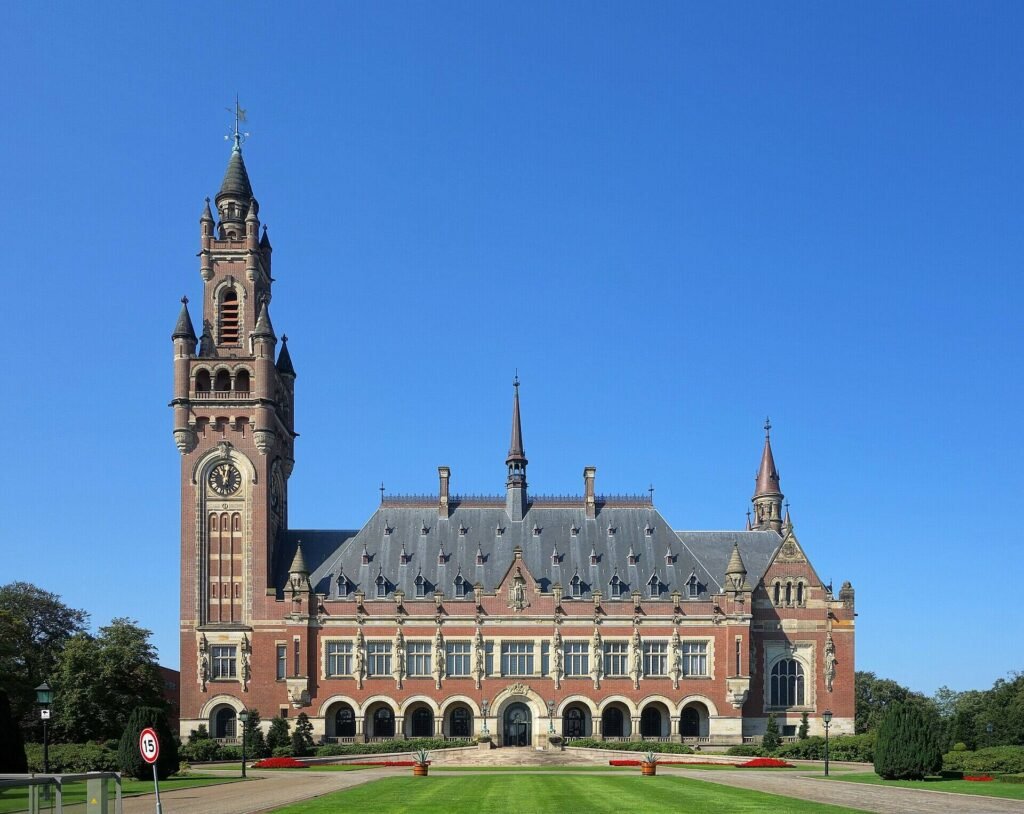
The International Court of Justice (ICJ) is the principal judicial organ of the United Nations. Seated at the Peace Palace in The Hague, it settles legal disputes between states under international law and gives advisory opinions on legal questions referred to it by authorized UN organs and specialized agencies.
History of the ICJ
The court grew out of a long effort to settle disputes between states by peaceful means. Modern international arbitration is generally dated to the Jay Treaty of 1794 between the United States and Great Britain, which created mixed commissions to resolve outstanding claims. The Alabama Claims arbitration of 1872, held under the Treaty of Washington, showed that a five-member tribunal could settle a major dispute: it ordered the United Kingdom to pay compensation, and the United Kingdom did.
After the First World War, Article 14 of the Covenant of the League of Nations called for a Permanent Court of International Justice. Its statute was adopted by the League Assembly in December 1920 and entered into force once a majority of League members had ratified it in 1921. The first judges were elected on 14 September 1921, and the court held its inaugural sitting at the Peace Palace on 15 February 1922 under the Dutch jurist Bernard Loder.
The court’s last public sitting took place on 4 December 1939, and it dealt with no further business during the Second World War. In 1943 the British government convened an informal Inter-Allied Committee of jurists in London, which reported in February 1944. A committee of jurists from 44 states then met in Washington in April 1945 to prepare a draft statute.
The San Francisco Conference, attended by 50 states, decided in 1945 to create an entirely new court rather than continue the old one. One reason was that the earlier court was tied to the League of Nations, which was about to be dissolved. The new court was established in June 1945 by the UN Charter and began work in April 1946.
Structure and membership of the ICJ
The court has 15 judges, elected to nine-year terms by the UN General Assembly and the Security Council. The two bodies vote at the same time but separately, and a candidate needs an absolute majority in both. One third of the court is elected every three years, judges may be re-elected, and new terms begin on 6 February. The judges choose a President and Vice-President by secret ballot for three-year terms.
Candidates are nominated by national groups of members of the Permanent Court of Arbitration, not by governments directly. Each group may put forward up to four candidates, no more than two of its own nationality. Judges must be persons of high moral character who hold the qualifications for the highest judicial offices in their countries or are jurists of recognized competence in international law.
The court may not include more than one national of the same state, and as a whole it must represent the main forms of civilization and the principal legal systems of the world. Judges are not delegates of any government. A judge can be dismissed only if the other members unanimously agree that he or she no longer meets the required conditions, which has never happened.
A Registry serves as the court’s administrative organ, and its official languages are English and French. Of the six principal organs of the United Nations, it is the only one not located in New York.
What does the ICJ do?
The court’s jurisdiction is twofold. In contentious cases it decides, in accordance with international law, legal disputes that states submit to it. Only states can be parties in these cases. In advisory proceedings it answers legal questions put to it by UN organs and agencies.
Under Article 93 of the Charter, all UN members are automatically parties to the court’s Statute. A state that is not a UN member may become a party on conditions set by the General Assembly on the recommendation of the Security Council. Being a party to the Statute does not by itself mean a state has accepted the court’s authority over a particular dispute.
The San Francisco Conference decided against compulsory jurisdiction, so the court’s reach in a contentious case depends on the states involved accepting it. The earlier court had worked in a similar way, through optional acceptance of its jurisdiction.
Advisory opinions can be requested by the General Assembly and the Security Council. Other UN organs and specialized agencies may also request them when the General Assembly has authorized them to do so, as Article 96 of the Charter provides.
Enforcement and limits of the ICJ
Article 94 of the Charter says each UN member undertakes to comply with the court’s decision in any case to which it is a party. If a party fails to perform its obligations under a judgment, the other party may turn to the Security Council. The Council may make recommendations or decide on measures to give effect to the judgment.
The court has no police force of its own, so the practical force of a judgment depends on state compliance and on political action by the Council, where permanent members hold a veto. Article 95 also leaves states free to take their disputes to other tribunals under existing or future agreements.
Independence and status of the judges
Judges receive privileges and immunities comparable to those of the head of a diplomatic mission when engaged in the court’s business. In The Hague, the President takes precedence over the doyen of the diplomatic corps. For 2026 the base salary was US$212,784 plus post adjustment, with a special supplementary allowance of US$25,000 for the President.
These arrangements are meant to protect the independence of the bench. They sit alongside the rule on dismissal and the requirement that judges make a solemn declaration in open court to act impartially and conscientiously before taking up their duties.
Key facts
- The ICJ was established in June 1945 by the UN Charter and began work in April 1946.1
- The court sits at the Peace Palace in The Hague and is the only principal UN organ not located in New York.1
- It has 15 judges elected to nine-year terms by the UN General Assembly and Security Council.2
- Its jurisdiction covers contentious cases between states and advisory opinions for authorized UN bodies.4
- Article 94 of the UN Charter lets a party to a case seek Security Council action if the other side does not comply with a judgment.5
Related concepts
Quick checkHow are ICJ judges chosen?Show answer
The UN General Assembly and Security Council vote separately and at the same time, and a candidate needs an absolute majority in both bodies. [2]
Sources
- 1. International Court of Justice, The Court, https://www.icj-cij.org/court
- 2. International Court of Justice, Members of the Court, https://www.icj-cij.org/members
- 3. International Court of Justice, History, https://www.icj-cij.org/history
- 4. International Court of Justice, Jurisdiction, https://www.icj-cij.org/jurisdiction
- 5. United Nations, Charter, Chapter XIV: The International Court of Justice, https://www.un.org/en/about-us/un-charter/chapter-14
- 6. United Nations, Voting System of the Security Council, https://www.un.org/securitycouncil/content/voting-system
Editorially reviewed by Specialty Digest Editorial TeamLast reviewed November 4, 2026Researched and drafted with AI assistanceReport an issue