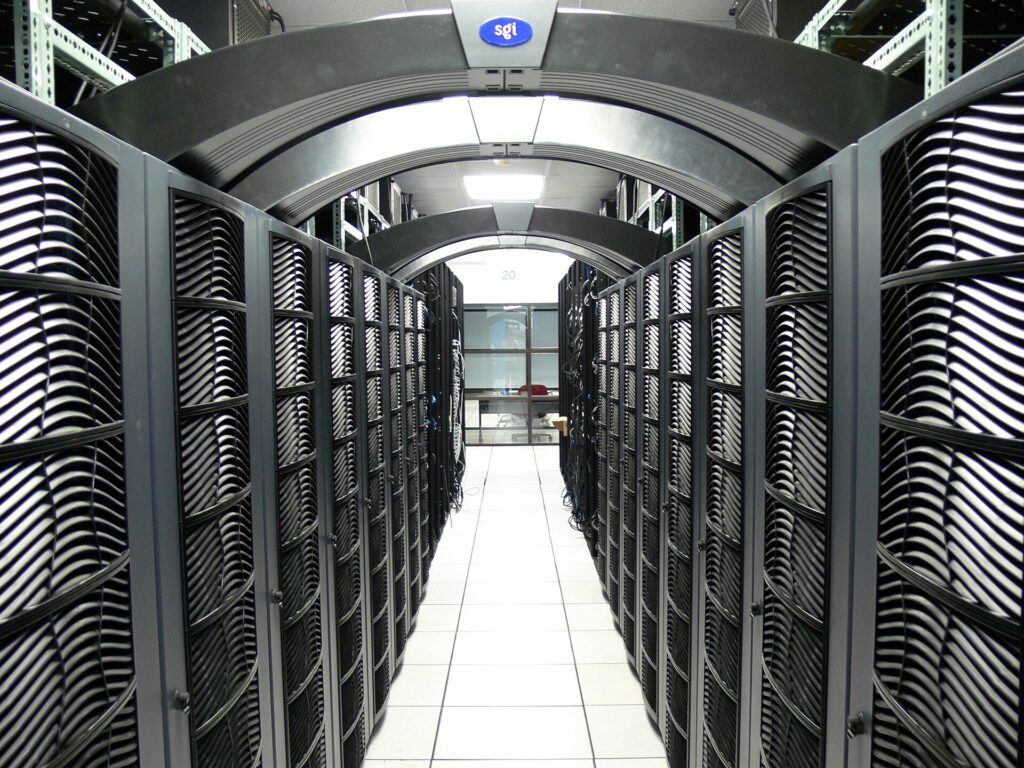
An AI system is a machine-based system that takes in data or other input and infers how to produce outputs such as predictions, generated content, recommendations or decisions. Those outputs can influence physical or virtual environments, from a spam filter sorting email to a robot arm moving a part. The term is broader than a single algorithm or model. It covers the whole working arrangement: data, one or more models, software, hardware, an interface and the people and rules around it. Governments use the phrase when they write laws on artificial intelligence because it names the thing that actually gets deployed and can cause harm or benefit.
History of the term AI system
Early researchers talked about intelligent programs and machines. As the field grew, engineers began to separate the learned component from the product built around it. The phrase AI system became standard in policy work during the late 2010s. The OECD adopted a definition in its 2019 recommendation on artificial intelligence and revised it in 2023 to stress that systems infer outputs from inputs and differ in their autonomy and ability to adapt after deployment. The European Union wrote a closely aligned definition into Article 3 of its Artificial Intelligence Act, which entered into force in 2024. The United States National Institute of Standards and Technology (NIST) uses similar language in its AI Risk Management Framework. This convergence matters because it gives lawmakers, auditors and engineers a shared target.
Components of an AI system
Most AI systems contain the same building blocks, even when they look very different on the surface.
- Data: the examples used to build and test the system, plus the live data it receives once deployed.
- Model: the mathematical structure, often a neural network, that maps inputs to outputs.
- Software and infrastructure: the code, servers, chips and cloud services that run the model.
- Interface: the screen, voice, sensor or application programming interface (API) through which people or other systems use it.
- Human oversight and rules: the processes that decide who can use the system, what it may do and how problems are reported.
A model on its own is not a system. A model file sitting on a disk does nothing until software feeds it data and connects its output to a real task. The surrounding parts often decide whether the system is safe, fair and useful in practice, which is why regulators examine all of them and not just the model.
Types of AI systems
AI systems can be grouped in several ways. By method, some are rule-based or symbolic, following logic written by people. Others are built with machine learning, and many modern products combine the two. By output, generative systems create text, images, audio or code, while predictive systems estimate a number or a category, such as the likelihood of a loan default. By autonomy, a system may only advise a human, may act within narrow limits, or may carry out multi-step tasks on its own. By scope, nearly every system in use today is narrow: it handles a defined set of tasks and cannot transfer its skill to unrelated ones.
How an AI system works across its lifecycle
An AI system is not built once and left alone. Standards bodies describe a lifecycle. Teams first define the purpose and the people affected. They then collect and prepare data, train and tune a model, and test it for accuracy, fairness and security. After deployment the system is monitored, because real-world data drifts away from training data and performance can decay. When the system is retired or replaced, its data and decisions may still need to be kept for audit. Treating the system as a lifecycle, not a finished product, is the central idea behind risk frameworks such as the one from NIST.
AI system vs. AI model vs. algorithm
These three terms are often mixed up. An algorithm is a procedure for solving a problem. An AI model is the trained artifact that results when a learning algorithm is run on data. An AI system is the full deployment that wraps one or more models in software, data pipelines, hardware and human processes. A chatbot, for example, uses a language model, but the chatbot as a product also includes safety filters, a user interface, logging and policies. Regulators care about all of those parts, because a safe model can still be placed in an unsafe system.
Examples of AI systems
AI systems appear in nearly every sector. Hospitals use them to flag suspicious areas in scans for a radiologist to review. Banks use them to spot unusual card activity. Logistics firms use them to plan delivery routes. Farmers use them to read satellite and drone images of crops. Phones use them for voice assistants, photo enhancement and text prediction. Online shops use them to recommend products, and email services use them to filter spam. In each case the same pattern holds: data goes in, an inference is made, and an output informs a person or a machine.
Risks and governance
Because AI systems act on inference, they can be wrong in ways that are hard to predict. They can reflect bias in their training data, expose private information, be fooled by adversarial inputs or be used for purposes their builders did not intend. Governance therefore focuses on the whole system. Regulations such as the EU AI Act sort systems by risk level and place stricter duties on high-risk uses such as hiring, credit scoring and medical devices. Organizations also use impact assessments, human oversight, documentation and incident reporting to keep systems accountable.
Common misconceptions about AI systems
One misconception is that an AI system understands the world as a person does. Most systems detect statistical patterns and have no awareness of meaning. A second is that an AI system is always autonomous. Many keep a human in the loop who approves or overrides each result. A third is that a system stays the same after launch. In reality, systems that keep learning, or that receive new kinds of data, can change behavior, which is why continuous monitoring is part of responsible practice. Finally, people sometimes assume that a high accuracy figure means a system is safe. Accuracy on a test set says little about rare cases, vulnerable groups or deliberate misuse.
FAQs
Is every piece of software with automation an AI system? No. Software that only follows fixed, fully specified rules is generally not an AI system under current definitions. The key feature is inference from input to generate outputs.
Is a chatbot an AI system? Yes. A chatbot built on a language model infers replies from the text it receives, so it fits the common legal and technical definitions.
Who defines what counts as an AI system? There is no single authority. The OECD, the European Union, NIST and national laws each publish definitions, and they are broadly aligned.
More in Artificial Intelligence
Key facts
- The EU AI Act defines an AI system as a machine-based system that infers, from the input it receives, how to generate outputs that can influence physical or virtual environments.1
- The OECD revised its AI system definition in 2023 to align with the same core idea of inference and varying levels of autonomy.2
- NIST treats an AI system as an engineered system whose risks must be managed across its whole lifecycle.3
Related concepts
Quick checkWhat distinguishes an AI system from ordinary software in most legal definitions?Show answer
It infers outputs from the inputs it receives, instead of only following fixed rules written in advance, and it may operate with varying levels of autonomy.
Sources
- European Union, Artificial Intelligence Act, Article 3: Definitions, https://artificialintelligenceact.eu/article/3/
- OECD, OECD AI Principles, https://oecd.ai/en/ai-principles
- NIST, AI Risk Management Framework, https://www.nist.gov/itl/ai-risk-management-framework
Editorially reviewed by Specialty Digest Editorial TeamLast reviewed November 17, 2026Researched and drafted with AI assistanceReport an issue