What Is Bhutan?
Bhutan is a small, landlocked kingdom in the eastern Himalayas, set between India [INTERNAL LINK NEEDED: India] and China [INTERNAL LINK NEEDED: China]. The World Bank describes it as a small, landlocked kingdom in the Himalayas between India and China, with a capital and largest city at Thimphu. Bhutan is a constitutional monarchy that has guided its own development around a policy framework it calls Gross National Happiness rather than economic output alone, and it is one of the very few countries in the world classified as carbon negative.
Key Takeaways
- Bhutan is a landlocked Himalayan kingdom bordered by India and China, with its capital at Thimphu.
- The country has a population of roughly 797,000 people and a land area of about 38,140 square kilometers (14,730 square miles).
- Bhutan unified as a single state in the seventeenth century under the Buddhist leader the Zhabdrung Ngawang Namgyal, and became a hereditary monarchy in 1907 under the Wangchuck dynasty.
- It became a constitutional monarchy with an elected parliament in 2008, a change initiated by the monarchy itself.
- Bhutan’s government has pursued Gross National Happiness as its central policy framework since the 1970s, weighing wellbeing alongside economic growth.
- Hydropower sold to India, along with tourism and remittances, forms the backbone of the economy, which the World Bank classifies as lower middle income.
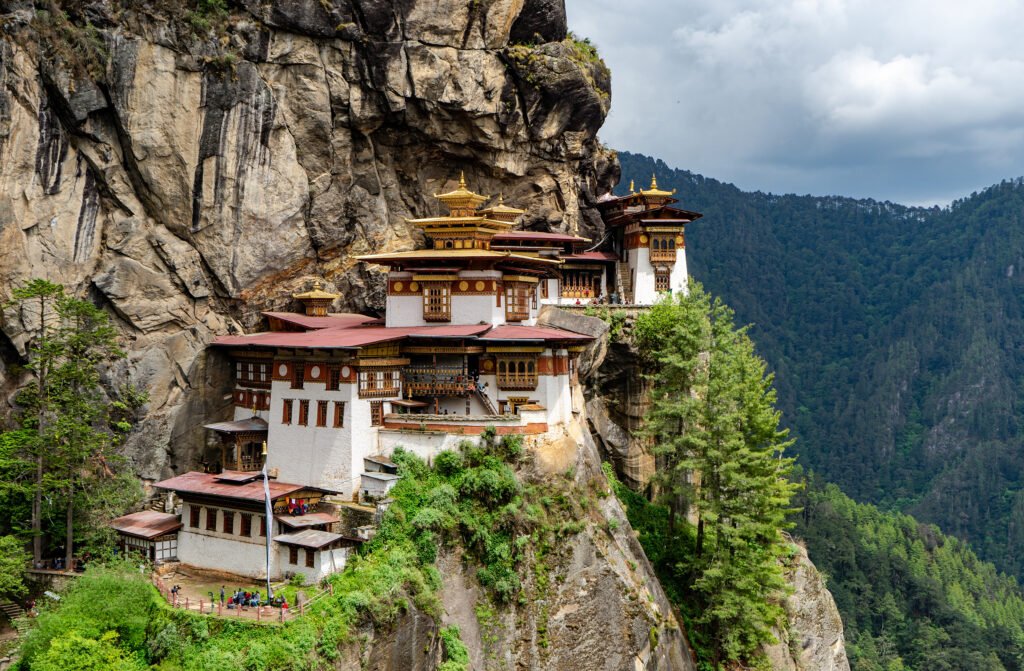
- Bhutan is most widely recognized internationally for Paro Taktsang, the Tiger’s Nest Monastery, and for its self-declared carbon negative status.
Where Is Bhutan Located? Geography of Bhutan
Bhutan sits on the southern slope of the eastern Himalayas, bordered by the Tibet Autonomous Region of China to the north and by India to the south, east and west [INTERNAL LINK NEEDED: Himalayas]. Its land area is approximately 38,140 square kilometers (14,730 square miles), roughly the size of Switzerland, according to World Bank data. The terrain rises sharply from subtropical plains along the southern border, through fertile central valleys where most of the population lives, to high alpine peaks and glaciers along the northern frontier with China. This vertical range gives Bhutan an unusually wide span of climates and ecosystems within a compact area, from dense subtropical forest to alpine tundra.
A Brief History of Bhutan
Unification Under the Zhabdrung
Buddhism reached the region associated with present-day Bhutan by around the seventh to ninth centuries, and tradition credits the Tibetan Buddhist teacher Guru Rinpoche, also known as Padmasambhava, with an early role in establishing the faith there. Bhutan took shape as a unified political and religious state in the early seventeenth century under Zhabdrung Ngawang Namgyal, a Tibetan Buddhist lama who fled sectarian conflict in Tibet, unified rival valley chieftains, and established a dual system of religious and civil authority. He also directed the construction of a network of dzongs, fortified monasteries that still serve as administrative and religious centers today.
The Wangchuck Monarchy and the Move to Democracy
After a period of regional governors competing for power, Ugyen Wangchuck was installed as Bhutan’s first hereditary king, or Druk Gyalpo, in 1907, founding the Wangchuck dynasty that still reigns. For much of the twentieth century, Bhutan limited foreign contact and modernized deliberately and gradually on its own terms. That changed most visibly in 2008, when the monarchy itself introduced a new constitution and Bhutan held its first democratic parliamentary elections, transforming the country into a constitutional monarchy with an elected government operating alongside the king.
Government and Economy in Bhutan
Bhutan is governed as a constitutional monarchy: a hereditary king serves as head of state while an elected prime minister and bicameral parliament handle day-to-day governance. Since becoming a constitutional monarchy in 2008, Gross National Happiness has been treated as the government’s overarching policy priority, a framework that weighs wellbeing, cultural preservation and environmental sustainability alongside conventional economic growth. Economically, the World Bank classifies Bhutan as a lower middle income country, with income per person estimated at around $3,718. Hydropower is the country’s principal export and revenue source, drawing on abundant Himalayan rivers to generate electricity that is sold mainly to India, Bhutan’s main trading partner, aid source and hydropower market. Tourism and remittances add further income. The World Bank reports that Bhutan has sharply reduced poverty, connected nearly all households to clean electricity, and graduated from the United Nations’ list of Least Developed Countries in December 2023, though poverty still varies widely by region, from about 1.5 percent in the capital Thimphu to 41.4 percent in the rural district of Zhemgang as of 2022.
Culture and People of Bhutan
Religion and Language
Vajrayana Buddhism is Bhutan’s state religion and shapes daily life, architecture and the annual calendar, though a Hindu minority, concentrated mainly in southern districts, also practices its faith openly. Dzongkha is the national language, though Bhutan is linguistically diverse, with a number of other Tibeto-Burman languages spoken in different valleys and regions.
Dress, Architecture and Festivals
Bhutanese law requires citizens to wear traditional dress, the gho for men and the kira for women, in schools, government offices and during official occasions, under a code known as Driglam Namzha. Traditional dzong architecture, with its whitewashed walls, ornate woodwork and multi-story fortress form, defines the built environment in every major town. Masked religious dances performed at annual festivals called tsechus, honoring Guru Rinpoche, remain central to religious and community life. Bhutan has one element inscribed on UNESCO’s Representative List of the Intangible Cultural Heritage of Humanity, reflecting this living tradition.
What Is Bhutan Known For?
Bhutan is most widely recognized for Paro Taktsang, commonly called the Tiger’s Nest Monastery, a monastery complex built into a cliff face roughly 900 meters above the floor of the Paro valley. According to long-standing tradition, the site marks a cave where Guru Rinpoche meditated, and the monastery that stands today was constructed in 1692. It has become the single image most associated with Bhutan internationally, appearing on tourism materials, in photography and in general reference works about the country.
Bhutan is equally well known for two policy ideas that set it apart from most nations: Gross National Happiness, which the government has used since the 1970s as an explicit alternative to gross domestic product as a measure of national progress, and its status as a carbon negative country, meaning it absorbs more carbon dioxide through its forests than it emits. Bhutan’s constitution requires that at least 60 percent of the country remain under forest cover in perpetuity, a legal commitment few countries have matched.
Despite this cultural profile, Bhutan currently has no properties inscribed on the UNESCO World Heritage List, even though it ratified the World Heritage Convention in 2001. Several sites, including dzongs and monasteries, remain under consideration rather than formally inscribed, a detail that surprises many readers given how visually iconic places like Paro Taktsang have become.
Why Bhutan Matters
Bhutan matters globally out of proportion to its small population for a few concrete reasons. Its Gross National Happiness framework has influenced international discussions of wellbeing measurement, including work referenced in United Nations wellbeing and development debates, by offering a working example of a government formally prioritizing wellbeing metrics alongside growth. Its carbon negative status makes it a frequently cited reference point in climate policy discussions about what a small, forest-rich economy can achieve. Geographically, it occupies a strategically sensitive position in the Himalayas between two of the world’s largest powers, India and China, which shapes its foreign policy and security calculations. Finally, Bhutan’s deliberate, government-led approach to opening its economy, tourism sector and political system on its own timeline offers a distinct case study in how a small state can modernize while working to preserve its language, religion and traditional culture.
Sources
- World Bank, Bhutan Overview, undated (continuously updated), accessed September 22, 2026
- World Bank Open Data, Population, Total: Bhutan, 2025 data, accessed September 22, 2026
- World Bank Open Data, Land Area: Bhutan, 2023 data, accessed September 22, 2026
- World Bank Open Data, Country Data: Bhutan, undated, accessed September 22, 2026
- UNESCO World Heritage Centre, States Parties: Bhutan, undated, accessed September 22, 2026
- UNESCO, Bhutan Member State Profile, undated, accessed September 22, 2026
Key facts
- Population approximately 796,682 as of 20252
- Land area approximately 38,140 square kilometers (14,730 square miles) as of 20233
- Capital and largest city: Thimphu4
- Constitutional monarchy since 2008, ruled by the Wangchuck dynasty since 19071
- Classified as lower middle income by the World Bank, with GDP per capita around $3,7181
Quick checkWhat policy framework does the Bhutanese government use instead of relying only on GDP to measure national progress?Show answer
Gross National Happiness, a framework Bhutan has used since the 1970s that weighs wellbeing, cultural preservation and environmental sustainability alongside economic growth.
Sources
- World Bank. Bhutan Overview. Undated (continuously updated) (accessed Accessed 2026-09-22)
- World Bank Open Data. Population, Total: Bhutan. 2025 (accessed Accessed 2026-09-22)
- World Bank Open Data. Land Area: Bhutan. 2023 (accessed Accessed 2026-09-22)
- World Bank Open Data. Country Data: Bhutan. Undated (accessed Accessed 2026-09-22)
- UNESCO World Heritage Centre. States Parties: Bhutan. Undated (accessed Accessed 2026-09-22)
- UNESCO. Bhutan Member State Profile. Undated (accessed Accessed 2026-09-22)
Editorially reviewed by Specialty Digest Editorial TeamLast reviewed September 22, 2026Researched and drafted with AI assistanceReport an issue