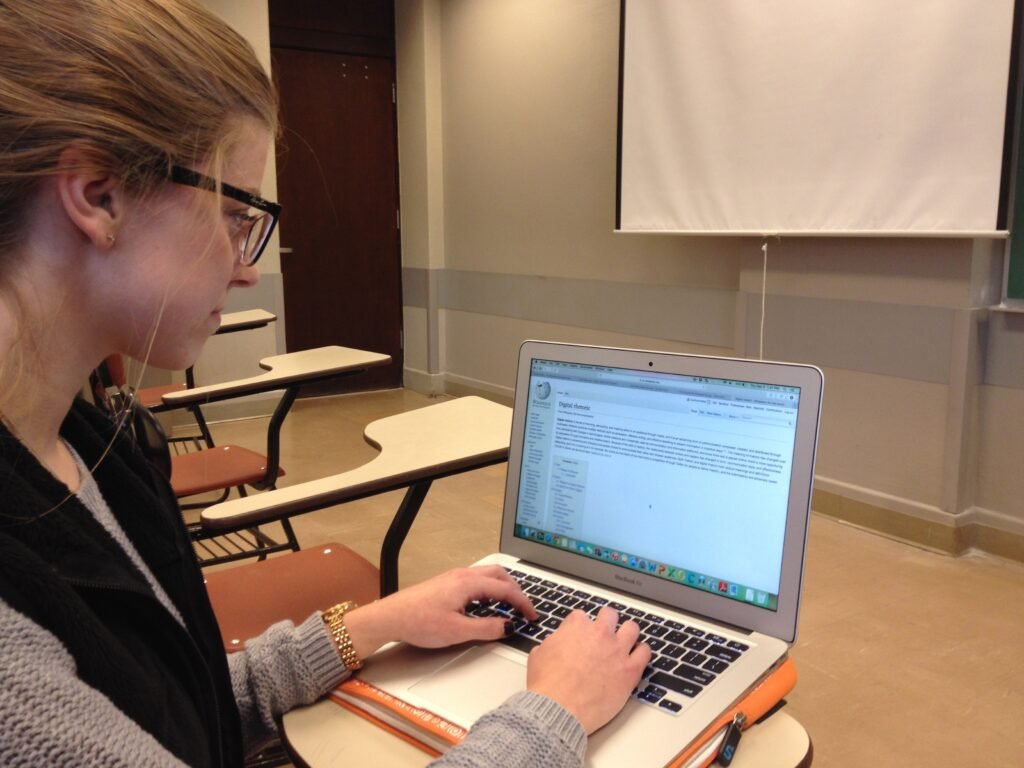
Blended learning is an instructional approach that combines traditional in-person classroom teaching with online or digital learning activities, giving students some control over the time, place, or pace at which they engage with digital components of a course. The term covers a wide range of specific classroom models rather than a single fixed format, ranging from a teacher simply supplementing lectures with online homework to a fully restructured classroom built around digital content delivery.
Common blended learning models
One widely used model, the flipped classroom, has students watch recorded lecture content online before class, freeing class time for hands-on practice, discussion, and teacher support rather than passive listening. Another common model, the station rotation model, divides a class period into stations, with students rotating between online learning activities, small-group instruction, and independent practice rather than every student doing the same activity at the same time.
Growth and research findings
Blended learning expanded significantly in the 2010s as schools gained wider access to devices and reliable internet connections, and expanded further still during the period of remote and hybrid instruction associated with school closures in 2020, after which many schools kept at least some digital components they had adopted out of necessity. Research on blended learning’s effectiveness has produced mixed results that depend heavily on implementation quality, with well-designed programs that use data from online activities to personalize in-person instruction generally showing stronger results than programs that simply add digital busywork without integrating it meaningfully into classroom teaching.
Measuring blended learning’s effectiveness
Researchers studying blended learning have generally cautioned against treating it as a single intervention with one predictable effect, since a program’s success depends heavily on factors such as teacher training, the quality of the digital content used, and how well online and in-person components are actually integrated rather than simply placed side by side. Studies comparing blended and fully in-person instruction have found that well-implemented blended models can match or modestly exceed traditional outcomes in some subjects, though the research base remains smaller and more mixed than for some other extensively studied instructional approaches.
Higher education institutions adopted blended learning extensively even before K-12 schools did, often as a way to extend access to students who could not attend every class session in person, and many colleges now offer entire degree programs built around a blended structure combining recorded lectures with periodic in-person or live online sessions.
Equity concerns in blended learning
Critics of rapid blended learning adoption have raised equity concerns, noting that students without reliable home internet access or a private space to complete online coursework can be disadvantaged by models that assume consistent access to technology outside of school hours. Schools serving lower-income communities have sometimes needed to invest heavily in device lending programs and internet subsidies specifically to make blended learning models viable for their full student population, an additional cost that better-resourced districts may not face to the same degree.
Blended learning in corporate training
Outside K-12 and higher education, many corporations have adopted blended learning models for employee training, combining self-paced online modules covering standardized content with in-person or live virtual sessions focused on discussion, role-play, or hands-on practice that benefits from real-time interaction. This corporate adoption has followed a similar logic to educational blended learning, using the efficiency of digital delivery for content that does not require live interaction while preserving in-person time for activities that genuinely benefit from it.
Teacher role shifts under blended learning
Adopting blended learning often changes what a teacher spends classroom time doing, shifting away from delivering the same lecture to an entire class at once and toward circulating among small groups or individual students working at different paces, which some teachers find more demanding to manage even as others report it allows more meaningful one-on-one interaction with struggling students than a traditional lecture format permits.
Parental perceptions of blended learning
Surveys of parents about blended learning have found a range of reactions, with some parents appreciating the ability to monitor a child’s online progress data and the flexibility digital components offer, while others express concern about increased screen time and worry that online components receive less attentive oversight from teachers than fully in-person instruction would, concerns that schools adopting blended models have had to address directly through parent communication.
Accessibility has become an increasingly important consideration in blended learning design, since online components must work reliably for students using assistive technology or those with limited bandwidth, requirements that are not always considered when digital content is adopted quickly without dedicated accessibility review.
Blended learning and data privacy
The data generated by students’ online learning activity, including detailed records of which questions they answered correctly or how long they spent on a given task, has raised data privacy questions that schools adopting blended learning have had to address, including how long student activity data is retained, which third-party companies can access it, and what protections exist against that data being used for purposes beyond the educational platform it was originally collected for.
Rural school districts have sometimes adopted blended learning specifically to expand access to specialized courses, such as advanced foreign languages or upper-level sciences, that a small school could not otherwise staff with an in-person teacher for a handful of interested students.
International comparisons of blended learning adoption show considerable variation, with some education systems embracing it as a core strategy for modernizing instruction while others have moved more cautiously, often citing concerns about equitable access to the technology blended models depend on.
FAQs
More in Teaching & Learning
Related concepts
Editorially reviewed by Specialty Digest Editorial TeamLast reviewed November 2, 2026Researched and drafted with AI assistanceReport an issue