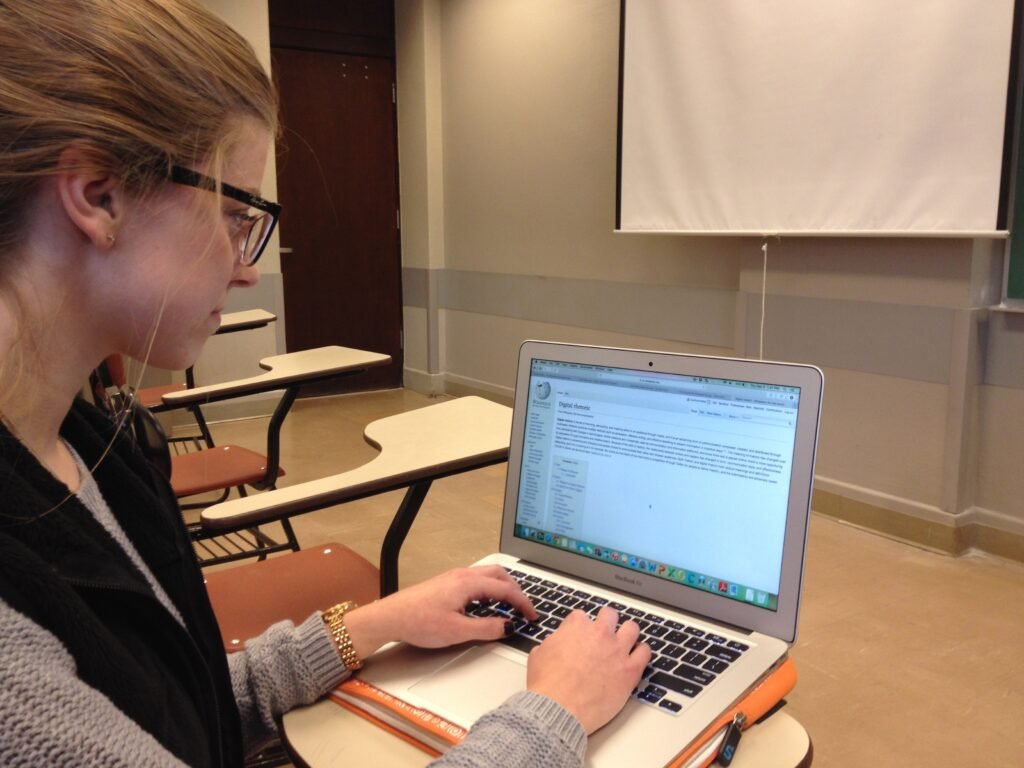
Blended learning is an instructional approach that combines traditional in-person classroom teaching with online or digital learning activities, giving students some control over the time, place, or pace at which they engage with digital components of a course. The term covers a wide range of specific classroom models rather than a single fixed format, ranging
Blended learning Read More »
An instructional approach combining in-person classroom teaching with online or digital learning activities.
In simple terms Bloom’s taxonomy sorts learning goals by how much thinking they demand, from recalling a fact up to producing something new. It gives teachers a shared vocabulary for saying what they actually want students to be able to do. The practical consequence is that a course can state its aims as verbs. Remembering
Bloom’s taxonomy Read More »
Bloom's taxonomy sorts learning goals by how much thinking they demand, from remembering a fact up to creating something new.
Classroom management refers to the techniques and strategies teachers use to organize a learning environment, establish routines, and address student behavior so that instructional time is used productively rather than lost to disruption. Kounin’s foundational research Psychologist Jacob Kounin conducted influential classroom observation research establishing that effective classroom management depends less on how teachers punish
Classroom management Read More »
The techniques teachers use to organize the learning environment and address behavior so instructional time is used productively.
Cooperative learning is an instructional approach in which small groups of students work together toward a shared goal, with each member’s success depending in part on the success of the group as a whole. It differs from simply placing students in groups and asking them to complete a task, since genuine cooperative learning is structured
Cooperative learning Read More »
An instructional approach where small groups of students work together toward a shared goal with individual accountability built in.
Differentiated instruction is a teaching approach in which educators tailor content, process, and assessment to meet the varying readiness levels, interests, and learning profiles of individual students, rather than teaching an entire class with a single uniform method. Tomlinson’s framework Education researcher Carol Ann Tomlinson is widely credited with popularizing differentiated instruction as a structured
Differentiated instruction Read More »
A teaching approach that tailors content, process, and assessment to individual students’ readiness, interests, and learning profiles.
Direct instruction is a teaching approach in which a teacher explicitly explains and models a concept or skill in a structured, step-by-step sequence, followed by guided and then independent student practice, rather than having students discover the content primarily on their own. Explicit, teacher-led sequence A typical direct instruction lesson follows a predictable sequence: the
Direct instruction Read More »
A teaching approach where a teacher explicitly models a skill step by step, followed by guided and then independent practice.
In simple terms A flipped classroom moves direct instruction, the part of teaching that explains new material, outside of class time, usually delivered as a short recorded video students watch at home, so that class time can be used for practice, discussion, and problem-solving instead. [2] How it works In a traditional classroom, a teacher
Flipped classroom Read More »
A flipped classroom moves direct instruction, such as a lecture, outside of class time, usually as a video students watch at home, so class time can be used for practice and discussion instead.
Inquiry-based learning is an instructional approach in which students develop understanding primarily by asking questions, investigating problems, and drawing their own conclusions from evidence, with the teacher acting as a facilitator who guides the process rather than delivering content directly upfront. Levels of inquiry Education researchers typically describe inquiry-based learning along a spectrum of structure.
Inquiry-based learning Read More »
An instructional approach where students build understanding by asking questions and investigating problems, with the teacher as facilitator.
Mastery learning is an instructional approach built around the idea that students should demonstrate a thorough understanding of one unit of material before moving on to the next, rather than progressing through a curriculum on a fixed schedule regardless of how well they grasped earlier content. The approach was formalized and popularized by educational psychologist
Mastery learning Read More »
An instructional approach where students demonstrate mastery of one unit before moving to the next, rather than progressing on a fixed schedule.
Project-based learning is an instructional approach in which students learn academic content and skills by engaging in extended, real-world projects that culminate in a tangible product or presentation, rather than through a traditional sequence of lectures and isolated assignments. Roots in experiential education Project-based learning traces its philosophical roots to early twentieth-century educational theorist John
Project-based learning Read More »
An instructional approach where students learn content and skills through extended, real-world projects ending in a tangible product.