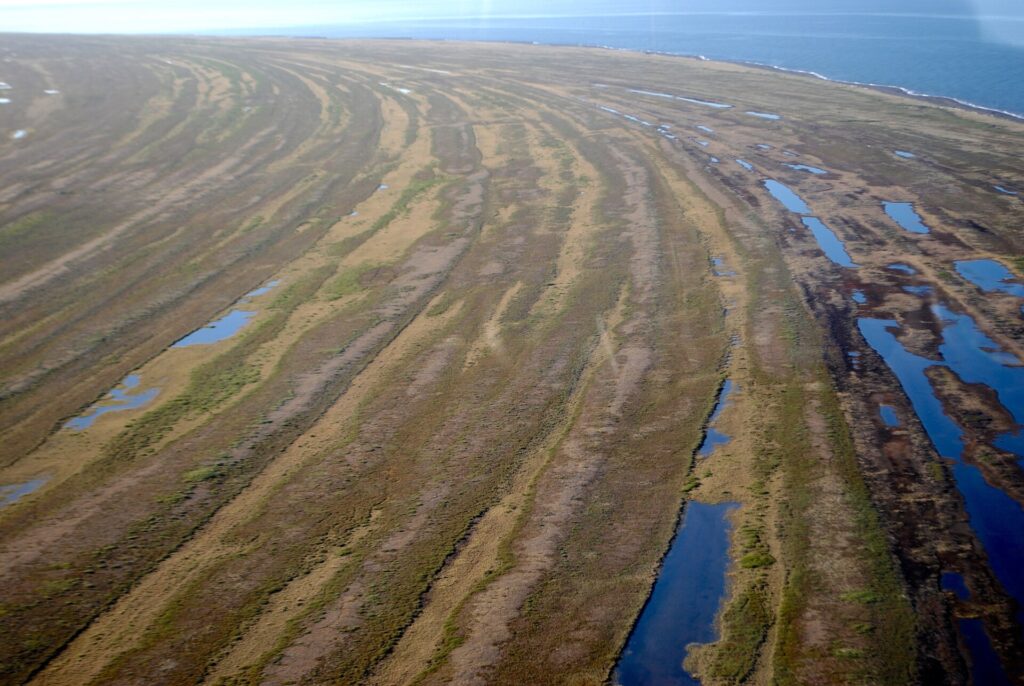
Cape Krusenstern National Monument in northwest Alaska covers 649,082 acres on the Chukchi Sea coast, above the Arctic Circle. Its archaeological district holds 114 beach ridges that record more than 5,000 years of human habitation.[1]
| Area | 649,082 acres |
|---|---|
| Established | 1 Dec 1978; ANILCA 2 Dec 1980 |
| Beach ridges | 114 |
| Nearest city | Kotzebue |
Archaeology
The ridges formed about 60 years apart, and the area holds evidence of more than 9,000 years of human occupation, including 5,000 years of Inupiat occupation. Researchers have excavated about one third of the 9,000-acre beach complex.[1]
Establishment
President Jimmy Carter declared it a national monument on 1 December 1978 under the Antiquities Act, and the Alaska National Interest Lands Conservation Act, signed on 2 December 1980, made it a National Park Service unit. Its headquarters are at the Northwest Arctic Heritage Center in Kotzebue.[1]
Establishment and size
President Jimmy Carter declared the monument on December 1, 1978, and it became one of fifteen new National Park Service units when Congress passed ANILCA in 1980. The monument and its archeological district were designated a National Historic Landmark and added to the National Register of Historic Places on November 7, 1973. It covers about 649,082 acres and extends roughly 20 miles inland from the Chukchi Sea coast [2].
Beach ridges
The cape has 114 beach ridges that alternate between sandy and gravelly bands, separated by narrow ponds. They formed about 60 years apart, built by longshore currents over about 6,000 years, and provide a sequential record of habitation [2].
Archaeology
The area holds evidence of roughly 9,000 years of human occupation. Paleo-Arctic sites on the mainland date to about 10,000 to 7,000 years ago, the Palisades site to about 6,000 years ago, the Western Thule culture existed from 950 to 1400 AD, followed by the Kotzebue culture from about 1400 to 1850. Researchers have excavated about one third of the 9,000-acre beach complex [2].
Inupiat and subsistence
The beach ridges preserve evidence of about 5,000 years of Inupiat occupation. Subsistence hunting by local residents is permitted, and about 19 percent of monument lands are owned by Native corporations [2].
Wildlife and geology
Mammals include caribou, brown bears, wolves, and wolverines, and marine mammals include bowhead, gray, and beluga whales and several seal species. Five salmon species, Arctic char, Dolly Varden, and northern pike are found, and the spectacled eider and Steller’s eider are listed as threatened. The land is mostly coastal plain with large lagoons and limestone hills, and permafrost produces pingos, ice wedges, and thaw ponds. The monument recorded 17,736 visitors in 2024 [2].
FAQs
What does the monument protect? A beach-ridge archaeological district.
How old are the oldest sites? About 10,000 to 7,000 years before present.
What is the nearest city? Kotzebue.
How many beach ridges does Cape Krusenstern have? 114 [2].
How long have people lived there? About 9,000 years of occupation is documented [2].
Sources
Key facts
- 649,082 acres
- 114 ridges
- 9,000 years of habitation
Quick checkBeach ridges?Show answer
114.
Sources
- Wikipedia. Cape Krusenstern National Monument. 2026 (accessed 2026-11-12)
- Wikipedia. Cape Krusenstern National Monument. 2026 (accessed 2026-11-14)
Editorially reviewed by Specialty Digest Editorial TeamLast reviewed November 12, 2026Researched and drafted with AI assistanceReport an issue