The discovery of gravitational waves was the first direct detection of ripples in spacetime, made by the twin LIGO detectors in the United States on 14 September 2015 and announced on 11 February 2016. The signal, named GW150914, came from the merger of two black holes more than a billion light years from Earth, and it confirmed a prediction of Albert Einstein’s general theory of relativity.
Background to the discovery of gravitational waves
Albert Einstein described gravitational waves in the years after he published the general theory of relativity in 1915. In that theory gravity is the curvature of spacetime, and a mass that accelerates, such as a pair of black holes circling each other, sends out ripples that travel at the speed of light.
For many years Einstein doubted that the waves could ever be measured and was unsure whether they were real or only a mathematical artifact. His contemporary Arthur Eddington was more skeptical still. Calculations toward the end of the 1950s showed that the waves carry energy, and so in principle they should be measurable.
The first attempts at measuring them failed. In the 1960s Joseph Weber at the University of Maryland built a resonant detector, and in the 1970s he claimed to have heard gravitational waves, but nobody could repeat his results, and the observations are now regarded as false alarms.
Indirect evidence arrived in 1974, when Russell Hulse and Joseph Taylor discovered a pair of extremely dense stars, a binary pulsar, with the Arecibo radio telescope. The two stars orbited each other faster and faster as they lost energy, and the energy loss matched the theoretical calculation for gravitational waves. They shared the 1993 Nobel Prize in Physics for the discovery.
Building the detector
Direct detection was a far harder challenge. According to the Nobel Foundation, the amplitude of a wave from a violent cosmic event is so small that measuring it is like determining the distance to a star ten light years away with a precision equal to the width of a human hair.
The solution was a laser interferometer. Rainer Weiss analyzed the possible sources of noise and designed such a detector at the Massachusetts Institute of Technology. Kip Thorne worked on the problem at Caltech, together with Ronald Drever, who built early prototypes in Glasgow. An interferometer has two arms that form an L, with heavy mirrors at the corner and the ends. A passing gravitational wave stretches one arm and squeezes the other, and a laser beam bouncing between the mirrors reveals the change in length.
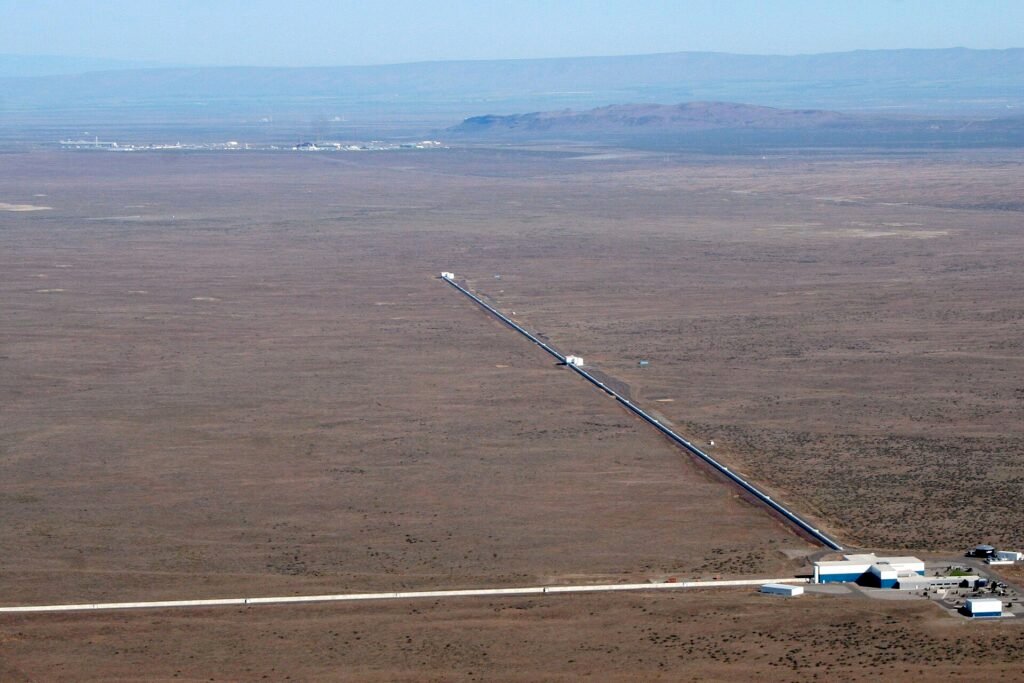
The Laser Interferometer Gravitational-Wave Observatory, or LIGO, has two sites with arms four kilometers long. One is outside Hanford, Washington, and the other is about 3,000 kilometers away in Livingston, Louisiana. Barry Barish led the project to completion. The collaboration involves more than a thousand researchers from over twenty countries, and the idea took more than forty years to realize.
The discovery
At 09:50:45 UTC on 14 September 2015, the two LIGO detectors simultaneously observed a short signal. It rose in frequency from 35 to 250 hertz, like a chirp, and its shape matched the waveform predicted by general relativity for the spiral inward and merger of two black holes, followed by the ringing of the single black hole left behind.
The team reported a signal-to-noise ratio of 24 and estimated a false alarm rate of less than one event in 203,000 years. According to the discovery paper in Physical Review Letters, the source lay at a distance of roughly 410 megaparsecs, about 1.3 billion light years. The black holes had masses of about 36 and 29 times that of the Sun, and the final black hole had about 62 solar masses. Roughly three solar masses of energy were radiated away as gravitational waves.
The disturbance at Earth was extremely small. The Nobel Foundation notes that the stretch in spacetime that LIGO measured was thousands of times smaller than an atomic nucleus. Rumors began to circulate months before the group had finished refining its calculations, and the discovery was announced on 11 February 2016.
How the detection was confirmed
Two detectors thousands of kilometers apart provided an important check, because a real wave must show up in both, while local disturbances would not. The team also compared the signal with computer simulations of black hole mergers, and the fit with general relativity was the main evidence that the source was what they said it was.
The paper concluded that the observation demonstrated the existence of binary stellar-mass black hole systems. It was the first direct detection of gravitational waves and the first observation of a binary black hole merger. The Nobel Foundation adds that it was the first indication that black holes of between 30 and 60 solar masses exist and that they can merge.
Impact and legacy of the discovery
The 2017 Nobel Prize in Physics was divided, with one half going to Rainer Weiss and the other half shared by Barry Barish and Kip Thorne, for decisive contributions to the LIGO detector and the observation of gravitational waves. Ronald Drever, who had been one of the pioneers of the design, died in March 2017, after the first discovery but before the prize announcement.
Gravitational waves are a new way of watching the universe. They do not depend on light, and they give information about events too violent or too hidden for telescopes to see. For a brief moment during the merger, the Nobel Foundation says, the radiation from the colliding black holes was many times stronger than the collected light of all the stars in the visible universe.
The Nobel Foundation describes the signal as a cosmic chirp that came to an abrupt stop at the moment of the merger. It calls gravitational waves an entirely new way of following the most violent events in space and of testing the limits of what is known.
More in Astronomy & Space
Key facts
- LIGO detected the signal GW150914 on 14 September 2015 at 09:50:45 UTC, and it was announced on 11 February 2016.12
- The signal came from two black holes of about 36 and 29 solar masses that merged into one of about 62 solar masses.2
- The source was about 1.3 billion light years from Earth.1
- Weiss, Barish and Thorne received the 2017 Nobel Prize in Physics for decisive contributions to LIGO and the observation of gravitational waves.3
Related concepts
Quick checkWhen were gravitational waves first detected?Show answer
LIGO detected gravitational waves for the first time on 14 September 2015, from the merger of two black holes, and the discovery was announced on 11 February 2016.
Sources
- Nobel Prize Outreach, The Nobel Prize in Physics 2017: Popular science background, Cosmic chirps, https://www.nobelprize.org/prizes/physics/2017/popular-information/
- B. P. Abbott et al., Observation of Gravitational Waves from a Binary Black Hole Merger, Physical Review Letters 116, 061102 (2016), https://journals.aps.org/prl/abstract/10.1103/PhysRevLett.116.061102
- Nobel Prize Outreach, The Nobel Prize in Physics 2017: Summary, https://www.nobelprize.org/prizes/physics/2017/summary/
- Nobel Prize Outreach, Press release: The 1993 Nobel Prize in Physics (binary pulsar), https://www.nobelprize.org/prizes/physics/1993/press-release/
Editorially reviewed by Specialty Digest Editorial TeamLast reviewed November 5, 2026Researched and drafted with AI assistanceReport an issue