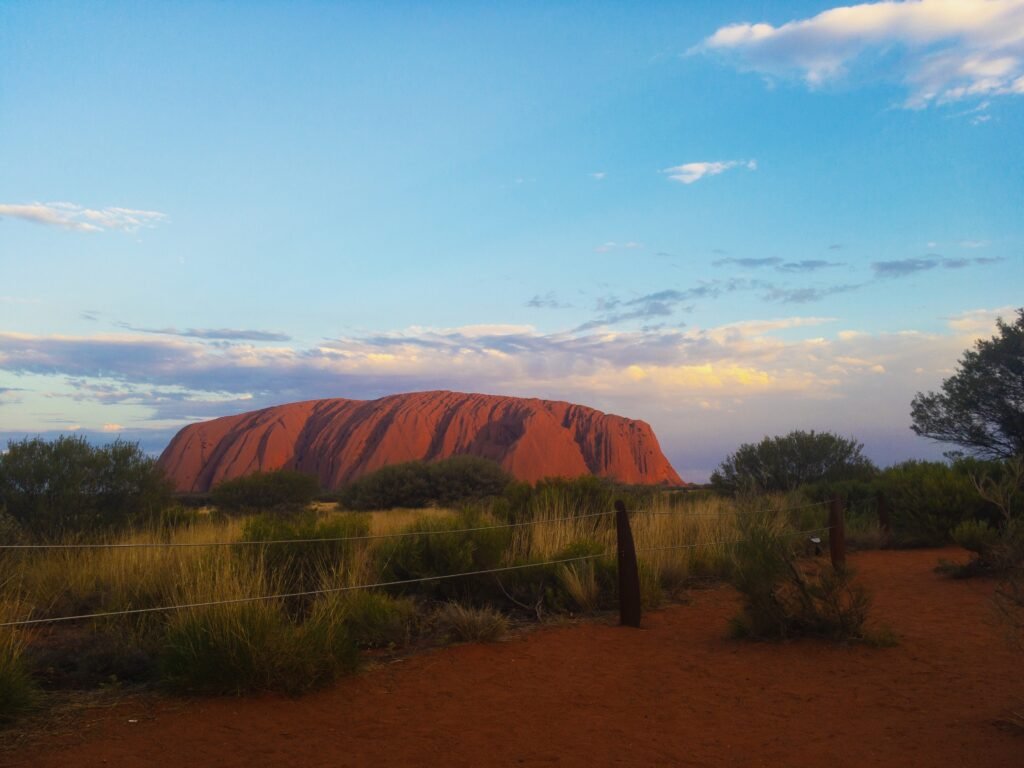
Australia is the world’s smallest continent and sixth-largest country by area, occupying an entire landmass between the Indian and Pacific Oceans. Its capital is Canberra, while Sydney and Melbourne are its largest and most internationally recognized cities. A former British colony federated into a single nation in 1901, Australia is now a high-income, developed economy known for its distinctive wildlife, vast interior deserts and multicultural population.
Where Is Australia Located?
Australia sits in the Southern Hemisphere, surrounded by the Indian Ocean to the west and the Pacific Ocean to the east, with Papua New Guinea and Indonesia to the north across the Torres Strait and Timor Sea, and New Zealand to the southeast. Much of the country’s interior, known as the Outback, is arid or semi-arid desert, while the population is concentrated along the temperate and subtropical eastern and southeastern coastlines.
A Brief History
Aboriginal and Torres Strait Islander peoples have lived in Australia for at least 65,000 years, making Australian Indigenous culture among the oldest continuous cultures in the world. British colonization began in 1788 with the establishment of a penal colony at Sydney Cove, and separate British colonies gradually developed across the continent through the nineteenth century. These colonies federated into the Commonwealth of Australia on January 1, 1901, creating a single nation while retaining the British monarch as head of state.
Government and Economy Today
Australia is a federal parliamentary constitutional monarchy comprising six states and several territories. It is a longstanding shareholder in the World Bank Group, holding a significant voting share in the International Bank for Reconstruction and Development, and has been a donor to the International Development Association since its founding, working closely with the World Bank on issues affecting the Pacific Islands, infrastructure and climate resilience (World Bank). Domestically, Australia has a high-income, services-driven economy with major mining, agriculture and export sectors, particularly in iron ore, coal and natural gas.
Culture and People
English is the primary language, though Australia is highly multicultural, shaped by sustained immigration from Europe, Asia and elsewhere since the mid-twentieth century, alongside a growing recognition of Aboriginal and Torres Strait Islander heritage and languages. Australian culture is closely associated with an outdoor, beach-oriented lifestyle, a strong sporting culture including cricket, rugby and Australian rules football, and a distinctive vernacular sense of humor.
What Is Australia Known For?
Australia is best known internationally for its unique wildlife, including kangaroos and koalas found nowhere else in comparable numbers, natural landmarks such as Uluru and the Great Barrier Reef, and cities like Sydney with its iconic Opera House and Harbour Bridge. It is equally known for its vast, sparsely populated Outback interior and its status as one of the world’s oldest continuously inhabited places, home to Aboriginal cultures dating back tens of thousands of years.
Key Takeaways
- Australia is the world’s smallest continent and sixth-largest country, with Canberra as its capital and Sydney and Melbourne as its largest cities.
- Aboriginal and Torres Strait Islander peoples have inhabited the continent for at least 65,000 years.
- British colonies federated into the Commonwealth of Australia on January 1, 1901.
- Australia is a longstanding World Bank shareholder and IDA donor, with a high-income economy built on mining, agriculture and services.
- The Great Barrier Reef, Uluru and Sydney’s Opera House rank among its most recognized landmarks.
Key facts
- Capital: Canberra
- Federation: January 1, 1901
- Government: Federal parliamentary constitutional monarchy
- Longstanding World Bank shareholder and IDA donor1
Quick checkWhen did Australia's colonies federate into a single nation?Show answer
Australia's colonies federated into the Commonwealth of Australia on January 1, 1901.
Sources
- World Bank. Australia Overview. Accessed 2026 (accessed 2026)
Editorially reviewed by Specialty Digest Editorial TeamLast reviewed September 22, 2026Researched and drafted with AI assistanceReport an issue